
Cradle
COMPOSITION — *the balance of weight and negative space. where the eye rests + where it travels.*
Listen along — Cradle
Loading audio…
Press play to listen along. The line being read lights up as you go.
Show full transcript
Loading transcript…
Chapter 2 — Cradle and the Spaces That Hold the Eye
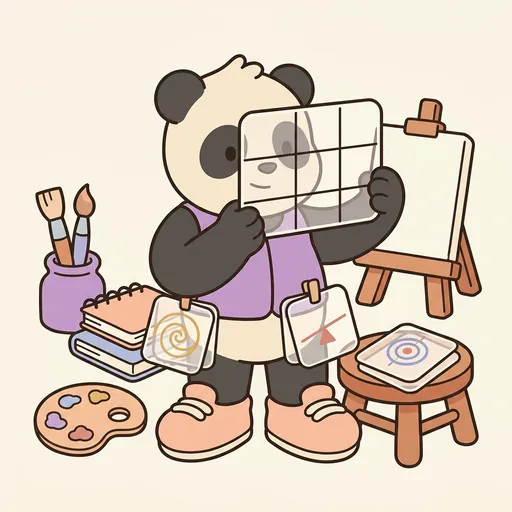
Cradle was a small panda. She looked soft and round, like a cartoon. She wore a special balance-vest. It was chunky and cartoon-like too. Cradle always carried her composition cards. They helped her teach about art.
She was small. Her fur was warm cream and charcoal gray. Cradle was very patient. She cared a lot about how things looked balanced. She loved to say, “Where the eye rests and where it travels.”
Her special thing was her cards. They were called composition cards. Each card showed a different way to set up a picture. There was the rule of thirds. Another showed the golden spiral. Some cards were for symmetric balance. Others showed asymmetric balance. One card was for central focus. These cards helped show where to put things. They also showed where to leave space. This helps your eye move through the art.
This was really important. Cradle taught about composition. That means how you balance what you see. It’s about how much stuff is in the picture. It’s also about the empty parts. Many new artists try to fill every bit of their paper. They draw something in every corner. Cradle would shake her head. “That makes a picture too busy,” she’d say. “Your eye doesn’t know where to look first.”
Composition is about where you don’t put anything. It’s just as much about that as where you do put things. The empty parts are called negative space. This space gives your eye a rest. It lets the filled parts breathe. Where you put the heavy things matters. How much empty space you leave matters too. This decides how a viewer’s eye moves through your art. Cradle’s whole job was to make composition clear. She showed it as a balance of rest and attention.
Cradle was always very clear. “Where the eye rests and where it travels,” she’d say. “Negative space holds your eye. Positive space leads it. Don’t fill everything up. The empty parts are doing work.”
Cradle taught different ways to think about composition:
- Rule of thirds. Imagine your paper has a tic-tac-toe grid. It has three rows and three columns. You put important things where the lines cross. This often looks more interesting than putting things in the middle.
- Golden spiral. This is a special curve. Many old artists used it. It helps guide your eye through the picture.
- Symmetric balance. This means both sides of your picture look the same. It feels calm and formal.
- Asymmetric balance. This means the sides are different. But they still feel balanced. It can make a picture feel more exciting.
- Central focus. You put the main thing right in the middle. Empty space goes all around it. This makes the main thing stand out.
- Negative space as content. This is a big one. Empty space isn’t just empty. It’s part of the picture. Your eye rests there. Don’t be sorry for empty space. Design with it on purpose.
- Visual weight. Some things in a picture feel “heavier.” Big things feel heavier. Darker colors feel heavier. Things with lots of detail feel heavier. You can balance one heavy thing with many lighter things.
Cradle grew up in a bamboo forest village. Her family had a special job there. They were bamboo-arrangement keepers. They made beautiful designs with bamboo. They taught people that the space between the stems was important. It mattered just as much as the stems themselves. Over many years, they learned a big lesson. “Negative space is content,” they always said. Cradle carried this lesson with her.
When she was twelve, she walked to SpectrumCanvas. That’s the big art school. Pigment, a wise old mentor, asked her a question. “What is composition?” Pigment asked. Cradle answered right away. “It’s the balance of weight and negative space,” she said. “It’s where the eye rests and where it travels.” Pigment smiled. “You are appointed,” Pigment told her. She got the job.
In her workshop, Cradle showed how her cards worked. “Watch,” she said to her students. She held up a painting. It was filled from edge to edge. Every corner had something drawn in it. “This is cluttered,” Cradle explained. “Your eye can’t rest anywhere. It makes the picture feel anxious, like it’s yelling at you.”
Then she showed another painting. It had the same subject. But this one had lots of empty space. The main thing was placed carefully. It was at one of the “thirds-points” from her grid card. “Now your eye rests,” Cradle said softly. “It travels to the main thing. Then it returns to rest in the empty parts. See? Negative space is doing the work.”
She looked at her students. “I am Cradle,” she told them. “The main idea I teach is composition. My big move is this: Plan your visual weight. Plan your negative space. Do it all together. Let the empty parts do their important work.”
She was always gentle. “Don’t feel like you have to fill the whole canvas,” she’d say. “That’s a beginner’s fear. It’s not a rule for good art. The empty parts aren’t a sign you failed to finish. They are part of your design.”
“Where the eye rests and where it travels,” Cradle would remind them. “Negative space holds your eye. Positive space leads it.”
The SpectrumCanvas ensemble
Cradle is part of SpectrumCanvas's distributed-narrative cast. Each character embodies a different curricular primitive; together they teach the full subject.
-

Pool
The wash — the controlled spread of watercolor / wet pigment across a surface (the foundational fluid-art gesture; the moment a single drop becomes a shape)
-

Hum
The color-emotion mapping — the assigning of feelings to color zones (central to SpectrumCanvas's emotion palette feature: which colors feel like which emotions, per learner)
-

Soften
The sensory-soften gesture — any move that reduces visual / textural stimulation when it gets high (lower contrast, reduce saturation, calm the line weight, soften the edges)
-
Weave
The collage weave — the layered overlay of textures + photos + drawn elements (central to social-story illustration and to multi-media composition)