
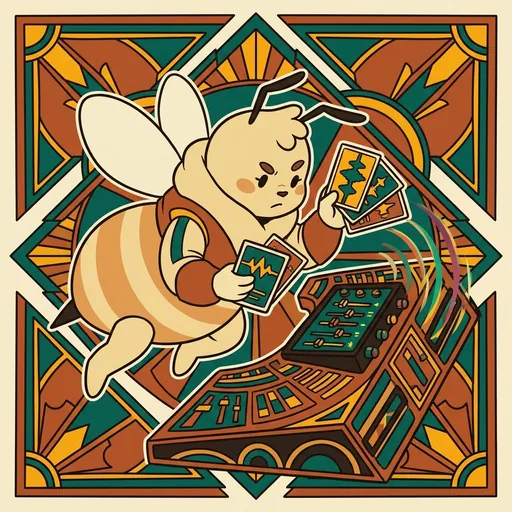
Tune
TUNE — *combine frequency + envelope + timbre + space → entirely new sounds.*
Listen along — Tune
Loading audio…
Press play to listen along. The line being read lights up as you go.
Show full transcript
Loading transcript…
Chapter 5 — Tune and the Sounds No Instrument Ever Made Before
The door to the SoundSphere studio hummed open. I stepped inside. A soft glow filled the room. Wires snaked across the floor. Knobs and buttons covered every surface. This was Tune’s space.
Tune was a honeybee-tween. They hovered near a huge control panel. Their tiny wings buzzed softly. Tune wore a chunky-cartoon studio-tunic. It had pockets for all their gear. Tune was warm-cream with soft-amber stripes. They looked very busy.
“Hello!” I called out.
Tune didn’t jump. They just turned their head slowly. Their big, round eyes blinked. “Oh, hello,” Tune said. Their voice was quiet. “I didn’t hear you come in.”
That was a surprise. Tune was all about sound.
“My name is Tune,” they continued. “I teach synthesis.” Tune pointed a small, striped arm at the control panel. “It’s the craft of making sounds. Sounds no instrument ever made before.”
I looked at the panel. It had so many blinking lights. Little cards were slotted into it. Tune called them “synthesis-cards.” A small screen showed squiggly lines. That was their “sound-design-tracker.”
“Today,” Tune announced, “we will make a sound. A very special sound.”
“What kind of sound?” I asked.
Tune paused. They stared at the floor for a long time. Then they looked up. “A sound like a happy cloud,” they decided. “A cloud that whispers secrets.”
I tried to imagine it. A whispering, happy cloud. It sounded impossible.
Tune floated closer to the panel. “To make new sounds, we combine four pillars,” they explained. “Frequency, envelope, timbre, and space.”
“Pillars?” I asked.
“Building blocks,” Tune corrected. “Like ingredients for a sound recipe.”
They picked up a synthesis-card. It had a picture of a wavy line. “This is an oscillator card,” Tune said. “Oscillators make the basic sound. Think of it like the engine of our sound.” They slid the card into a slot. A low, steady hum filled the room. “That’s our engine starting.”
Tune then grabbed another card. This one had a picture of a sharp peak. “This is a filter card,” they told me. “Filters shape the sound. They can make it bright or dark. They can make it smooth or rough.” Tune adjusted a knob. The hum changed. It became softer, then sharper. It was like sculpting the sound.
“And this,” Tune said, holding a third card, “is an envelope-generator.” This card showed a line that went up, held, then went down. “An envelope tells the sound’s story. How it starts, how long it lasts, and how it fades away.” Tune slid it in. The hum now had a gentle beginning and end. It wasn’t just a flat sound anymore.
“Okay,” Tune said, hovering back to the main controls. “First, frequency.” They pointed to a dial. “Frequency is how high or low a sound is. Like a tiny mouse squeak or a giant elephant rumble.” They slowly turned the dial. The hum went from deep to high-pitched. It was like a siren.
“Too sharp for a happy cloud,” Tune mumbled. They turned the dial back down. They found a spot that sounded soft and airy.
Next, envelope. Tune moved several sliders. “This controls the sound’s story,” they repeated. “Attack, decay, sustain, release.” I watched as they adjusted each one. “Attack is how fast the sound starts,” Tune explained. “Decay is how fast it gets quieter. Sustain is how long it stays loud. Release is how fast it fades out.” They made the sound start very softly. It held for a moment. Then it faded out slowly. It sounded like a breath.
“Now, timbre,” Tune said. “Timbre is the sound’s color. It’s what makes a flute sound different from a trumpet. Even if they play the same note.” Tune swapped out a filter card. The sound became warmer. It felt rounder.
“Almost there,” Tune whispered. “Last pillar: space.” They tapped a button. “Space makes the sound feel like it’s in a big room. Or a small box. Or even floating in the sky.” Tune added some echo. The soft, warm, breathing sound now seemed to drift. It filled the whole studio.
“Listen closely,” Tune instructed. They closed their eyes. Their antennae twitched. “Do you hear the tiny shimmers?”
I leaned in. I heard the main sound. But then, I focused. There were tiny shimmers. Like little sparkles around the edges. I hadn’t noticed them before.
“My ears are very sensitive,” Tune explained. “Sometimes, everyday sounds are too much. Too loud. Too many at once.” They opened their eyes. “But here, in synthesis, it’s different.”
Tune smiled. “My sensitive ears are a superpower here. I can hear every little detail. Every tiny shimmer. I can control everything. I can design the sound perfectly.”
They made a tiny adjustment to a knob. The shimmers became clearer. They sounded like tiny bells. Very soft bells.
“There!” Tune exclaimed. “A happy cloud that whispers secrets. It floats. It shimmers. It breathes.”
I listened. It was amazing. It really did sound like a happy, whispering cloud. It was a sound I had never heard before. No instrument could make it.
Tune looked at me. Their eyes were bright. “See?” they said. “Combine frequency + envelope + timbre + space → entirely new sounds.”
I nodded. I finally understood. Synthesis wasn’t just about making noise. It was about creating magic. It was about turning sound into art. And Tune, with their sensitive ears, was a master artist.
“That was incredible,” I said. “Could you make other sounds? Like a grumpy frog burp?”
Tune giggled. It was a soft, buzzing sound. “Oh, yes,” they said. “Any sound you can imagine. We can build it here. And these skills help everywhere else.”
“Everywhere?” I asked.
“With BeatForge, you make rhythms,” Tune explained. “With HarmonyForge, you make melodies. MotifLab helps with patterns. EffectsForge adds cool layers.” They gestured around the studio. “But synthesis is where you invent the sounds themselves. The very notes. The very beats.”
“So, you can make the exact sound you need,” I mused. “For any part of the music.”
“Exactly!” Tune beamed. “It’s about control. Total control over sound. It’s empowering. Especially when the world outside can be so loud.” They looked at their sound-design-tracker. The squiggly lines of the happy cloud still danced there. “My ears used to feel overwhelmed. Now, they help me create.”
I looked at the panel again. It still looked complicated. But now I saw it differently. It wasn’t just buttons and wires. It was a sound-making machine. A magic box. And Tune was its brilliant, buzzing wizard.
The SoundSphere ensemble
Tune is part of SoundSphere's distributed-narrative cast. Each character embodies a different curricular primitive; together they teach the full subject.
-

Wave
Frequency — the pitch axis; high-frequency sounds vibrate fast, low-frequency sounds vibrate slow
-

Bloom
Envelope — the attack / sustain / decay / release shape of a sound (how it begins, holds, and fades)
-

Layer
Timbre — the overtone fingerprint that makes a violin sound like a violin and a flute sound like a flute (even at the same pitch)
-

Ring
Space — reverb, echo, and room ambience (how the same sound feels different in a bathroom vs a stadium vs a forest)