
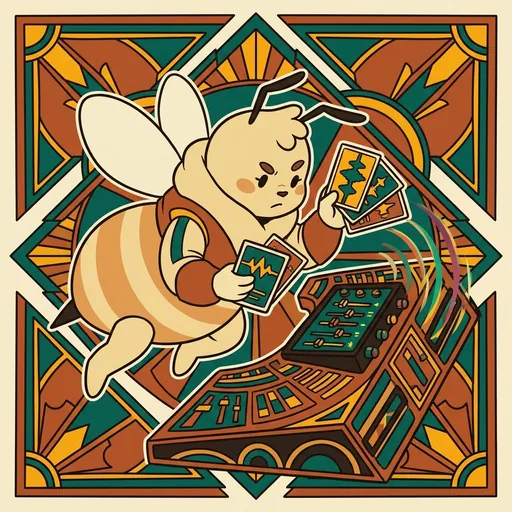
Tune
TUNE — *combine frequency + envelope + timbre + space → entirely new sounds.*
Listen along — Tune
Loading audio…
Press play to listen along. The line being read lights up as you go.
Show full transcript
Loading transcript…
Chapter 5 — Tune and the Sounds No Instrument Ever Made Before
Tune leaned closer, her warm-cream-with-soft-amber stripes shimmering under the studio lights. A tiny frown creased her brow as she listened, head tilted, to the sound pulsing from the speakers. It was almost right, a low, guttural growl meant to be the call of the rare, elusive Gloomfang, but it still felt… flat. Like a picture without depth, or a story missing its most important chapter.
She adjusted a knob, a tiny, almost imperceptible turn, and the growl sharpened, gaining a metallic edge. Too much. She twirled it back, her movements precise, economical. Tune understood sound not just as something heard, but as something felt, something that had shape and texture. For her, the world was a symphony, often overwhelming, but here, in the SoundSphere studio, she was the conductor. Here, she was in control.
Her small fingers hovered over a bank of sliders and buttons on the massive synthesizer console. This was her domain, the place where she practiced synthesis. It wasn’t about finding existing sounds in a library. Instead, it was about creating entirely new ones, sounds no instrument had ever made before. She often said, “Combine frequency + envelope + timbre + space → entirely new sounds.” It was her mantra, a secret code to unlock sonic universes.
“The Gloomfang,” she murmured, more to herself than anyone, “needs to feel ancient. Like it’s been echoing through forgotten caverns for centuries. It needs to carry the weight of time.”
She tapped a small, translucent card against a reader on her wrist. Synthesis-card: Ancient Echoes. The screen on her sound-design-tracker glowed, displaying a complex web of parameters. She was starting with the sound’s frequency, its basic pitch. A low growl meant low frequencies, but she needed to layer in subtle higher harmonics to give it that ‘ancient’ quality, like the high-pitched whine of wind through stone. She adjusted the oscillator, watching the waveform shift, listening intently for the subtle changes. She nudged the sub-oscillator down a hair, adding a foundational rumble that was felt more than heard, a deep tremor that hinted at vast, unseen forces.
Next, the envelope. This was how a sound behaved over time, its life cycle from birth to fade. “Think of it like a story,” she’d once explained to a bewildered new recruit, a wide-eyed kid named Pip who was still learning about basic rhythm. “Does it start suddenly, like a jump scare? That’s a fast attack. Does it fade out slowly, like a whisper disappearing into the night? That’s a long release.” For the Gloomfang, she wanted a slow, deliberate attack, a sustained, rumbling sustain that held its power, and a long, drawn-out release that would hang in the air, full of foreboding, like a lingering threat. She manipulated the ADSR (Attack, Decay, Sustain, Release) controls, shaping the sound’s lifespan with meticulous care, ensuring each stage flowed seamlessly into the next.
The growl now had a better shape, a more deliberate presence. It felt like it was truly happening, not just playing. But it still lacked character, that unique fingerprint that made it distinctly Gloomfang. This was where timbre came in, the “color” or quality of the sound. It’s what makes a trumpet sound different from a clarinet, even if they play the exact same note at the exact same pitch. Tune wanted a deep, resonant timbre. She aimed for something organic yet menacing, like wood creaking under immense pressure or ancient stone grinding together. She experimented with filters, sweeping them across the frequency spectrum, listening for the sweet spot where the growl gained its unique voice. She added a touch of subtle distortion, just enough to give it a primal edge without making it harsh or artificial. A hint of chorus widened the sound, giving it a sense of mass and presence.
Finally, space. A sound doesn’t exist in a vacuum. Where does it seem to be coming from? How does it interact with its environment? This involved effects like reverb and delay. Tune imagined the Gloomfang’s call echoing through vast, damp caverns, a place where light had never touched, where only sound could travel. She dialed in a long, dark reverb, letting the growl bounce and decay, creating the illusion of immense, empty chambers. A slight, almost imperceptible delay made the echoes overlap, giving the sound a layered, ghostly quality. It was as if multiple Gloomfangs were calling from different depths. She adjusted the pre-delay, ensuring the initial growl hit before the echoes began, giving it immediate impact.
She closed her eyes, letting the synthesized growl wash over her. Her auditory sensitivity, which sometimes made everyday noises feel like a physical assault—the clatter of silverware, the sudden bark of a dog, the cacophony of a busy street—was her greatest asset here. In the controlled environment of the studio, with the precise tools of synthesis, she could harness that sensitivity. It was like having a super-powered microscope for her ears. She could isolate a single harmonic, adjust its level, and reintegrate it into the whole. All of this happened in her mind, before she made a single physical adjustment. This wasn’t just hearing; it was seeing sound, understanding its molecular structure.
The growl now filled the studio, a living, breathing entity. It was deep, ancient, and undeniably menacing. It began with a slow, heavy intake of breath, held its terrifying presence, and then slowly, agonizingly, faded into the cavernous silence, leaving a distinct chill in the air. It was perfect.
Tune smiled, a small, satisfied curve of her lips. She had taken four abstract concepts – frequency, envelope, timbre, and space – and woven them into something concrete, something new, something that resonated with the very core of what a Gloomfang should be. This was the essence of synthesis: turning imagination into audible reality, crafting emotions and stories out of pure sound. It was a craft, a science, and for Tune, a profound act of creation. The Gloomfang’s call was complete, ready to haunt the soundscape of whatever world it was destined for, a testament to the power of careful listening and deliberate design. Her journey in the SoundSphere had begun with a quiet curiosity. Now, it culminated in this mastery, closing a significant arc in her understanding of sound’s boundless potential.
For Tune, this wasn’t just about making noise; it was about building worlds, one carefully sculpted sound wave at a time. Her ability to perceive every minute detail, once a source of overwhelming sensory input, had transformed into an unparalleled strength. Here, she wasn’t just reacting to sound; she was commanding it, shaping it with intention and precision. Each new sound she brought into existence was a testament to the idea that even the most challenging sensitivities could become profound gifts, especially when combined with the endless possibilities of synthesis. The studio, once a place of mere instruments, had become a portal to infinite sonic creation, and Tune, the honeybee-tween, was its most meticulous architect.
The SoundSphere ensemble
Tune is part of SoundSphere's distributed-narrative cast. Each character embodies a different curricular primitive; together they teach the full subject.
-

Wave
Frequency — the pitch axis; high-frequency sounds vibrate fast, low-frequency sounds vibrate slow
-

Bloom
Envelope — the attack / sustain / decay / release shape of a sound (how it begins, holds, and fades)
-

Layer
Timbre — the overtone fingerprint that makes a violin sound like a violin and a flute sound like a flute (even at the same pitch)
-

Ring
Space — reverb, echo, and room ambience (how the same sound feels different in a bathroom vs a stadium vs a forest)