
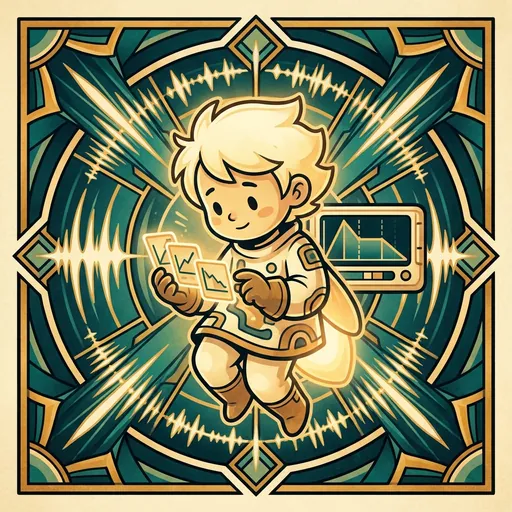
Bloom
BLOOM — *attack / sustain / decay / release. how a sound begins, holds, fades.*
Listen along — Bloom
Loading audio…
Press play to listen along. The line being read lights up as you go.
Show full transcript
Loading transcript…
Chapter 2 — Bloom and the Shape Every Sound Has
Bloom shimmered. She was a firefly-tween. Her glow was soft and warm. It was like cream with amber light. She wore a chunky studio tunic. It had pockets everywhere. She moved with a quiet hum. She held a stack of small cards. They had big, bold letters: A, D, S, R.
Her workshop was a cozy place. It smelled faintly of ozone and old paper. Tiny lights blinked on every surface. Wires snaked across the floor. They looked like sleeping snakes. Strange instruments sat on shelves. They waited to make new sounds.
“Welcome,” Bloom said. Her voice was soft. It hummed like a tuning fork. “I am Bloom. I teach envelope.”
She held up her cards. They glowed faintly. “It’s how every sound has a shape.”
I blinked. A sound has a shape? I thought sounds were just… there. Or gone. Like a light switch. On, off. Simple.
Bloom seemed to read my mind. She smiled. Her amber glow pulsed gently. “Sounds are not just on and off. They begin. They hold. They fade.”
She tapped one of her cards. “This is a big idea. But it’s also very simple. Think of a bell. Or a drum. They don’t just appear. They have a story.”
She picked up a small, glowing device. It had a tiny screen. “This is my envelope tracker,” she explained. “It shows sound shapes. Like a map for your ears.”
Bloom pressed a button. A clear piano sound rang out. DONG! It was bright and quick.
On the screen, a bright line shot up. It climbed super fast. It looked like a tiny rocket. Then it dropped a little. It held for just a split second. Then it faded away. It was gone almost before I could blink.
“See?” Bloom pointed. Her finger glowed. “Sharp beginning. Quick fade. Then gone.”
Next, she pressed another button. A violin sound filled the room. WHEEEE! It was smooth and long. It felt like a warm hug.
The line on the screen rose slowly. It took its time. It was like a gentle hill. It stayed high for a while. It was a long, steady breath. Then it dipped. And it vanished slowly. It seemed to float away.
“This sound builds up,” Bloom said. “It stays strong. Then it lets go slowly. Very polite, the violin.”
A drum sound came next. BAM! It was loud and sudden. It made me jump a little.
A super-fast spike appeared on the screen. It was like a tiny lightning bolt. Then nothing. The line just vanished. Poof!
“That’s a quick hit,” Bloom grinned. “No holding back. Just BAM and done. Drums are direct.”
Finally, a bell. DING-DONG! The sound shimmered. It hung in the air.
The line shot up again. Then it slowly, slowly faded. It lingered in the air. It was like a long, drawn-out sigh.
“Bells ring out for ages,” Bloom whispered. “They like to linger. They say goodbye very slowly. Sometimes you can still hear them when they’re gone.”
Bloom held up her cards again. They glowed brighter now. “These letters stand for the parts of a sound’s shape. They are the secrets of the envelope.”
She showed the ‘A’ card. “A is for Attack. How fast does the sound start? Does it jump out? Or does it creep in? Think of a drum. It attacks fast. Or a violin. It attacks slowly.”
Then ‘D’. “D is for Decay. After the attack, how fast does it drop to its main level? A piano drops fast. A plucked string decays quickly.”
The ‘S’ card. “S is for Sustain. How long does the sound hold its main level? Does it stay strong? Or does it vanish quickly? A violin has long sustain. A drum has almost no sustain.”
Finally, ‘R’. “R is for Release. When you let go, how long does the sound take to completely disappear? Does it vanish fast? Or does it float away? A bell has a long release. A piano has a medium release.”
“These four parts,” Bloom explained, “make up the whole sound story. The envelope.”
Bloom went back to the piano sound. She showed its shape on the tracker. “Piano has a fast Attack. A quick Decay. Almost no Sustain. And a medium Release.”
She showed the violin. “Slow Attack. Long Sustain. Slow Release.”
The drum. “Super fast Attack. Super fast Decay. No Sustain. Fast Release.”
The bell. “Fast Attack. Long Release.”
“See how different they are?” Bloom asked. “Even if they play the same note. Their shapes are unique. That’s why they sound different.”
She tapped the screen. “It’s like they have different personalities. All because of their envelope.”
“Every sound has a shape,” Bloom repeated. Her voice was firm but kind. “This shape is its envelope. It’s what makes a piano sound like a piano. It makes a violin sound like a violin.”
I looked at the tracker. The lines were like little mountains and valleys. Each one was different. Each one told a story. A sound’s secret story.
Bloom smiled. Her glow brightened a bit. “It’s the secret life of sounds. Once you know their shapes, you can make them do anything. You can even make new sounds. Sounds nobody has ever heard.”
“You can use this idea in BeatForge,” she added. “To make your drums punchier. Or in HarmonyForge. To make your melodies sing longer.”
“Attack / sustain / decay / release,” she whispered. “How a sound begins, holds, fades.”
I nodded slowly. My mind was buzzing. Sounds weren’t just noises. They were tiny, invisible sculptures. Each with its own special shape. And Bloom was teaching me how to see them. It felt like learning a secret language. A language of sound.
The SoundSphere ensemble
Bloom is part of SoundSphere's distributed-narrative cast. Each character embodies a different curricular primitive; together they teach the full subject.
-

Wave
Frequency — the pitch axis; high-frequency sounds vibrate fast, low-frequency sounds vibrate slow
-

Layer
Timbre — the overtone fingerprint that makes a violin sound like a violin and a flute sound like a flute (even at the same pitch)
-

Ring
Space — reverb, echo, and room ambience (how the same sound feels different in a bathroom vs a stadium vs a forest)
-

Tune
Synthesis — how primitive sound-elements (frequencies + envelopes + layers + space) combine to build entirely new sounds