
Etyma
LATIN ROOTS — the foundational morphemes of Latin-derived English. *port* (carry), *scrib* (write), *dict* (say), *vis* (see), *audi* (hear). Knowing the root cracks open hundreds of derivative words.
Press play to listen along. The line being read lights up as you go.
Show full transcript
Loading transcript…
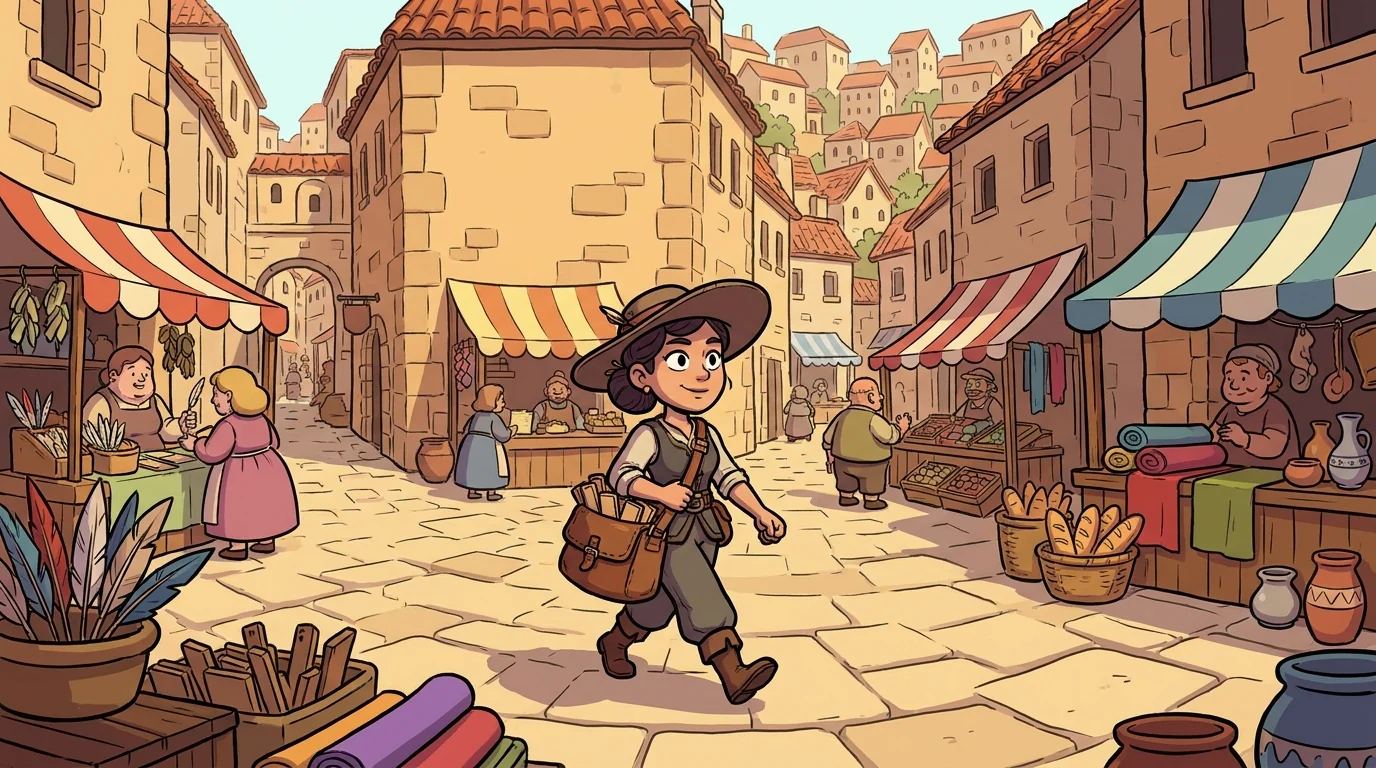
Etyma lives in the Latin Quarter.
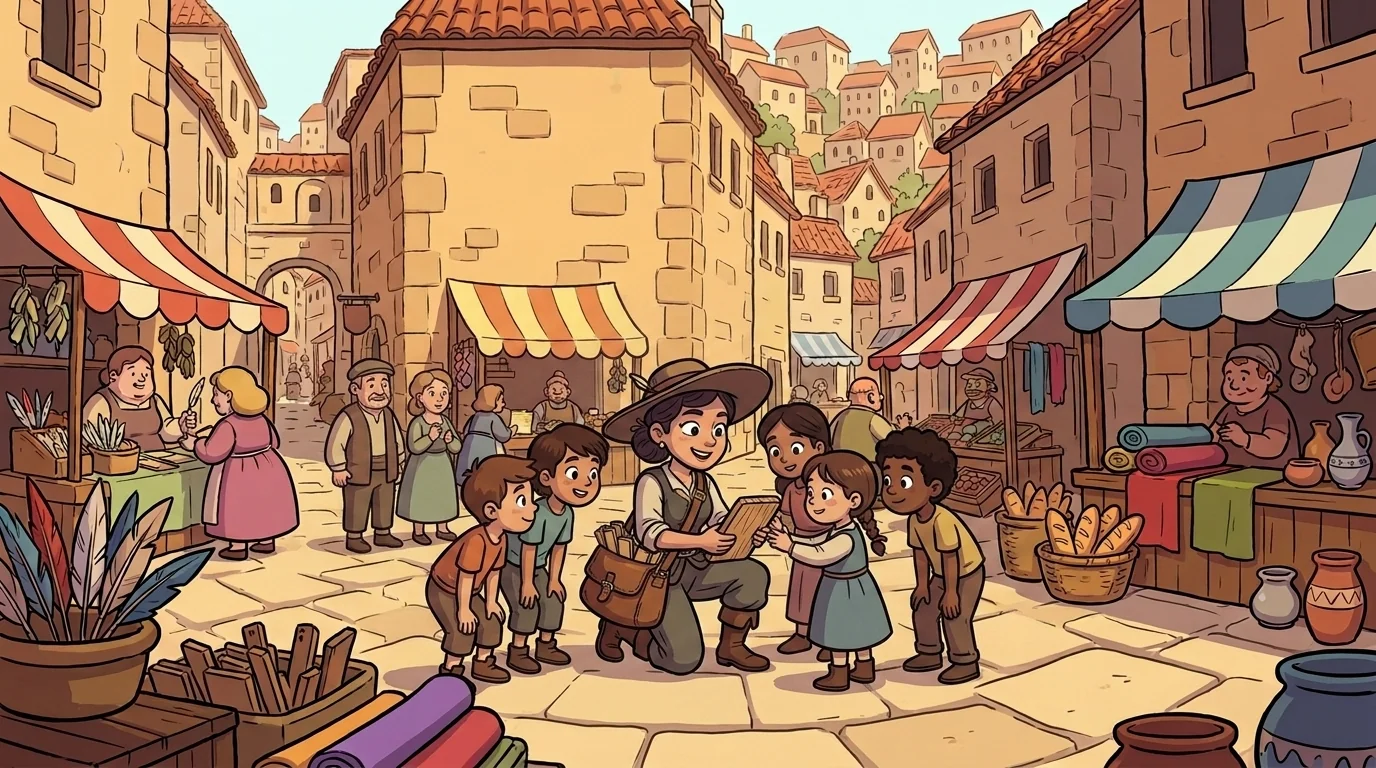
It’s not a place you can find on a map. It’s a neighborhood where words live. Specifically, all the English words that started out in Latin. The spelling academy is huge, with stone buildings and twisty streets. It has six different neighborhoods for six language families. The Latin Quarter is the biggest. Its streets are paved with smooth stones. Its market square is always buzzing with noise and smells. You can buy anything from ink quills to fresh bread. Etyma says thousands of words live here. Each one is a Latin root, a tiny piece of an ancient language.
Etyma is the Latin Quarter's guide. She walks visitors through the neighborhood. She introduces them to the word families. She shows them how a root can travel into English. Some roots stayed the same. Some got a little worn down over the years. Some even joined up with other roots to make brand new words.
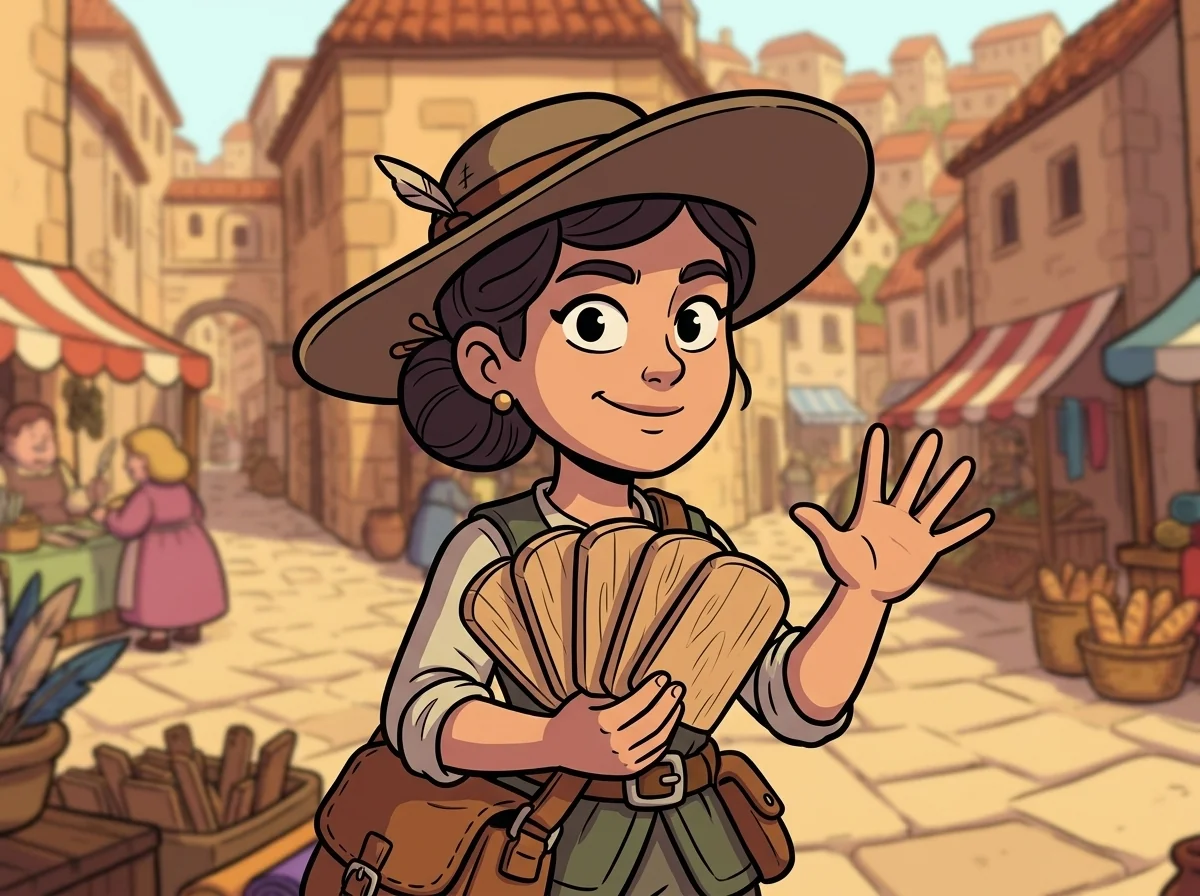
Etyma is a small woman with a quick, sure step. Her dark hair is always pinned up. She wears a wide-brimmed hat to shade her eyes. She carries a leather satchel everywhere she goes. It’s full of small wooden tablets. Each tablet has a Latin root carved into it.
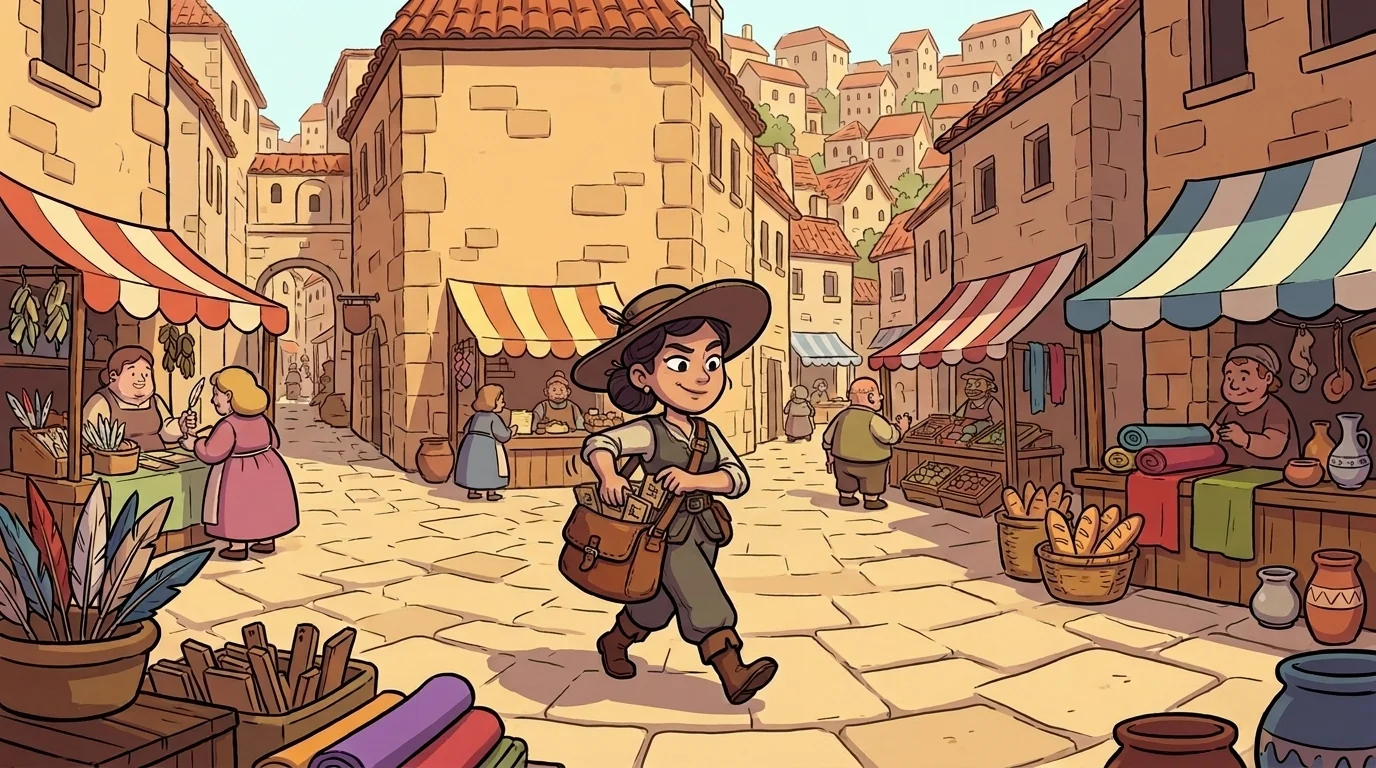
The tablets are her secret weapon. When kids ask about portable or import, she pulls out a tablet. It says port. “Port means carry,” she’ll say. Then she’ll show them export and transport, too. When they ask about scribe, she brings out a tablet that says scrib. “Scrib means write,” she explains. Then she shows them describe and prescription. And even manuscript. When they ask about dictate, out comes the dict tablet. “Dict means say.” Then she points to predict, contradict, and verdict.
The tablets click softly in her satchel as she walks.
Etyma’s real name is Aurelia. But everyone calls her Etyma. She grew up in a house that spoke Latin. Even at the dinner table! Her parents were both teachers. Her grandma was a scribe who wrote books for the kingdom’s church. Her grandpa was a stonemason. He carved Latin words onto monuments.
Aurelia learned Latin before she was four years old. As a little kid, she didn’t think it was strange. She just understood two languages. But around age eight, she noticed something amazing. So many English words were just old Latin words. They were a little worn down, like old coins. The English word script was the Latin scriptum. The English word portable was Latin portabilis. The patterns were everywhere.
She started keeping a list. By age twelve, her list was huge. She had found over two thousand English words from Latin roots. By fourteen, she could guess what new words meant. She just looked at their roots. She figured out this trick all by herself. She just watched how words worked.
When Aurelia was seventeen, she walked into the main hall of the QuillSpell academy. She asked to take their big spelling test. The test had three hundred words. Some were easy. Some were incredibly hard. Most students got about half of them right. Aurelia spelled two hundred and ninety-seven correctly.
The academy master was a quiet woman named Lex. She saw Aurelia’s score. She asked to see her right away.
The interview went like this.
Lex asked, "How did you spell floccinaucinihilipilification?"
Aurelia smiled. “That word is just five Latin roots,” she said. “All stacked together.” She listed them on her fingers. “Floccus, a bit of wool. Naucum, a tiny thing. Nihilum, nothing. Pilus, a single hair.” She paused. “And -fication at the end just means ‘making something.’”
“Each root means something small and worthless,” Aurelia explained. “So the whole word means deciding something is worthless. You just spell the roots in order.” Then she spelled it out loud. “F-L-O-C-C-I-N-A-U-C-I-N-I-H-I-L-I-P-I-L-I-F-I-C-A-T-I-O-N.”
Lex set down her teacup. She had run the academy for fifteen years. She had never, ever heard a teenager do that. No one had ever broken down that word by its roots.
“You’re not just a student,” Lex said. “You’re a teacher. The Latin Quarter has needed a guide for years. Will you take the job?”
Aurelia said yes. And she got her new name: Etyma. It comes from an old Greek word, etymon, which means “true meaning.” She has been the guide for twenty-three years now.
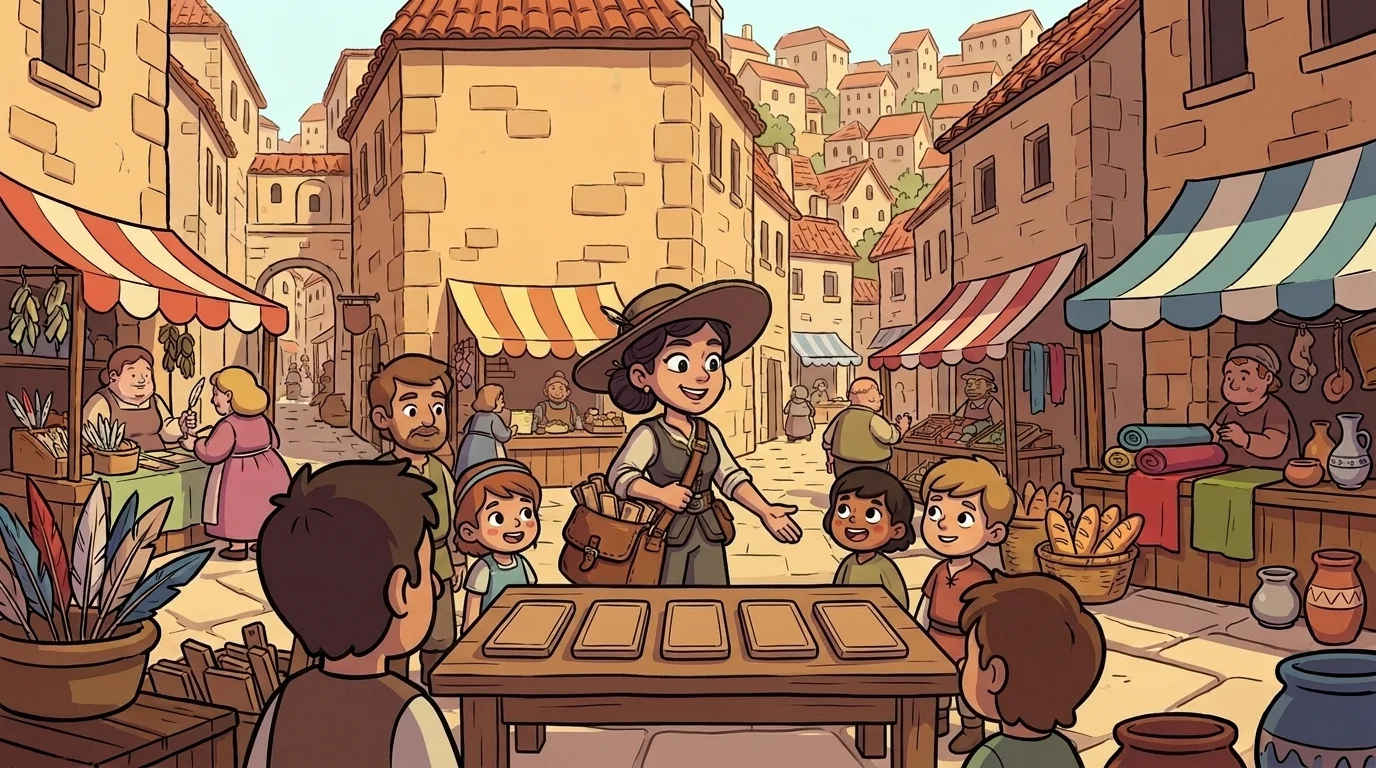
She starts every first-day lesson the same way. She opens her leather satchel. She lays out five wooden tablets on her desk. They say: port, scrib, dict, vis, audi.
She turns to the class. “These are five Latin roots,” she says. “They are super common in English. Port means carry. Scrib means write. Dict means say. Vis means see. Audi means hear. If you know these five, you can unlock hundreds of English words. Let me show you.”
She picks up port. “Words from port are everywhere,” she says. “Like portable and transport. Or import and export. A report is news you carry back. An export is something you carry out of a country. A porter is someone who carries bags for a job. See the root? The meaning is right there.”
The kids always lean forward. You can almost hear the click in their brains. Before, English spelling felt like a random jumble of letters. But Etyma shows them it’s a code. Most of it makes perfect sense. You just have to know the roots.
When children ask if learning Latin roots is hard, Etyma always says the same thing.
“They are not hard,” she says, her eyes twinkling. “They are patterns. Learn a few dozen roots. You will unlock thousands of English words. Learn one root, and the other words almost spell themselves.”
She still keeps the wooden tablets in her satchel. Sometimes children ask to hold one. She always lets them. The tablets are much smoother now than when she first got them. Twenty-three years of curious hands have polished them smooth.
The QuillSpell ensemble
Etyma is part of QuillSpell's distributed-narrative cast. Each character embodies a different curricular primitive; together they teach the full subject.
-

Sophia
Greek Acropolis — Greek roots (bio, geo, photo, log, graph, phon)
-

Birch
Germanic / Old English Grove — short, punchy Anglo-Saxon roots (mouth, hand, foot, hear, see, walk)
-

Saga
Old Norse Longhouse — northern roots (sky, take, gift, raise, weak, scant)
-

Margaux
French Chateau — Norman-French roots (royal, chef, ballet, garage, hotel, courage)
-

Zayn
Arabic Oasis — Arabic-origin English loans (algebra, algorithm, alchemy, zenith, sugar, cotton)
-

Hush
Silent-letter clan (kn-, gn-, wr-, mb, gh, pn-, ps-)
-

Twin
Double-consonant rule (running, beginning, hopped, planned — short-vowel-CVC + suffix)
-

Ember
Schwa-keeper (the unstressed-vowel "uh" — `about`, `pencil`, `lemon`, `circus`, `medium`)
-
Wren
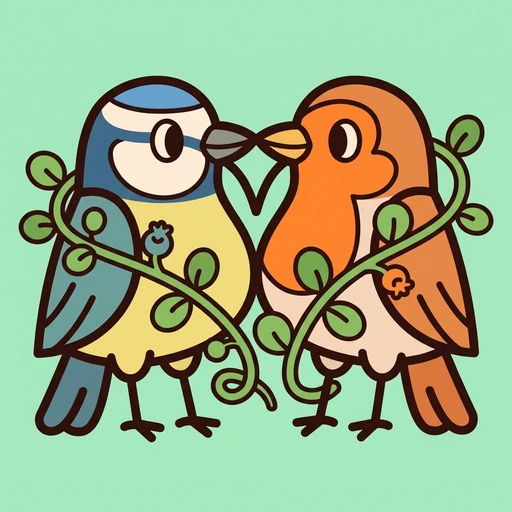
Vowel-team duos (ai, ea, ee, oa, ow, ie, oi) — "when two vowels go walking"
-

Affix
Suffix-stack guardian (root + suffix + suffix: nation → national → nationalize → nationalization)
-

Cadence
Syllable-rhythm master (di-vid-ing words for spelling: VC/CV, V/CV, syl-lab-i-fi-ca-tion)