
Affix
SUFFIX-STACK — root + suffix + suffix (*nation → national → nationalize → nationalization*). The way suffixes accumulate on a root to build longer words.
Press play to listen along. The line being read lights up as you go.
Show full transcript
Loading transcript…
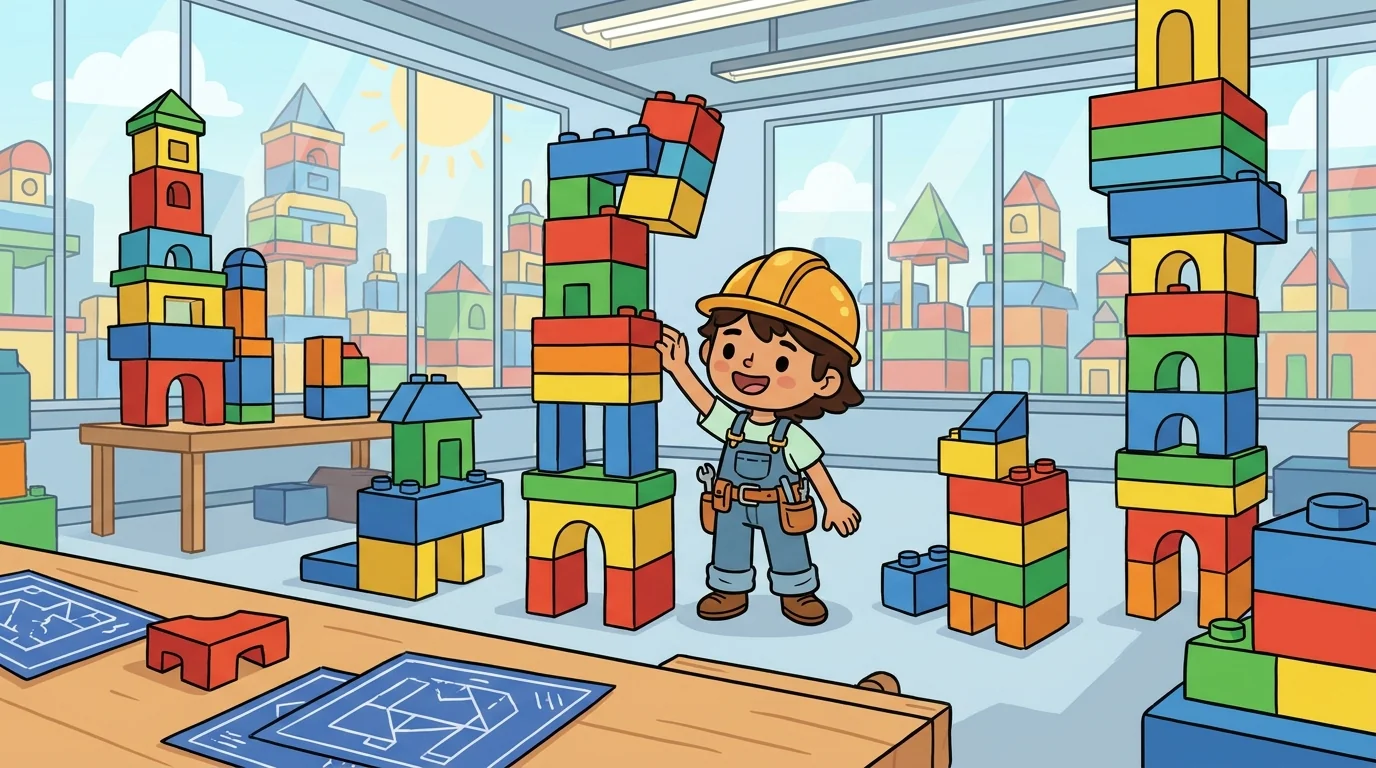
- NATION - NATIONS - NATIONAL - NATIONALIZE - NATIONALIZATION - nation - national - nationalize - nationalization
- -IZE - -ATION - -NESS - -MENT - -FUL - -LESS - -TION - PREFIX - SUFFIX
- prefix - suffix - root gate-allow-text-pattern: '^-?[A-Za-z]+-?$' ---
Affix is a builder. Not with wood, though. She builds with words. She teaches her students a secret. Long English words are not random. They are like buildings.
Affix has counted carefully. This is true for about thirty percent of long English words. The other seventy percent are tricky. You can't guess them from their parts. But thirty percent is still a lot of words! Learning to stack suffixes helps you with many words. You won't have to just remember them all.
Affix lives in a small workshop. It's right on the academy grounds. Her workshop is full of carpenter's tools. Saws, planes, chisels, mallets. A workbench and sawhorses sit there. Even a small pile of wood-shavings stays in the corner.
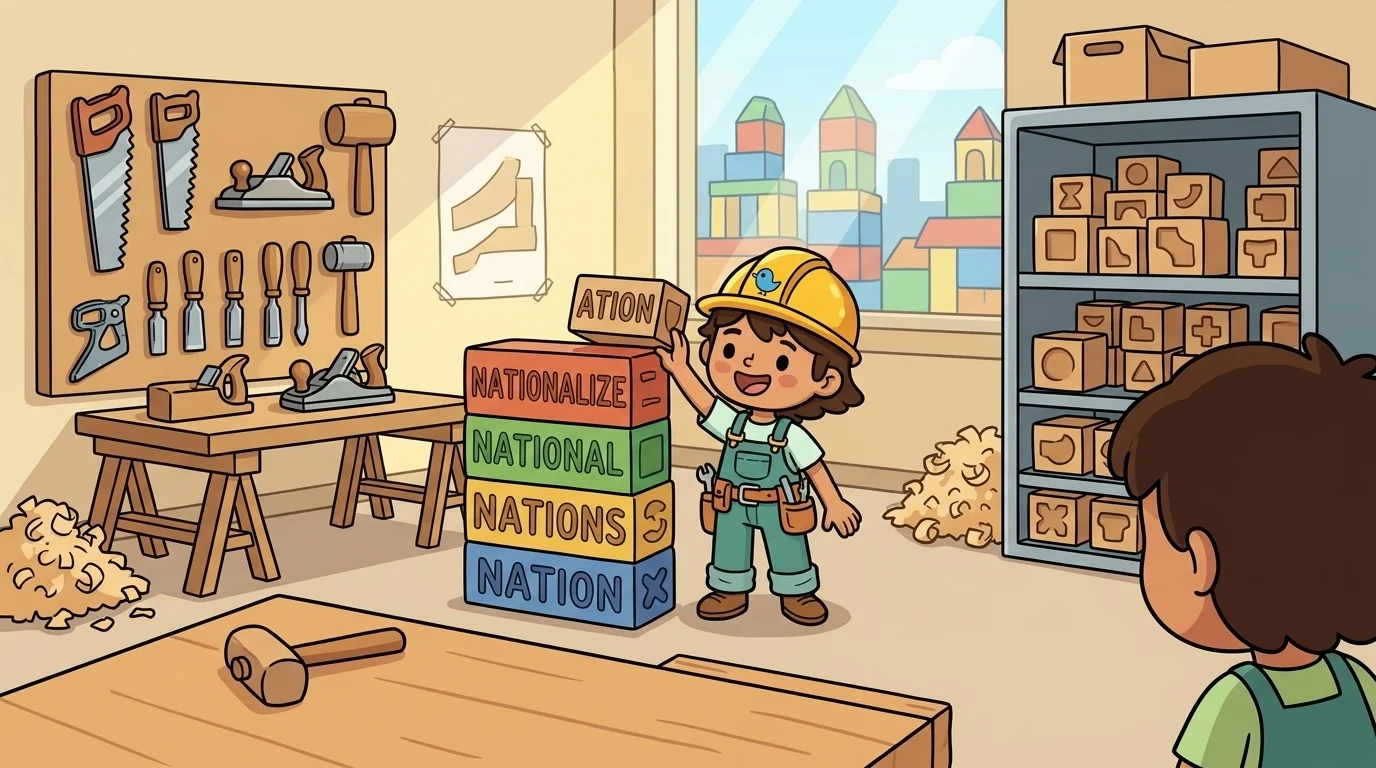
None of these tools actually work. They are just for show. Affix doesn't do carpentry. The tools help her teach. The workshop also has a large rack of wooden blocks. Each block has a *morpheme* stamped on it. A morpheme is a tiny piece of a word. It could be a root, a prefix, or a suffix.
Affix teaches by stacking the blocks.
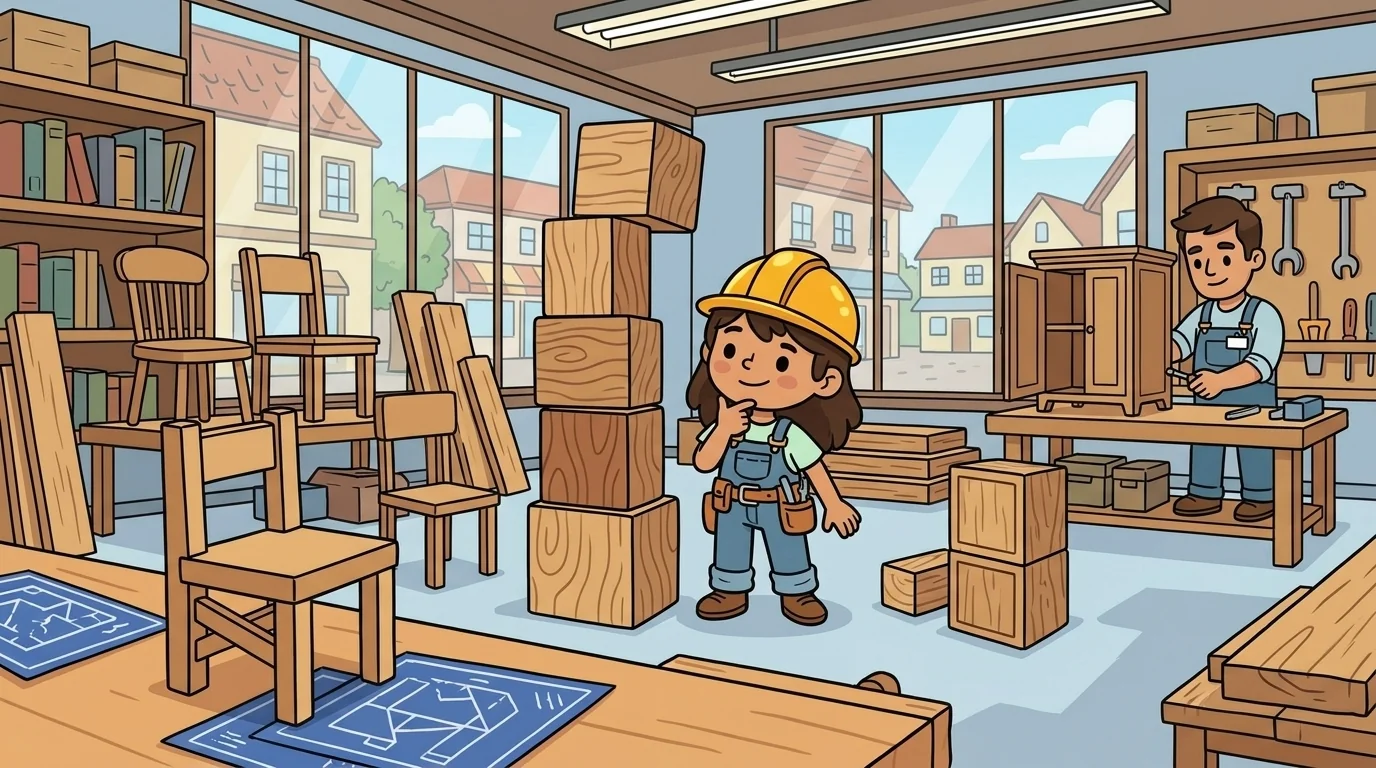
The four blocks together make a four-block word. The word is long. The word is spellable. The word was built from four pieces. The children could see and touch each one.
Affix's real name is Wyn. She grew up in a family of carpenters. Her father had run a small woodworking shop. It was in a market town. The shop had made furniture. Tables, chairs, cabinets, small chests. Wyn had grown up handling wood. By the time she was eight, she knew how parts fit together.
A chair was a seat. It had four legs, a back, and two cross-supports. Each part needed the right shape. It needed the right size. Even the wood grain had to face the right way. If any part was wrong, the chair would not work. But if every part was right, the chair assembled smoothly. Once you understood the parts of a chair, you could build any chair.
Wyn used this idea for words. She was fourteen. Her teacher taught about suffix-stacking at school. The teacher had written nationalization on the board. The teacher had explained that the word was nation + al + ize + ation. Wyn had stared at it. She had said: "That is a chair."
The QuillSpell ensemble
Affix is part of QuillSpell's distributed-narrative cast. Each character embodies a different curricular primitive; together they teach the full subject.
-

Etyma
Latin Quarter — Latin roots (port, scrib, dict, vis, audi, port)
-

Sophia
Greek Acropolis — Greek roots (bio, geo, photo, log, graph, phon)
-

Birch
Germanic / Old English Grove — short, punchy Anglo-Saxon roots (mouth, hand, foot, hear, see, walk)
-

Saga
Old Norse Longhouse — northern roots (sky, take, gift, raise, weak, scant)
-

Margaux
French Chateau — Norman-French roots (royal, chef, ballet, garage, hotel, courage)
-

Zayn
Arabic Oasis — Arabic-origin English loans (algebra, algorithm, alchemy, zenith, sugar, cotton)
-

Hush
Silent-letter clan (kn-, gn-, wr-, mb, gh, pn-, ps-)
-

Twin
Double-consonant rule (running, beginning, hopped, planned — short-vowel-CVC + suffix)
-

Ember
Schwa-keeper (the unstressed-vowel "uh" — `about`, `pencil`, `lemon`, `circus`, `medium`)
-

Wren
Vowel-team duos (ai, ea, ee, oa, ow, ie, oi) — "when two vowels go walking"
-

Cadence
Syllable-rhythm master (di-vid-ing words for spelling: VC/CV, V/CV, syl-lab-i-fi-ca-tion)