
Etyma
LATIN ROOTS — the foundational morphemes of Latin-derived English. *port* (carry), *scrib* (write), *dict* (say), *vis* (see), *audi* (hear). Knowing the root cracks open hundreds of derivative words.
Press play to listen along. The line being read lights up as you go.
Show full transcript
Loading transcript…
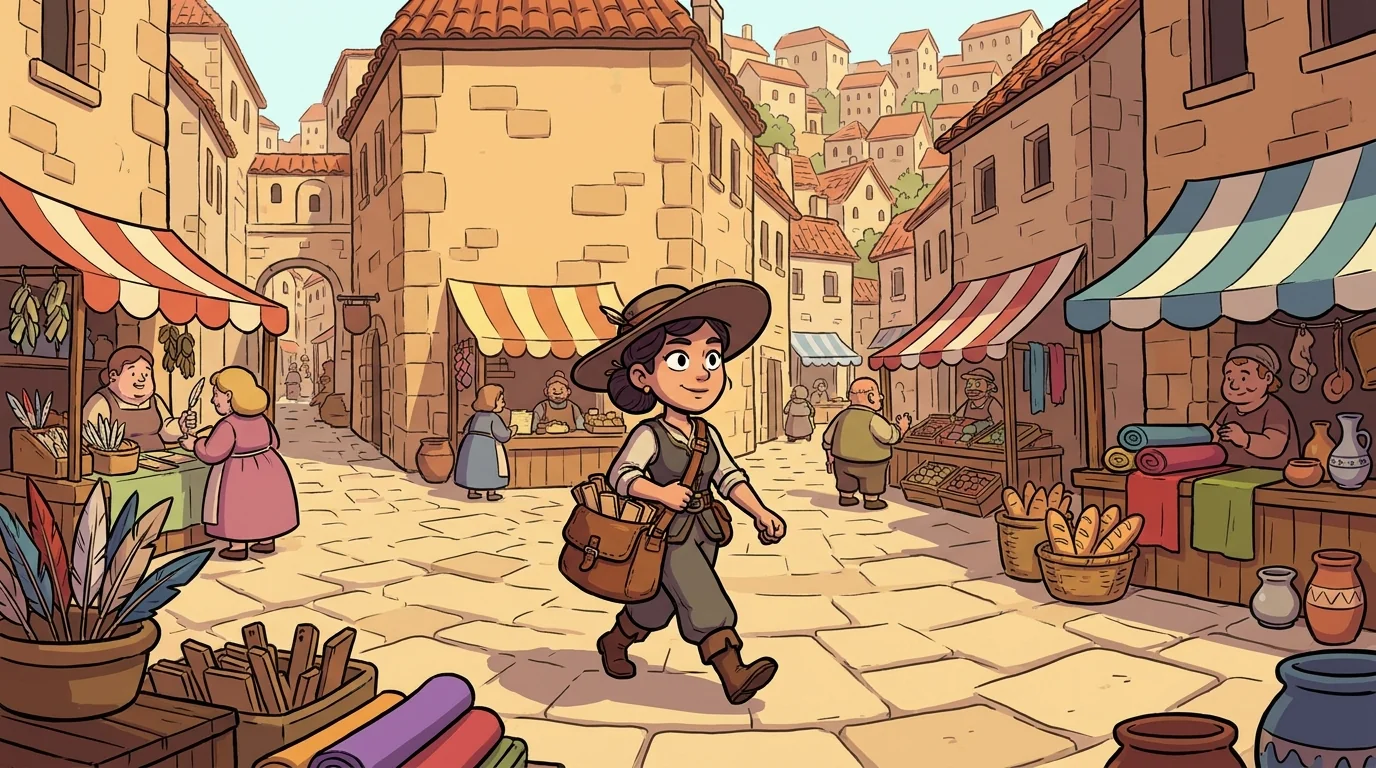
Etyma lived in the Latin Quarter. It wasn't a city neighborhood, not really. It was a bustling part of the QuillSpell spelling academy, a place where Latin words had come to live. The academy itself was huge, a sprawling maze of old stone buildings and winding cobbled lanes. Six different neighborhoods made up the campus, each dedicated to a language family that had given English some of its core words. The Latin Quarter was the biggest. Its streets were paved, its market square always busy. Thousands of residents called it home, Etyma often said. Each resident was a Latin root, a tiny seed of meaning that had grown into English words over hundreds of years.
Etyma was the Latin Quarter's guide. She led visitors through its winding paths, introducing them to the ancient roots. She showed how these roots had traveled into English, sometimes whole, sometimes worn smooth like old river stones. Other times, they joined with different roots to build new, complex words.
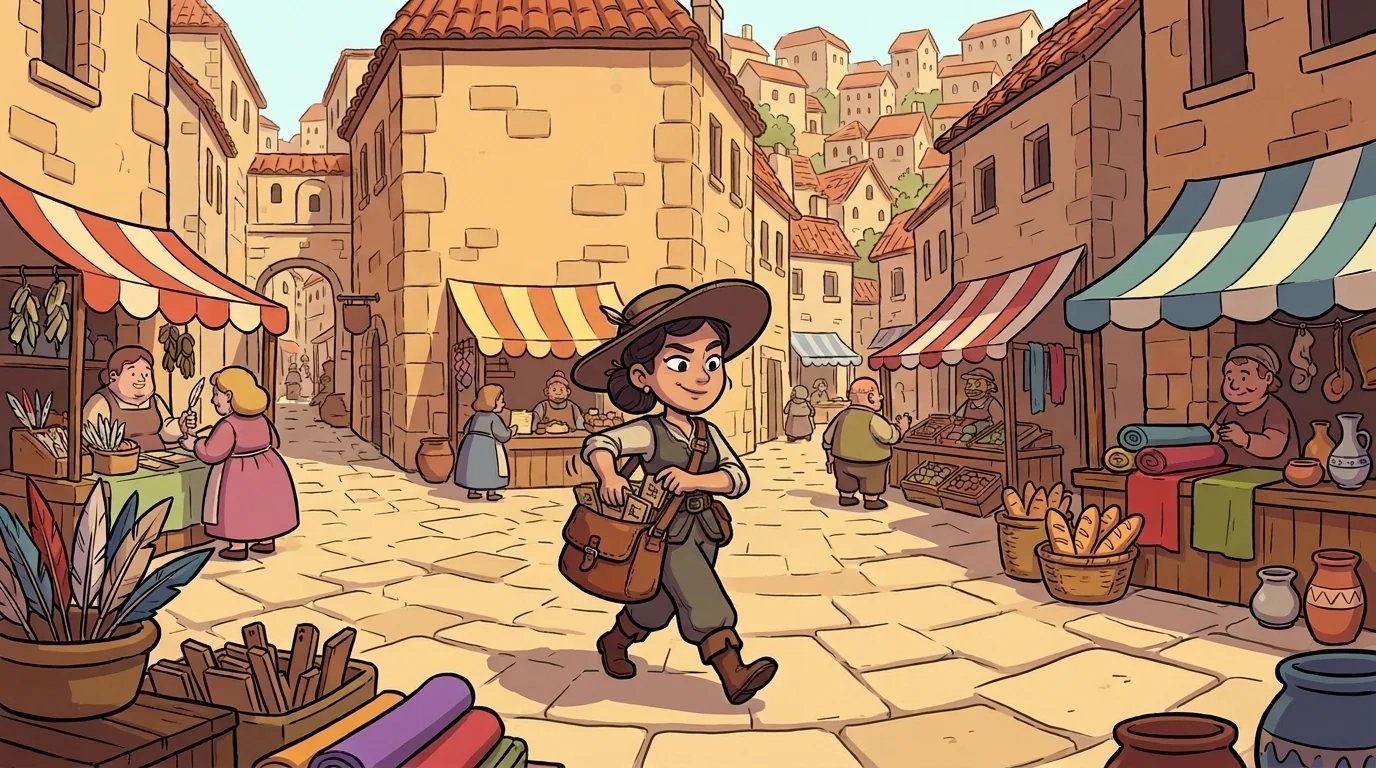
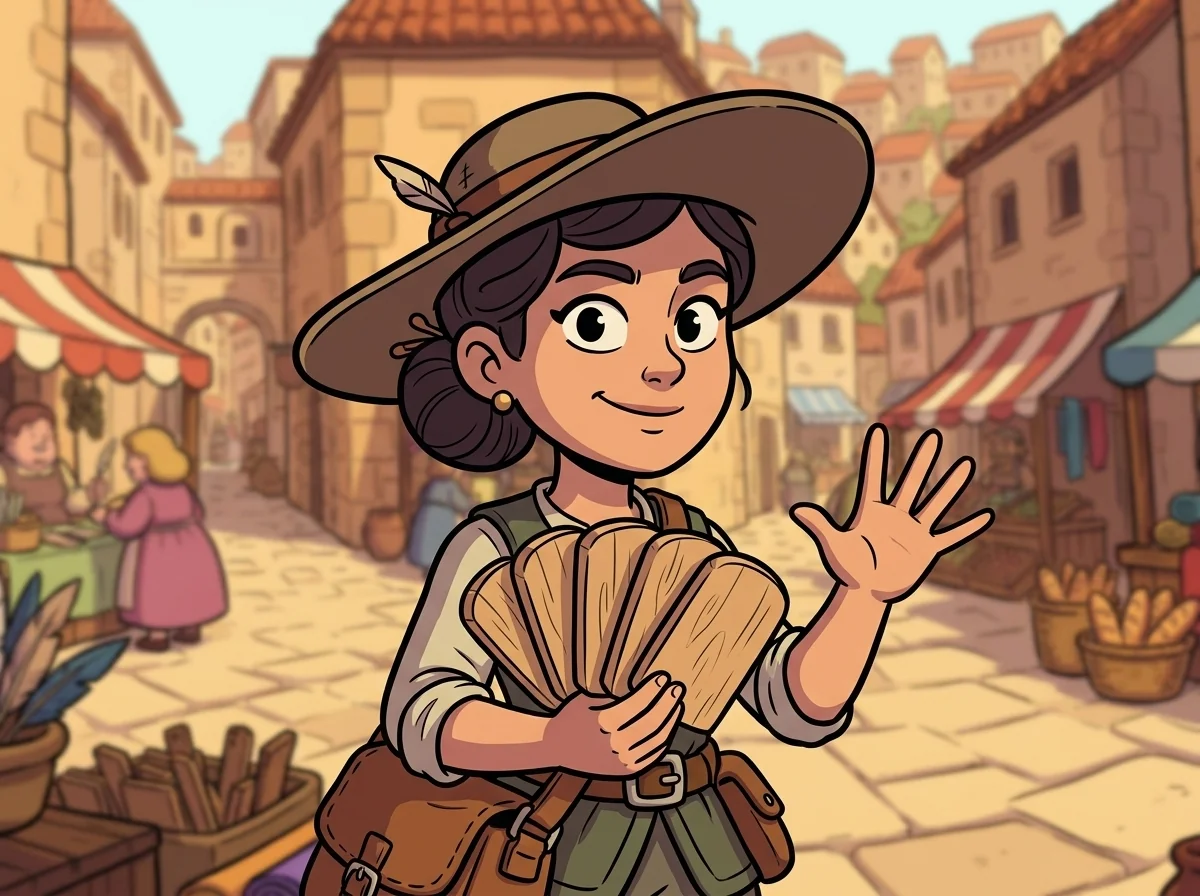
She was a small woman, olive-skinned, in her early forties. Her dark hair was always pinned neatly under a wide-brimmed hat. She carried a leather satchel, its surface soft and worn. Inside, small wooden tablets clicked together with every step. Each tablet held a Latin root carved deep into its grain. These were her teaching tools, her way of showing how words worked. If a child asked about portable or transport, Etyma would pull out the port tablet. 'It means carry,' she would explain. For scribe or manuscript, she’d show them scrib, meaning write. And for dictate or verdict, out came dict, meaning say. The roots were like keys, unlocking dozens of English words.
Etyma's real name was Aurelia, but no one called her that anymore. She grew up in a house where Latin wasn't just a school subject. It was spoken at supper, as natural as breathing. Her parents taught ancient languages. Her grandmother had been a scribe for the kingdom's church, writing in Latin until she was very old. Her grandfather carved Latin words onto stone monuments. Aurelia learned Latin before she was four. She didn't think of it as a separate language, just another way to talk. Then, around age eight, something clicked. She started noticing things, little echoes. English words often sounded like Latin words, just a bit softer, a bit worn down. Script sounded like scriptum. Portable sounded like portabilis. Dictionary sounded like dictionarium. The connections were everywhere, like a secret code waiting to be cracked. She started a list, filling notebooks with her discoveries. By twelve, she had found over two thousand English words that came straight from Latin. By fourteen, she could look at a new, strange English word and guess its meaning. She would break it apart, find the Latin roots, the prefixes, the suffixes. No one had taught her this. She had simply figured it out, watching how words fit together, like a puzzle she was born to solve.
At seventeen, Aurelia walked into the grand main hall of the QuillSpell academy. She asked to take the placement test. It was a brutal challenge: three hundred spelling words, from simple to ridiculously hard. Most hopeful students scored somewhere between forty and seventy percent. Aurelia scored two hundred and ninety-seven out of three hundred. Lex, the academy master, was a quiet woman known for her calm demeanor. She looked at Aurelia's score. Then she looked at Aurelia. An interview was requested immediately.
The interview was brief. Lex leaned forward, her eyes sharp. 'How did you spell floccinaucinihilipilification?' she asked.
Aurelia didn't hesitate. 'It's five Latin roots, stacked up,' she explained. 'Floccus means a tuft of wool. Naucum means a trifle. Nihilum means nothing. Pilus means a hair. And -fication is a suffix.' She paused, letting the words sink in. 'Each root means something small and worthless. So the whole word literally means the act of judging something to be worthless. The spelling just follows the roots, laid out in order: F-L-O-C-C-I-N-A-U-C-I-N-I-H-I-L-I-P-I-L-I-F-I-C-A-T-I-O-N.'
Lex slowly set down her tea cup. She had been the academy master for fifteen years. Never once had a seventeen-year-old explained that word by pulling it apart, root by root.
'You are not a placement candidate,' Lex said, her voice soft but firm. 'You are faculty. The Latin Quarter has needed a guide for years. Will you take the position?'
Aurelia accepted without a second thought. She was given her academic name, *Etyma, from the Greek word etymon*, meaning 'true meaning.' She has been the Latin Quarter's guide for twenty-three years now.
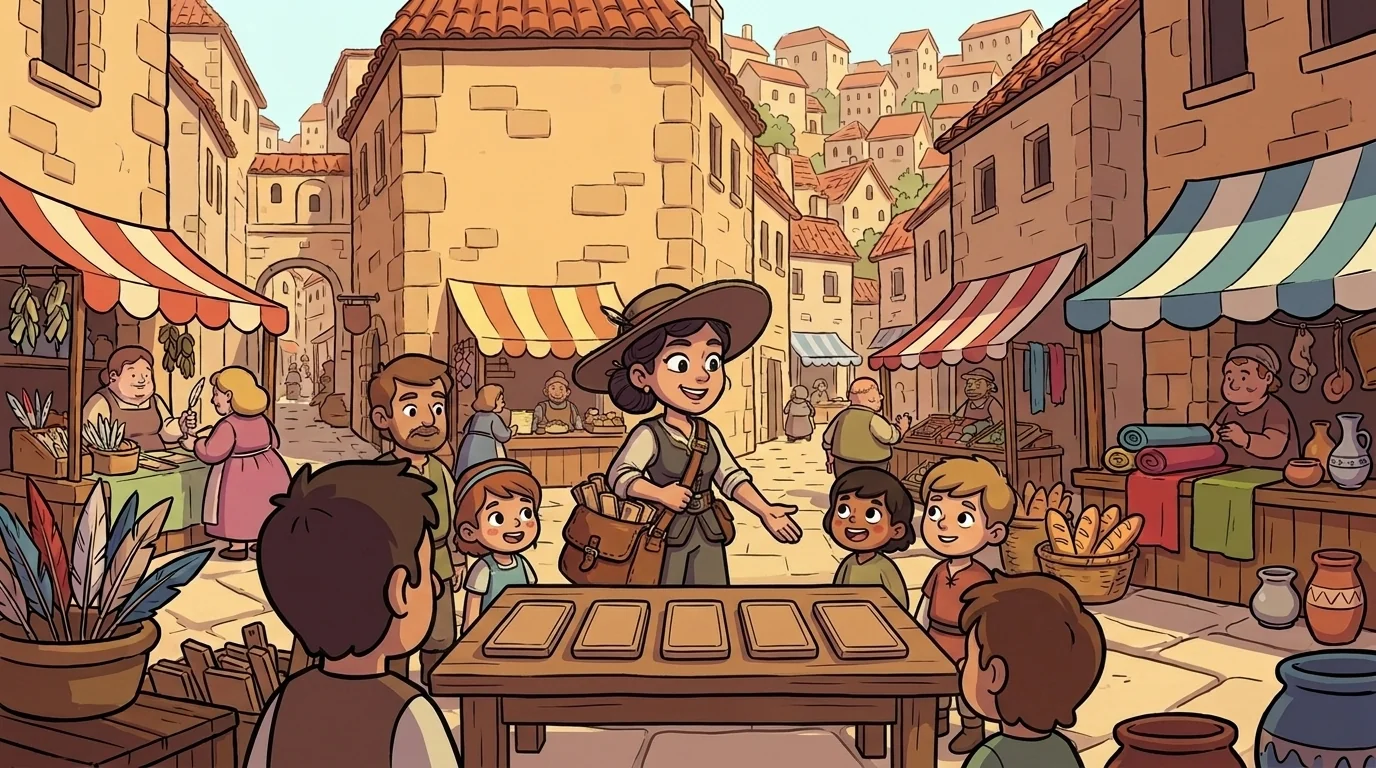
In her classroom, Etyma started every first-day lesson the same way. She opened her worn leather satchel. One by one, she laid five wooden tablets on her desk: port, scrib, dict, vis, audi. She turned to the class, her eyes bright. 'These are five Latin roots,' she told them. 'They are among the most common roots in English. Port means carry. Scrib means write. Dict means say. Vis means see. Audi means hear.' She paused, letting the words hang in the air. 'Learn these five, and you can unlock hundreds of English words. Let me show you how.'
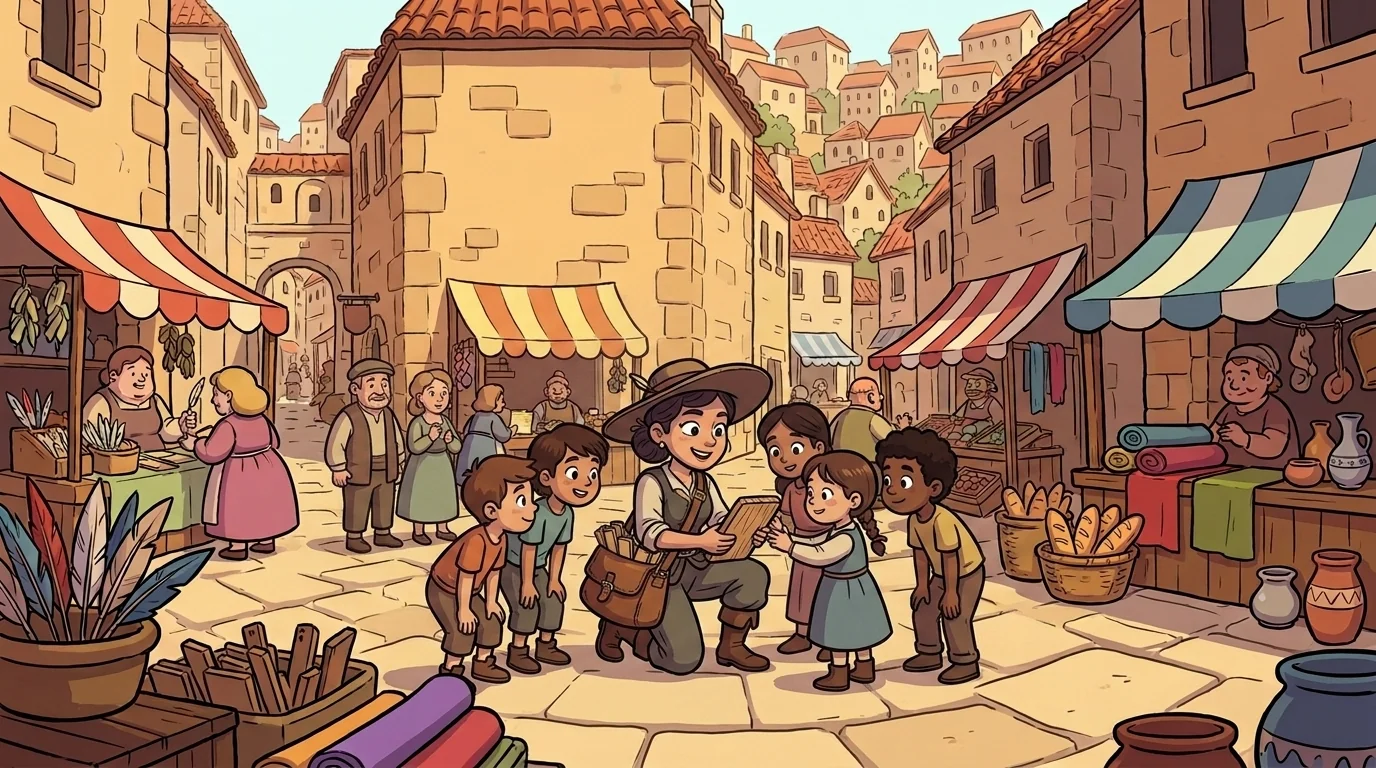
She picked up port, its wood smooth under her fingers. 'Think of words built from port: portable, transport, import, export, portage, porter, deport, report.' She listed them slowly. 'The root always means carry. A report is something you carry back. An export is something you carry out of the country. A porter is someone whose job is to carry things.' The children watched, their faces shifting. At first, some looked bored, others confused. But as she spoke, their eyes widened. They had always thought English spelling was just a jumble of letters, full of random rules. Etyma was showing them a hidden logic, a secret code beneath the surface.
When children asked if Latin roots were hard, Etyma always shook her head. 'They aren't hard,' she would say. 'They are patterns. Learn a few dozen roots, and thousands of English words suddenly make sense. You learn the root once. Then all the words that come from it practically spell themselves. The pattern carries you, like a strong current, through the whole language.'
She still kept those wooden tablets in her satchel. Sometimes, a child would ask to hold one. Etyma always allowed it. Over twenty-three years, she had noticed, the tablets had grown smoother. The children's hands had polished them, one curious touch at a time.
The QuillSpell ensemble
Etyma is part of QuillSpell's distributed-narrative cast. Each character embodies a different curricular primitive; together they teach the full subject.
-

Sophia
Greek Acropolis — Greek roots (bio, geo, photo, log, graph, phon)
-

Birch
Germanic / Old English Grove — short, punchy Anglo-Saxon roots (mouth, hand, foot, hear, see, walk)
-

Saga
Old Norse Longhouse — northern roots (sky, take, gift, raise, weak, scant)
-

Margaux
French Chateau — Norman-French roots (royal, chef, ballet, garage, hotel, courage)
-

Zayn
Arabic Oasis — Arabic-origin English loans (algebra, algorithm, alchemy, zenith, sugar, cotton)
-

Hush
Silent-letter clan (kn-, gn-, wr-, mb, gh, pn-, ps-)
-

Twin
Double-consonant rule (running, beginning, hopped, planned — short-vowel-CVC + suffix)
-

Ember
Schwa-keeper (the unstressed-vowel "uh" — `about`, `pencil`, `lemon`, `circus`, `medium`)
-

Wren
Vowel-team duos (ai, ea, ee, oa, ow, ie, oi) — "when two vowels go walking"
-

Affix
Suffix-stack guardian (root + suffix + suffix: nation → national → nationalize → nationalization)
-

Cadence
Syllable-rhythm master (di-vid-ing words for spelling: VC/CV, V/CV, syl-lab-i-fi-ca-tion)