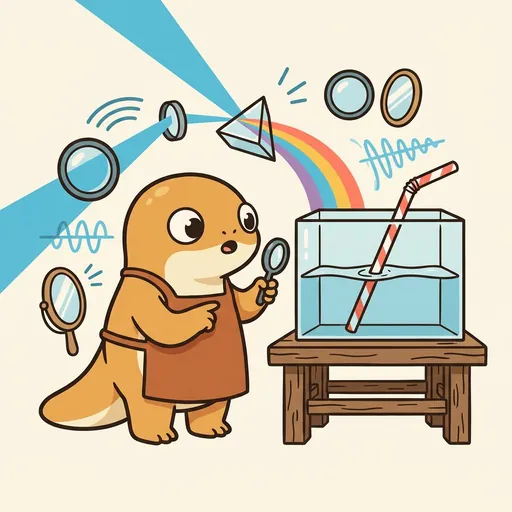
Bend
REFRACTION — *light slows in denser media — and slowing means bending. that's why a straw looks broken in water.*
Listen along — Bend
Loading audio…
Press play to listen along. The line being read lights up as you go.
Show full transcript
Loading transcript…
Chapter 2 — Bend and the Straw That Looks Broken
Bend was a small mudpuppy-salamander-tween. He was chunky and soft-skinned, not slimy at all. He had a special water tank and a straw at his workbench.
Bend was small. He was warm amber with a cream belly. He was really curious about how light acts in different stuff. He always said, “Light slows in denser media — and slowing means bending.” His special thing was his water-tank show-and-tell. It was a clear glass tank. It was half-filled with water. A straw sat partly in the water. If you looked from the side, the straw looked bent. It looked broken right where it met the water. That was refraction. You could see it clearly.
This was important. Bend taught about the primitive of refraction. It’s when light changes speed. This makes it change direction. It happens when light goes into something new. Lots of kids see the straw look broken. But they don’t understand why. The reason is simple. Light moves at different speeds. It moves slower in water than in air. It’s even slower in glass. When light hits a new material at an angle, one side slows down first. This makes the light beam turn. It’s like a tiny pivot. That’s refraction. Bend’s whole job was to show how refraction worked. He used his water-tank show to make it clear.
Bend was always clear. “Light slows in denser media,” he’d say. “And slowing means bending. In air, light travels at one speed. In water, it’s slower. In glass, it’s slower still. When light crosses the boundary at an angle, the speed change makes it pivot. That’s refraction. That’s why the straw looks broken.”
Bend taught the refraction basics:
- Speed of light in media. Light moves super fast in empty space. It’s almost as fast in air. In water, it’s a bit slower. In glass, it’s even slower. Heavy stuff slows light down.
- Index of refraction. This is a special number. It tells you how much light slows down in something. A bigger number means slower light.
- Snell’s law. This is a math rule. It tells you exactly how much light bends. You need to remember “Snell’s law.” It’s important for serious light work.
- Total internal reflection. Imagine light hitting water from inside. If it hits at a super steep angle, it just bounces back. It doesn’t go through. This makes diamonds sparkle. It’s also how internet cables work.
- Apparent depth. Water always looks shallower than it is. Fish look like they’re in a different spot. It’s all because of refraction.
- Why the straw looks broken. Light from the straw underwater bends. It bends when it leaves the water. This makes the straw look bent where it hits the water.
- Atmospheric refraction. Sunsets look red and squished. That’s light bending through our air. Mirages happen in deserts. Hot air near the ground bends light in weird ways.
Bend grew up in the cave-stream village. His family had been water-watchers for the village. His family were mudpuppies. They hunted underwater. They had to know light bends. Where a fish looked was not where it really was. For many years, they taught a rule. “What you see underwater is tricky. You always need to fix it. Refraction is the fix.” Bend learned this important lesson. He carried it forward.
He walked to PrismForge when he was twelve. Optic, his teacher, had asked him a question. “What is refraction?” Bend answered right away. “Light slows in denser media — and slowing means bending. When light crosses a boundary at an angle, the speed change makes it pivot. That’s why the straw looks broken in water.” Optic just nodded. “You are appointed,” he said.
In his workshop, Bend showed off his water tank. “Watch,” he said. He put the straw in. Looking from the side, the straw looked bent at the water line. “See? The straw is actually straight. The light from the underwater part bends. It bends as it leaves the water. This makes it look like it moved. Your eye follows the light back. It sees the straw where the light seems to come from. That’s why you see a bend.” He picked up a small laser. He shined the red beam at the water surface. He aimed it at an angle. The beam visibly bent as it entered the water. “There’s refraction working,” he explained. “The light’s path changed. It hit the water and turned. Snell’s Law tells us how much it turns.” He looked at his students. “I am Bend. I teach about refraction. Remember this: Light slows down in thick stuff. Slowing down means bending. The straw isn’t broken. Your eye is just following bent light.”
He was gentle when he spoke. “Don’t be tricked by appearances underwater. Fish are deeper than they look. Pool floors are deeper than they appear. Refraction always makes things look different. You always need to correct for it. Once you know it’s happening, you can fix what you see.”
“Slowing means bending. The straw isn’t broken. The light is.”
The PrismForge ensemble
Bend is part of PrismForge's distributed-narrative cast. Each character embodies a different curricular primitive; together they teach the full subject.