
Bend
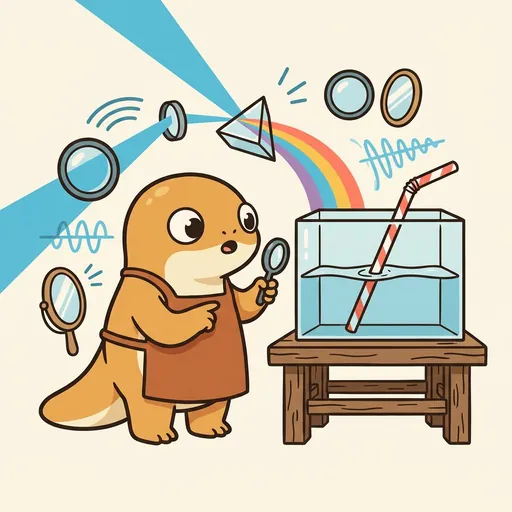
REFRACTION — *light slows in denser media — and slowing means bending. that's why a straw looks broken in water.*
Listen along — Bend
Loading audio…
Press play to listen along. The line being read lights up as you go.
Show full transcript
Loading transcript…
Chapter 2 — Bend and the Straw That Looks Broken
Bend, a mudpuppy-salamander-tween, carefully adjusted the small glass tank on his workbench. His skin, a warm amber with a cream-colored belly, seemed to glow under the workshop lights. He was chunky and soft-skinned, not slimy or creepy, and his deep curiosity about how light behaved in different materials was clear in his focused gaze.
His signature demonstration sat right in front of him: a clear glass tank, half-filled with water. He picked up a simple drinking straw, striped red and white, and eased it into the water. From above, the straw looked perfectly normal. But when he tilted his head and peered through the side of the tank, the straw seemed to kink where it met the surface. It looked like someone had bent it clean in half.
This wasn’t a trick. It was refraction, made visible. Refraction is what happens when light changes speed as it moves from one material into another. This change in speed makes the light change direction, or bend. Most people have seen the straw-looks-broken effect but don’t understand why. Bend’s whole purpose was to make that mechanism clear.
“Watch,” Bend said softly, his voice earnest. “The straw isn’t broken. It’s just light doing its job.” He pointed with a soft, webbed finger. “Light slows in denser media — and slowing means bending.”
He explained it simply. “In air, light travels at one speed. In water, it slows down. A lot. Think of it like running through mud after running on solid ground. You slow down, right? Glass is even denser than water, so light slows down even more in glass.”
When light crosses the boundary between air and water at an angle, the side of the light wave that enters the denser material slows first. This causes the wave to “pivot,” like a car hitting mud with one wheel first. That pivot is refraction. Bend’s work was all about making this mechanism explicit through his water-tank demonstration.
“That’s refraction,” Bend continued. “That’s why the straw looks broken.”
Bend taught the core ideas of refraction. He talked about the speed of light in media. “Light is fastest in a vacuum,” he said. “Almost as fast in air. But in water, it’s only about three-quarters of that speed. In glass, it’s closer to two-thirds. Slower in denser media, always.”
He also mentioned the index of refraction. “This is just a number that tells you how much light slows down in a material,” he explained. “For water, it’s about 1.33. For glass, it’s around 1.5. A higher number means slower light.”
Then there was Snell’s law. “This is the rule that predicts exactly how much the light will bend,” Bend said, tapping the side of the tank. “It’s a formula, n1 times sin(theta1) equals n2 times sin(theta2). You’ll memorize ‘Snell’s law’ if you get serious about optics. It’s important.”
He even hinted at total internal reflection. “If light hits the water at a steep enough angle, sometimes it doesn’t even go into the water,” he mused. “It just bounces right off, like a mirror. That’s how fiber optics work, sending light signals down tiny glass threads. It’s also why diamonds sparkle so much.”
Bend also explained apparent depth. “Water always looks shallower than it really is,” he said. “Fish also appear to be at a different depth than they actually are. Both of these are consequences of refraction.”
And, of course, he always circled back to why the straw looks broken. “Light from the submerged part of the straw bends as it leaves the water,” he patiently repeated. “That bending makes the straw appear to shift at the water-line.”
Finally, he touched on atmospheric refraction. “Sunsets look red and flattened because light bends through Earth’s atmosphere,” he noted. “Mirages appear in deserts because hot air near the ground bends light in unexpected ways.”
Bend grew up in the cave-stream village, a place where understanding light was crucial. His family had been the water-watchers for generations. They were mudpuppies whose underwater hunting required a deep understanding that light bends. This meant the position of prey, as seen, was never the actual position. They learned over many generations that “what your eye sees underwater is what you must compensate for; refraction is the correction needed.” Bend had carried that lesson forward.
He walked to PrismForge when he was twelve. Optic, the mentor, had asked him one question: “What is refraction?”
Bend had answered without hesitation. “Light slows in denser media — and slowing means bending. When light crosses a boundary at an angle, the speed change makes it pivot. That’s why the straw looks broken in water.”
Optic had simply nodded. “You are appointed.”
In his workshop, Bend demonstrated with the water-tank. “Watch.” He put the straw in. Looking from the side, the straw clearly bent at the water-line. “See? The straw is actually straight. The light from the underwater part bends as it leaves the water, making the apparent position shift. Your eye traces the light back to where it appears to come from. That’s why you see a bend.”
He then picked up a small laser and aimed it at the water surface at an angle. The thin red beam visibly bent as it entered the water. “There’s refraction in action,” he said, satisfied. “The angle changed at the boundary. Snell’s law predicts how much.”
He straightened up, looking at his audience with calm, amber eyes. “I am Bend. The primitive I teach is refraction. The move is: light slows in denser media; slowing means bending. The straw isn’t broken; your eye is just doing geometry on bent light.”
He was gentle, his voice reassuring. “Don’t be tricked by appearances underwater. Fish are deeper than they look. Pool floors are deeper than they appear. Refraction is a constant correction. Once you know it’s happening, you can compensate.”
“Slowing means bending,” he concluded, looking at the straw again. “The straw isn’t broken. The light is.”
The PrismForge ensemble
Bend is part of PrismForge's distributed-narrative cast. Each character embodies a different curricular primitive; together they teach the full subject.