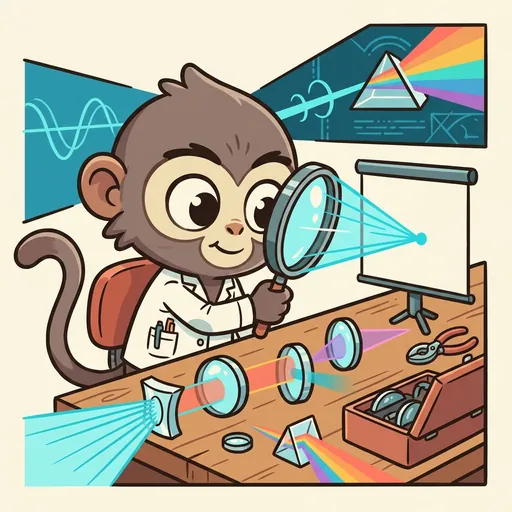
Focus
LENS ACTION — *converging lenses bring parallel rays to a point. diverging lenses spread them apart. that's how telescopes, eyes, and magnifying glasses work.*
Listen along — Focus
Loading audio…
Press play to listen along. The line being read lights up as you go.
Show full transcript
Loading transcript…
Chapter 4 — Focus and the Rays That Meet at a Point
Focus was a small langur. He wore a tiny optometrist coat. It had pockets for all his lenses. His fur was warm grey. Creamy rings circled his big, curious eyes. He looked a bit like a cartoon character. But he was very real. Focus loved to bring light rays together. Or spread them apart. He worked at a small workbench. Lenses of all shapes and sizes lay there.
Focus was small. He was warm grey. Creamy rings circled his eyes. He was super curious. He loved to bring light rays together. Or spread them out. He often said, “Converging lenses focus. Diverging lenses spread. That’s how every optical device works.” His favorite thing was his lens toolkit. It was always with him. He had a magnifying glass. That was a converging lens. He had a concave eye-glass. That was a diverging lens. He had many other lenses too. Some were thick. Some were thin. He also carried a tiny projection screen. It folded flat. He could set it up anywhere.
Focus taught about lens action. This was a big idea. It meant how curved glass bends light. Lenses can focus light. They can also spread it out. Most kids just use glasses. Or cameras. Or magnifying glasses. They don’t know how they work. Focus wanted to change that. He knew the secret. A curved lens bends each light ray. It bends them differently. It depends on where the ray hits the lens.
“See?” Focus would say. He held up a lens. “This is a converging lens.” It curved outward. “It bends light rays inward. They meet at one spot. We call that the focal point.” He swapped it for another. “This is a diverging lens.” It curved inward. “It bends light rays outward. They spread apart.”
He tapped his tiny coat. “That’s how every optical device works. Your eye has a converging lens. A magnifying glass is a converging lens. A telescope uses them. Reading glasses too. Lenses are everywhere!” He loved to say it. He wanted everyone to know. Lens action was super important. It was all around us.
Focus loved to show how lenses worked. He had special terms for them.
First, there were converging (convex) lenses. He held one up. It was thick in the middle. It curved out like a tiny hill. “These lenses bend light inward,” he explained. “They bring parallel rays to a single point.” He pointed to his eye. “Your eye has one. So does a camera. Magnifying glasses use them. Telescopes too. They make things bigger. Or help you see far away.”
Next, he showed diverging (concave) lenses. This one was thin in the middle. It curved inward, like a tiny valley. “These lenses spread light rays out,” Focus said. “They make things seem smaller. Or help people who can’t see far.” He tapped his own eye-rings. “Some glasses for nearsighted people use these.”
“Every lens has a focal length,” Focus continued. He held up two converging lenses. One was thick. One was thinner. “This is the distance from the lens to the spot where light meets.” He put the thick lens down. “A thick lens has a short focal length. It’s super powerful. It bends light a lot.” He picked up the thinner one. “A thinner lens has a longer focal length. It’s less powerful. It bends light less.” He made a “whoosh” sound. “It’s all about how much the light bends!”
He then talked about images. “Sometimes, light rays really meet. They make a real image.” He held up a magnifying glass. “You can project this image onto a screen.” He pointed to a leaf. “But if you just look through a magnifying glass, you see a virtual image. The rays only seem to meet. You can’t project it.” He winked. “It’s a bit like magic. But it’s just physics.”
“Your eye-lens is amazing,” Focus told everyone. “It’s a converging lens. It focuses light onto your retina. That’s at the back of your eye. As you get older, your eye lens gets stiff. It can’t bend as well. That’s why some grown-ups need reading glasses.” He made an old-person face. “They help the eye lens do its job.”
Focus always said, “You can do this yourself!” He believed in DIY. “It’s absolutely possible. Get a magnifying glass. Find a piece of paper. You can make a simple projector! Two convex lenses. A cardboard tube. You have a telescope!” He clapped his paws. “Optics is not just for scientists. It’s hands-on fun!”
Focus grew up high in the canopy-village. It was part of PrismForge. His family were forest-watchers. They watched for danger. They watched for new plants. They were langurs. Their special eye-rings helped them see well. They had great vision. They needed to understand focus. They needed to know about depth. For many generations, they had a saying. “Your eye is a lens. Learn how lenses work. Then you will understand how you see.” Focus took that lesson to heart. He carried it forward.
When Focus was twelve, he walked to PrismForge. He wanted to be a lens master. Optic was the head mentor. Optic looked at Focus. “What is lens action?” Optic asked. Focus stood up tall. “Converging lenses bring parallel rays to a point,” he said. “Diverging lenses spread them apart. That’s how every optical device works. Eyes, cameras, telescopes, magnifying glasses. It’s all the same physics.” Optic smiled. “You are appointed,” he said. Focus felt a thrill. He was ready to teach.
In his workshop, Focus loved to show things. He picked up a converging lens. He had his tiny projection screen ready. “Watch this,” he said. He aimed a small flashlight at the lens. The light went through. He moved the screen. He found the perfect spot. A sharp, bright dot appeared. “See that?” he asked. “That’s the focal point. All the parallel rays meet right here.”
He moved the screen back a little. The dot blurred. It became a fuzzy circle. “Now it’s out of focus,” he explained. “The lens still bends the light. But the screen isn’t in the right place. It’s not catching the rays when they all meet.”
He swapped the lens. He put in a diverging lens. “Now watch,” he said. He aimed the flashlight again. The light hit the screen. But it just spread out. It made a big, dim circle. “See?” he said. “The rays spread out. There’s no focal point on this side. The focal point is on the other side. It’s a virtual one.” He tapped the lens. “It’s like the light thinks it came from there.”
Focus stood proudly. “I am Focus,” he announced. “I teach lens action. Remember this. Converging lenses bring rays to a point. Diverging lenses spread them out. You just have to pick the right lens for the job!”
Focus was always gentle. “Don’t be scared of optics labs,” he said. “They look fancy. But they are not hard.” He held up two simple lenses. “Two cheap lenses. A piece of card. You have a working projector!” He grinned. “Two cheap lenses. A cardboard tube. You have a working telescope!” He clapped his paws. “Optics is super easy to do yourself. It’s one of the most hands-on parts of physics.”
He looked around. “Lenses are everywhere,” he said softly. “And now you can name what they’re doing.”
The PrismForge ensemble
Focus is part of PrismForge's distributed-narrative cast. Each character embodies a different curricular primitive; together they teach the full subject.