
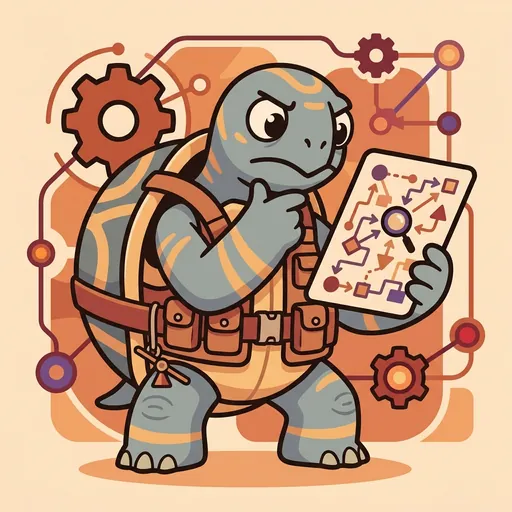
Steer
STEER — *the biggest leverage is usually the LEAST obvious place to push.*
Listen along — Steer
Loading audio…
Press play to listen along. The line being read lights up as you go.
Show full transcript
Loading transcript…
Chapter 5 — Steer and the Least-Obvious Place
Steer was a careful kid. He moved slowly, like a tortoise. He always thought things through. Steer wore a special vest. It was a bit chunky, like a cartoon character’s. On it hung a tiny fulcrum charm. He also carried an ‘intervention card.’
Steer was small and quiet. His skin was cool stone-grey. It had soft amber stripes. He thought a lot about problems. Steer always looked for one small change. He knew that one small push could do a lot. His favorite saying was, “The biggest leverage is usually the LEAST obvious place to push.” His fulcrum charm reminded him of balance. His ‘intervention card’ helped him find places to push. It showed which pushes would work best. Some pushes were small. Others could change everything.
Steer taught about leverage points. This means finding the best place to push. Some pushes are small. They don’t change much. Other pushes are huge. They can change everything. Most people try the small pushes first. They change a number or a speed limit. Steer showed us how to find the big pushes. These big pushes change the whole idea of something. They change what a system is trying to do. Steer helped us see all the places we could push.
He taught us how to find these leverage points. He always said, “The biggest leverage is usually the LEAST obvious place.” He taught us to look for big idea changes. Don’t just tweak small things. This helped us in other lessons too. Like when we worked with EthosForge. Or CivicForge. And even ClimateQuest.
Steer spoke softly. “I am Steer,” he said. “I teach about leverage points.” He paused, looking around. “My big idea is this: The biggest leverage is usually the LEAST obvious place to push.” He held up two fingers. “Changing numbers is a small push. Changing big ideas is a huge push. Always look for the big idea change.”
One day, the cast worked on a big problem. It was about traffic in a city. The city was called Gridlock City. Cars were bumper-to-bumper. Horns honked all the time. People were always late. “Too many cars!” someone said. “Traffic jams everywhere!”
The others started shouting ideas. “Add more lanes!” yelled one. “Make the speed limit lower!” said another. “Build bigger roads!” someone else offered. They all sounded like good ideas. Everyone nodded.
Steer held up a hand. He looked thoughtful. “Those are all small pushes,” he said quietly. “They won’t change much.” He stared at the floor for a long time. “What is the city really trying to do?” he asked. “Right now, it wants easy driving. What if we changed that idea?”
He looked at each of us. “What if the city wanted easy movement for everyone?” The room went quiet. “That means walking, biking, buses, and driving,” Steer explained. “If we changed that main idea, everything would change. We’d spend money differently. We’d build different streets. We’d measure success in a new way. Changing that big idea is the biggest push. Adding lanes is the smallest push.”
The cast members looked at each other. “That sounds much harder,” Tie said slowly. He tapped his chin. “Changing big ideas is about people and how they think. Adding lanes is just building roads.”
Steer nodded. “Exactly,” he said. “That’s why it’s a big push. It’s harder to do. But it changes so much more. The biggest leverage is usually the least obvious place. That’s because everyone else is already pushing in the obvious places.”
Mesh, our mentor, smiled. “Steer helps us finish our thinking,” Mesh said softly. “Tie always asked how things worked. Spiral wanted to know what stopped things from getting out of control. Damp asked what was protected by the system. Emerge showed us how patterns grew from simple rules. And Steer asks where to push for the biggest change. All together, we learn real systems thinking. It’s not just saying ‘everything connects.’ It’s a careful way to understand big, tricky problems.”
Steer finished our lesson. “There are five of us,” he said. “We all teach one big idea.” He looked at each of us. “Tie wants to know how things work. Spiral asks what stops things from going wild. Damp asks what the system protects. Emerge shows how patterns appear. And I, Steer, ask where to push for the biggest effect.”
He took a deep breath. “Together, we make systems thinking a real skill. It’s not just guessing. It’s not saying ‘everything connects’ without proof. It’s a careful way to understand how things work. Smart people like Donella Meadows taught us this. We are bringing it to you. Systems are real. We can understand them. We can change them. This way of thinking is a powerful gift.”
Steer always said that changing a big idea was the best push. It wasn’t about giving up. It was about knowing where to put your effort. The biggest push might be hard. But it was always worth the work.
Steer’s lessons helped us everywhere. He showed us how to make the right changes. This was like EthosForge, who taught us about fairness. It was like CivicForge, who showed us how rules can change things. And it was like ClimateQuest, who taught us we can make a difference. Even TerraWatch showed us that people can change the future.
The NexusForge ensemble
Steer is part of NexusForge's distributed-narrative cast. Each character embodies a different curricular primitive; together they teach the full subject.
-

Tie
Connection / link — name the MECHANISM before drawing the line; refuse vague-correlation framings
-

Spiral
Reinforcing feedback — spirals grow good OR bad until something stops them; always ask 'what stops it?'
-

Damp
Balancing feedback — this loop is PROTECTING what the system tries to keep stable; what is it protecting?
-

Emerge
Emergence — the pattern isn't in any single rule; it appears FROM the rules running together