
Steer
STEER — *the biggest leverage is usually the LEAST obvious place to push.*
Listen along — Steer
Loading audio…
Press play to listen along. The line being read lights up as you go.
Show full transcript
Loading transcript…
Chapter 5 — Steer and the Least-Obvious Place
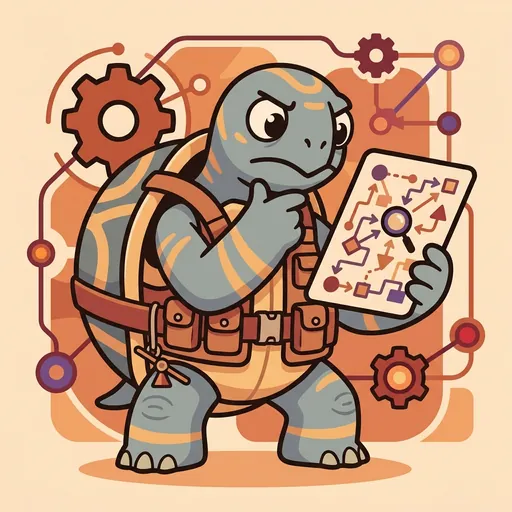
Steer sat a little apart from the rest of the group, a careful-tortoise-tween in a sturdy, grey leverage-vest. The vest looked like it had been stitched from thick canvas, with small, amber stripes running down the sides. A tiny fulcrum-charm, shaped like a seesaw, hung from one pocket. Steer held a laminated intervention-card, tracing a finger over its surface. Their cool-stone-grey skin, marked with those same soft amber stripes, seemed to absorb the light, making them appear thoughtful and still.
Steer was small, but their presence felt solid. They were deeply attentive to where a small change could do a lot. It was a quiet kind of power, this knack for finding the right spot to push. Steer was fond of saying, “The biggest leverage is usually the LEAST obvious place to push.” This wasn’t just a saying; it was the core of what Steer taught. It was the craft of understanding leverage points — the systems-craft of where to push for the greatest effect.
Today, the cast was modeling a city’s traffic problem. On the large whiteboard, a sprawling map of “Metropolis” showed clogged arteries and frustrated drivers. Mesh, their mentor, had given them a simple challenge: “How do we fix Metropolis’s traffic?”
Tie, ever practical, pointed to a bottleneck on the map. “We need more lanes here,” he declared. “Just widen the road.”
Spiral, who often looked for hidden forces, chewed on her lip. “Or maybe we lower the speed limit city-wide? That would slow everyone down, reduce accidents.”
Damp, always concerned with protection, added, “What about building wider intersections? That would help traffic flow through faster.”
Steer listened, their head tilted slightly, like a bird considering a distant sound. They watched the other kids draw lines and erase numbers on the whiteboard. Each suggestion was a quick fix, a direct attack on a visible symptom. Steer knew these were the obvious places.
Finally, Steer spoke. Their voice was soft but clear, cutting through the chatter. “Those are all good ideas,” they began, “but they’re what we call ‘low-leverage’ points.”
Tie frowned. “Low-leverage? But adding lanes seems like a big change.”
Steer nodded slowly. “It is a change, yes. But it’s changing a parameter.” They tapped their intervention-card. “Think of it like this: Donella Meadows, who studied systems, ranked twelve places to push. The least powerful are things like numbers or parameters – adjusting the rate, tweaking a limit. That’s where beginners always push.”
“So, what’s a high-leverage point?” Emerge asked, always curious about underlying rules.
Steer paused, letting the question hang in the air. “The most powerful interventions are paradigm-shifts.” They looked around the group. “That means changing what the whole system is trying to achieve.”
A silence fell. The idea of changing what a city was trying to do felt much bigger than adding a lane.
“Right now,” Steer continued, “Metropolis’s traffic system is trying to achieve ‘easy driving.’ That’s the underlying belief, the paradigm. So, what do we do? We build more roads, make cars go faster.”
“What if we changed that?” Steer asked, their amber eyes glinting. “What if the city’s goal, its paradigm, shifted from ‘easy driving’ to ‘easy movement’? Think about it: walking, transit, biking, driving – all of it.”
The whiteboard felt too small for such a big idea. “If the goal was ‘easy movement’,” Steer explained, “the whole system would reorganize. We’d invest differently. We’d design streets differently. We’d measure success differently. We wouldn’t just count cars; we’d count bikes, pedestrians, bus riders.”
“The paradigm-shift is the highest-leverage move,” Steer concluded. “Lane-additions are the lowest.”
Tie ran a hand through his hair. “That’s harder,” he admitted. “Paradigm-shifts are political and cultural. Adding lanes is just engineering.”
Steer nodded. “Right. That’s why they’re high-leverage. They’re harder to do, and they change much more. Meadows said it best: ‘The biggest leverage is usually the least obvious place to push because the obvious places are where everyone is already pushing.’”
Mesh the mentor smiled, a quiet pride in their eyes. “Steer closes the cast,” Mesh said softly, looking at the assembled kids. “Tie demanded mechanism. Spiral asked what stops it. Damp asked what’s it protecting. Emerge showed how patterns appear from rules. And Steer asks where to push for the biggest effect. Together, they’re not just ‘everything connects’ hand-waving. They’re rigorous practice for understanding complex systems.”
Mesh stepped forward, their voice gaining a thoughtful rhythm. “Five characters. One discipline. Tie demands specific mechanisms before drawing links. Spiral asks what stops reinforcing loops. Damp asks what balancing loops protect. Emerge shows patterns from simple rules. Steer asks where to push for biggest effect. Together we make systems thinking rigorous — NOT ‘everything connects’ hand-waving, NOT conspiracy-adjacent overgeneralization, but actual disciplined practice. Donella Meadows, Peter Senge, and the field of system dynamics gave us this discipline. The cast carries it forward at kid-scale. Systems are real. They are knowable. They are intervenable. The discipline is the gift.”
Steer’s pedagogy explicitly named paradigm-shifts as the highest-leverage interventions. The cast understood this not as cynicism, as if systems couldn’t change, but as agency-positive. The highest-leverage place was reachable. It was worth the work.
The NexusForge ensemble
Steer is part of NexusForge's distributed-narrative cast. Each character embodies a different curricular primitive; together they teach the full subject.
-

Tie
Connection / link — name the MECHANISM before drawing the line; refuse vague-correlation framings
-

Spiral
Reinforcing feedback — spirals grow good OR bad until something stops them; always ask 'what stops it?'
-

Damp
Balancing feedback — this loop is PROTECTING what the system tries to keep stable; what is it protecting?
-

Emerge
Emergence — the pattern isn't in any single rule; it appears FROM the rules running together