
Tie
TIE — what EXACTLY does this one do to that one?
Listen along — Tie
Loading audio…
Press play to listen along. The line being read lights up as you go.
Show full transcript
Loading transcript…
Chapter 1 — Tie and the Exact-Mechanism Question
Tie stood in front of the big forest drawing and would not let anyone draw the arrow.
The whole cast had spent the morning sketching a model of a woodland on the huge paper wall — trees, deer, wolves, rivers, all of it. Spiral, quick as ever, grabbed a marker and swept a bold line from the wolves straight across to the trees. “There. Wolves affect trees. Done.”
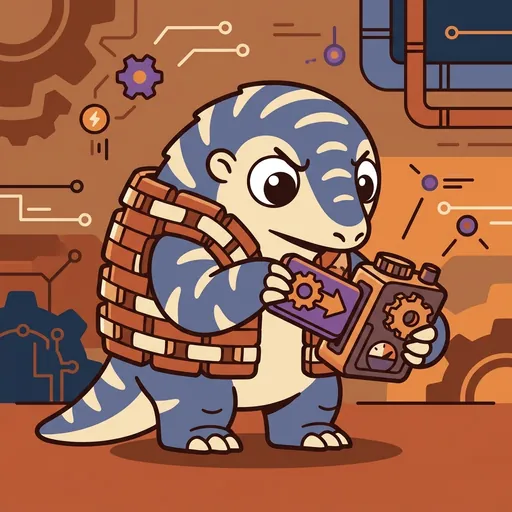
Tie, a small careful pangolin-tween in a soft blue vest, held up one paw. Not to stop the fun. Just to slow it down. “Wait,” she said. “How?”
“How what?”
“How do the wolves get all the way over to the trees? Show me the steps.” Tie tapped the empty space the arrow had jumped across. “You skipped everything in the middle.”
Spiral frowned at the marker, then at the wall. “Well — wolves eat deer.”
“Good. That’s a step.” Tie drew a small neat line: wolves → fewer deer.
“And deer eat the little baby trees.”
“Another step.” Fewer deer → fewer saplings eaten.
“So more baby trees survive. More trees grow up.” Spiral’s eyes widened.
“Now draw your line,” Tie said, and she let Spiral finish it. Three short arrows, each one a real thing happening to a real thing. “Before, you had wolves and trees with a big magic gap in between. Now you have a chain. Every link named. That,” she said, capping the marker, “is the difference between understanding a forest and just guessing about one.”
Tie had learned to ask how the hard way, in a place where everybody was very sure and nobody could explain anything.
When she was small, her whole burrow-village loved a good story. Someone would say, “The moths came because the moon was full,” and everyone would nod, satisfied, and move on. It sounded true. It felt true. And for a long time Tie nodded along too, because the nodding felt warm and belonging felt good.
But one evening she asked, quietly, “How does the moon make the moths come, though?” — and the whole room went sideways. People got annoyed. “It just does. Everything’s connected.” And that answer landed in her chest like a stone. Because it wasn’t an answer at all. It was a door slammed shut with a smile on it.
She went outside and sat in the dark, feeling small and a little bit lonely, turning it over. Everything’s connected was supposed to sound wise. But it explained nothing. It could be stretched over anything. If everything explains everything, then nothing really explains anything.
And then, sitting under the actual moon, she felt the loneliness turn into something sturdier. A quiet, stubborn certainty. She didn’t want the warm nod. She wanted the steps. She wanted to be able to say: this, then this, then this — and point to each one. That night she decided she would rather ask the awkward how forever than pretend a magic gap was an answer.
She walked to NexusForge when she was twelve, because it was a place that studied how things fit together — and she wanted to find out if it studied them carefully or just hopefully.
Mesh, the mentor who ran the modeling hall, met her at the door. Mesh did not ask her to prove she was clever. Mesh pointed at a chalkboard where someone had written STRESS → BAD SLEEP with a fat arrow between them, and asked, “Is that true?”
Tie looked at it a long moment. “Maybe. But I can’t tell yet. There’s a gap.” She picked up the chalk. “Stress makes your mind race at night. A racing mind keeps you awake. Staying awake means less sleep.” She wrote each step small, in a row, filling the gap. “Now I can check it. Each piece is something you could actually watch happen. If one piece is wrong, I’ll know which one.”
Mesh studied the little chain of steps for a while. “Most people,” Mesh said, “would have just told me the arrow was right.”
“The arrow might be right,” Tie said. “I just won’t draw it until I can walk across it.”
Mesh smiled. “You belong here.”
Tie’s corner of the hall was full of half-finished models, and one afternoon a boy came in dragging his feet, holding a worksheet like it had insulted him.
“I have to explain why the fish are disappearing from the pond,” he grumbled. “So I wrote ‘pollution.’ And my teacher wrote ‘HOW?’ with a big circle around it. What does she even want?”
Tie knew that stuck, caught-out feeling. She’d felt it in a dark burrow years ago. “She wants the middle,” Tie said gently. “You jumped from pollution all the way to no fish. Let’s find the steps.” She slid a blank page over. “What does pollution actually do when it lands in the water?”
He thought. “It… feeds the algae? Too much algae?”
“That’s a step. Write it.” He did. “And when the algae goes wild — what happens to the water?”
“It uses up… the oxygen?” He was leaning in now.
“Keep going.”
“And fish need oxygen. So if there’s no oxygen —” His face lit. “The fish can’t breathe. That’s why they’re gone.”
“Look at that.” Tie tapped the row he’d built. “Pollution, then too much algae, then no oxygen, then fish can’t breathe. Four steps. Each one a real thing. You didn’t have a reason before — you had a word. Now you have a chain nobody can knock over, because you can point at every link.”
The boy stared at his own page like it had grown. “It’s the same word I wrote before.”
“But now you can walk it,” Tie said. “Anybody can shout a word. The move is smaller and harder than that. You just ask, every single time: what exactly does this one do to that one? And you don’t draw the line until you can say.”
The boy packed up slowly, and at the door he turned back with a quieter question.
“When everybody’s already agreeing,” he said, “and I’m the only one asking how — doesn’t it feel kind of rude? Or dumb?”
Tie remembered the burrow. The warm nods. The stone in her chest. “It feels lonely for about a minute,” she said honestly. “And then it feels like solid ground under your feet.” She looked at his four little steps. “Being the one who asks how isn’t the person who ruins the story. It’s the person who makes the story true. That’s not rude. That’s the most careful kind of kindness there is.”
He nodded and went out into the afternoon. Tie sat a while with the empty models around her, and felt it settle in her chest — not the loneliness she’d braced for, but that sturdy, quiet calm. The steady, warm certainty of someone who no longer has to pretend the gap is an answer.
The NexusForge ensemble
Tie is part of NexusForge's distributed-narrative cast. Each character embodies a different curricular primitive; together they teach the full subject.
-
Spiral
Reinforcing feedback — spirals grow good OR bad until something stops them; always ask 'what stops it?'
-

Damp
Balancing feedback — this loop is PROTECTING what the system tries to keep stable; what is it protecting?
-

Emerge
Emergence — the pattern isn't in any single rule; it appears FROM the rules running together
-
Steer
Leverage points — the biggest leverage is usually the LEAST obvious place to push (Meadows)