
Grow
GROW — the patient math of money over time. interest on interest.
Listen along — Grow
Loading audio…
Press play to listen along. The line being read lights up as you go.
Show full transcript
Loading transcript…
Chapter 3 — Grow and the Slow Magic of Time
In the corner of the MintForge courtyard, a small tree-frog perched on the rim of a clay jar, watching a single coin at the bottom the way other people watched sunsets.
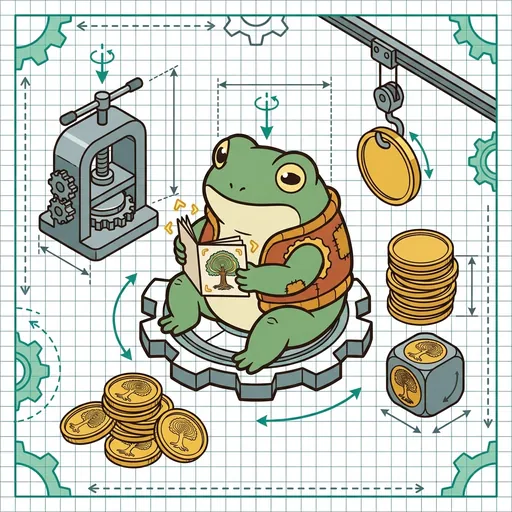
Grow was warm leaf-green with a cream belly, and she wore a little savings-vest with pockets she rarely used. She had a card tucked under one arm — a drawing of a tree, its rings numbered — but right now she wasn’t drawing. She was just waiting.
A girl leaned over the jar. “That’s it? One coin? You’ve been sitting here all morning for one coin?”
“Watch,” Grow said, and dropped a second coin in. Tink. Then she wrote a tiny number beside the first ring on her tree-card. “Now come back tomorrow.”
The girl came back the next day, and the day after, and by the end of the week the jar had a small heap in it — more than the days should have added up to.
“You’ve been sneaking extra in,” the girl accused.
“I haven’t touched it except to add what it earned.” Grow tilted the jar so the light caught the pile. “Every day the jar pays a little for holding the coins. And then — this is the part everyone misses — the next day it pays on the bigger pile, including yesterday’s pay. The growing thing keeps growing off itself.” She grinned, slow and green. “Interest on interest. Patience is the secret pigment.”
The girl stared into the jar like it had done a trick. It sort of had.
Grow learned it long before she had words for it.
She hatched in the savings-tree village, one of hundreds of eggs in a jelly ribbon along a still pond. She was a speck, then a tadpole, then a lumpy froglet with a stub of tail she kept tripping on. It took years. She remembered a summer when nothing about her seemed to change at all — same pond, same reeds, same small body — and she’d felt a hot, itchy frustration, like she was stuck being unfinished forever.
Her great-aunt, an old frog who had lived through more seasons than anyone could count, found her sulking under a lily pad.
“You feel like nothing’s happening,” the great-aunt said. It wasn’t a question.
Grow nodded, miserable.
“Come here.” The old frog pressed a wide, cool foot against Grow’s back. “Do you feel that? Under the skin. You’re building legs. Lungs. A whole new shape. It’s the slowest, biggest work there is, and it doesn’t show until it all shows at once.” She looked out at the still water. “The fast things spend themselves and are gone by winter. The slow things — the ones that grow off what they already grew — those become the trees the whole village sits under.”
Grow didn’t turn into a frog that afternoon. But the stuck, itchy feeling changed. It wasn’t nothing happening. It was everything happening, quietly, underneath. That was a feeling she could sit with.
She walked to MintForge at twelve, because a place that studied money ought to understand the kind that grows the slow way.
Penny, the mentor who ran the courtyard, met her at the gate. She didn’t ask Grow to prove she was clever. She asked one thing. “What happens to a saved coin, given enough time?”
Grow didn’t answer with a speech. She borrowed two jars. In the first she dropped a coin, and beside it wrote plus five, every year, on the first coin only. In the second she dropped a coin too — but wrote plus five on whatever’s in the jar now. She lined them up on the wall where the sun would track across them.
“The first one adds the same little bit forever,” Grow said. “The second one adds a little bit more every time, because there’s more in the jar to grow from. Give them ten years and the second jar leaves the first one behind. Give them thirty and it isn’t even close.”
Penny looked at the two jars a long moment. “You belong here,” she said.
Grow’s workshop filled up, over time, with people who felt behind.
A boy came in one afternoon and slumped onto the bench. “I’ve been saving a dollar a week since spring,” he said. “It’s barely anything. My cousin spends way more than me and it feels like he’s got a fortune.” He pushed his little tin across the bench. “Feels like I’m doing all this waiting for nothing.”
Grow knew that slump. She’d felt it under the lily pad.
She set her tree-card in front of him instead of the tin. “Put your finger on the first ring.” He did. “That’s this year. Small, right? Now trace out.” His finger followed the rings — and they weren’t evenly spaced. Each one sat farther from the last than the one before it.
“Why do they spread out?” he asked.
“Because each year’s growth adds to the trunk, and next year grows off the bigger trunk. The tree doesn’t grow the same each year. It grows more.” She tapped the outer rings, where they raced apart. “Your first years feel slow because you’re near the middle, where the rings are tight. That’s the hardest part — trusting the curve before it starts to open up.” She slid the tin back to him. “Your cousin’s spending is a fast thing. It’s loud now and gone by winter. Yours is a slow thing. Keep feeding it and one day it grows faster than you can, all on its own.”
The boy turned the tin over in his hands. “So it’s not nothing.”
“It’s the opposite of nothing. It’s just early.” She smiled. “Small, plus time, plus a little patience — that’s bigger than almost anyone expects.”
Later, when the courtyard was empty and the sun had crossed both jars, the boy came back with one quieter question.
“When it’s growing so slow you can’t even see it,” he said, “how do you know it’s working?”
Grow thought about the still pond. About the itchy summer and the cool foot against her back and everything happening underneath where she couldn’t watch it.
“You mostly can’t see it,” she admitted. “Not for a while. That’s the honest part. There’s this stretch where you keep putting the coin in and nothing looks different, and it takes a kind of quiet faith to keep going.” She looked toward the wall where her tree-card hung. “But the growing is real even when it’s invisible. Every bit you add stays in and starts pulling its own weight. And then one season — later than you’d like, sooner than you fear — you look in the jar, and it’s more than you ever put there.”
The boy nodded slowly, and Grow watched the tight, behind feeling ease off his shoulders — the same way, years ago, hers had loosened under the lily pad.
She didn’t say the rest out loud, but she felt it, warm and green and certain: the slow, unfinished-feeling stretches are the ones already doing the deepest work. You just have to stay gentle with yourself long enough to let them.
The MintForge ensemble
Grow is part of MintForge's distributed-narrative cast. Each character embodies a different curricular primitive; together they teach the full subject.
-

Coin
Currency + exchange — what money is, what it does, what it can't measure
-

Tag
Percentage + markup — the transparent math of how prices are built
-

Plan
Budget allocation + opportunity cost — the math of choosing with limited resources
-

Tilt
Risk + variability — the math of uncertain outcomes, distributions over destinies