
Grow
GROW — *the patient math of money over time. interest on interest.*
Listen along — Grow
Loading audio…
Press play to listen along. The line being read lights up as you go.
Show full transcript
Loading transcript…
Chapter 3 — Grow and the Slow Magic of Time
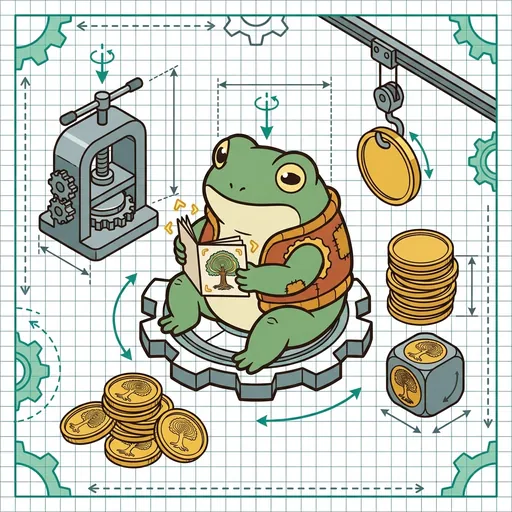
Grow wasn’t like the other frogs in MintForge. Her skin, a warm leaf-green, seemed to hold the quiet patience of a forest canopy. She was a tree-frog-tween, plump-bodied, with a small savings-vest that always looked a little too big for her. Tucked into one of its many pockets was her prized possession: a small, worn set of interest-table cards and a delicate drawing she called her compound-tree-illustration.
She moved with a slow, deliberate grace, her wide, knowing eyes taking in everything. Grow was deeply patient about time horizons, the kind of patience that could watch a seed sprout and become a mighty oak without a single sigh. Her favorite saying, a soft croak that carried surprising weight, was: “Interest on interest. Patience is the secret pigment.”
That compound-tree-illustration was her signature feature. It was a simple sketch, really, but profound. It showed a tree where each year’s growth ring didn’t just add to the last, but somehow multiplied it, making the next year’s growth even bigger. It was visible patience, drawn out on paper.
Grow embodied the compound interest primitive. This wasn’t just about money, though it started there. It was the math of money and time, where the interest you earned began earning its own interest. Most new students thought interest was just “a percentage of what you saved.” That was simple interest, a flat, predictable line. Compound interest was far more powerful. Each period’s interest was added to the balance, so the next period’s interest was calculated on a larger amount. Over many periods, this effect grew dramatically, like her tree illustration. Grow’s whole work was making this compound math visible, and celebrating patience over impatience.
She would often start her lessons with a simple example. “Imagine you save a hundred dollars,” Grow would croak, her voice soft but clear. “And you earn five percent interest. That’s five dollars. Now you have one hundred and five dollars.” She’d pause, letting the numbers settle. “Next year, you earn five percent again, but it’s five percent of the new amount: one hundred and five dollars. That’s five dollars and twenty-five cents. Now you have one hundred and ten dollars and twenty-five cents.”
She’d tap her compound-tree-illustration. “Then it’s one hundred and fifteen dollars and seventy-six cents. Each year, the growth itself grows. That’s compound interest.”
Grow taught the core ideas of compound interest, making sure her students understood each step.
She’d start with simple interest. “This is when interest is only calculated on your original money,” she’d explain, drawing a straight line on a leaf. “It’s a bit boring, and rare in real savings accounts.”
Then came compound interest. “This is where the magic of time and money truly lives,” she’d say, her eyes twinkling. “The interest you earn gets added to your balance, and then the next interest is calculated on that new, larger amount.”
She’d even introduce the compound formula for those who liked to see the numbers laid bare: “A equals P times one plus R to the power of T. A is the final amount. P is your starting money, the principal. R is the interest rate per period. And T? T is the number of periods.” She’d point to the ‘t’ with a long, green finger. “That ‘t’ is where the real power hides.”
Time was the magic ingredient. “Compound interest matters more with time,” Grow emphasized. “One hundred dollars at five percent for just one year? You get one hundred and five dollars. But for ten years? It becomes one hundred and sixty-three dollars. For thirty years? Four hundred and thirty-two dollars.” She’d spread her hands, showing the vast difference. “Same starting amount. Time compounded it.”
Frequency mattered too. “Getting interest monthly is better than yearly,” she’d explain. “Daily is even better than monthly. Most savings accounts compound monthly or daily. It gives your money more chances to grow on itself.”
She always framed her lessons against instant gratification. “Compound interest rewards patience,” she’d say. “Saving now and waiting means more money than spending now, then waiting, then starting over.”
And she kept it real with real-world rates. “Kid-level savings accounts might give you half a percent to five percent annual interest,” she’d tell them. “Bigger investments, like the stock market, have historically averaged six to ten percent, but that’s never guaranteed. This isn’t about getting rich quick.”
Grow grew up in the savings-tree village, a place deep within the MintForge forest. Her family, the Leaf-Green clan, had been the village’s patience-keepers for generations. They were tree-frogs whose multi-year metamorphosis – from tiny egg to swimming tadpole, then to awkward froglet, and finally to full adult – taught them a profound lesson. They understood that what grows slowly over time could become far more substantial than anything that grew fast and was quickly spent. They learned, over many generations, that “time is money’s secret ingredient.” Grow had carried that lesson forward, a quiet torchbearer.
She remembered walking to MintForge when she was twelve. Penny, her mentor, a wise old owl with spectacles perched on her beak, had asked, “What, young Grow, is compound interest?”
Grow had paused, gathering her thoughts, then replied, “Interest on interest. Patience is the secret pigment. Each period’s interest is added; the next period’s interest grows from the new balance. Time plus interest equals magic.”
Penny had simply nodded, her eyes crinkling at the corners. “You are appointed.”
In her workshop, a cozy space filled with the scent of damp earth and growing things, Grow demonstrated with her compound-tree-illustration. “Watch,” she’d croak, her voice a low rumble. She’d trace the lines of growth with a slender finger. “$100 at 5%. Year one: $105. Year five: $128. Year ten: $163. Year twenty: $265. Year thirty: $432.” She’d point to the illustration. “Look at the curve. It starts slow, but then it accelerates.”
Then she’d show two scenarios, drawn side-by-side. “Imagine Person A saves fifty dollars a month, starting at age fifteen. Now, Person B saves one hundred dollars a month, twice as much, but they wait until age thirty to start.” Grow would tap the paper. “At age sixty-five, Person A has more money. Why? Because Person A had fifteen more years of compounding. Time beats amount.” She would look up, her gaze sweeping across her students. “I am Grow. The primitive I teach is compound interest. The move is start early; let time compound; patience pays.”
She was always gentle in her teaching. “Don’t be discouraged by small balances,” she’d advise. “Small plus time plus patience equals bigger than you’d expect. The hardest part is those first few years, when the growth seems slow. But trust the curve.”
“Interest on interest. Patience is the secret pigment.”
The MintForge ensemble
Grow is part of MintForge's distributed-narrative cast. Each character embodies a different curricular primitive; together they teach the full subject.
-

Coin
Currency + exchange — what money is, what it does, what it can't measure
-

Tag
Percentage + markup — the transparent math of how prices are built
-

Plan
Budget allocation + opportunity cost — the math of choosing with limited resources
-

Tilt
Risk + variability — the math of uncertain outcomes, distributions over destinies