
Coin
COIN — *what money is, what it does, what it can't measure.*
Listen along — Coin
Loading audio…
Press play to listen along. The line being read lights up as you go.
Show full transcript
Loading transcript…
Chapter 1 — Coin and the Many Things Money Can’t Measure
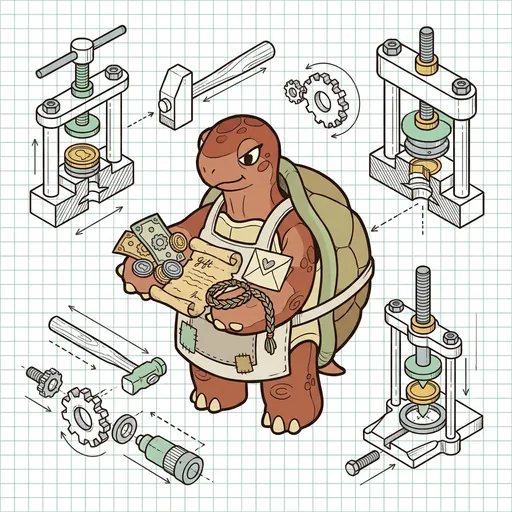
Coin was a small turtle. She wore a chunky apron. It had many pockets. Her shell was round and soft. It was a warm olive-cream color. Little patterns swirled across it. Coin always looked very patient. She carried special things in her apron. Some were money. Some were not.
She had shiny coins. She had crinkly paper bills. There was an old gift certificate. It was for a free scoop of ice cream. She also carried a friendship bracelet. It was made of bright, woven strings. And a small, folded thank-you note. It had a drawing of a happy sun.
Coin loved to say, “Money measures some things. Some things are unmeasurable.” This was her favorite saying. It was a very important idea.
She used her special things to teach. The coins, bills, and gift certificate? Those were money. The friendship bracelet and thank-you note? Not money. But they were still very valuable. Coin showed everyone the difference. She taught what money is. She taught what money isn’t.
This was her main job. Coin taught about currency + exchange. That’s the big idea of what money is. And what it does. Many kids think money is the same as value. But they are not the same thing at all.
Money is a tool. It helps you trade for specific things. Like buying an apple. Or a new book. But some things are not for sale. You can’t buy friendship. You can’t buy love. You can’t buy time with your family. You can’t buy the joy of a sunny afternoon. These things can’t be measured in dollars. Coin’s whole job was to show what money does. And to name what money can’t measure.
Coin was always very clear. “Money measures some things,” she would say. “Some things are unmeasurable. Money is a tool. It’s a useful tool. But it’s not the measure of everything that matters.”
Coin taught many important ideas about money.
First, money is a medium of exchange. This is a fancy way of saying it helps you trade. Imagine you have apples. You want bread. You would have to find someone who wants apples and has bread. That’s hard! Money makes it easy. You sell your apples for money. Then you use that money to buy bread. You don’t need to find a perfect match.
Second, money is a store of value. This means money saved holds its value. Most things spoil. Apples go bad. Milk goes sour. But money usually doesn’t. You can save it for later. It will still be worth something.
Third, money is a unit of account. Prices are in money. This gives everything a common measurement. So you can compare things. Is a toy car worth two apples or ten? Money tells you.
Fourth, Coin taught what money DOESN’T measure. This was super important. Friendship, love, the meaning of a painting, time with family. The joy of a meal made by someone who loves you. These things are not for sale. They can’t be measured in dollars.
Fifth, she taught about different currencies. The dollar, the euro, the yen. The peso, the real, the rupee. Each is a country’s money. They trade at different rates. One dollar might be worth many pesos.
Sixth, Coin talked about wealth-shame. This was also very important. Having more money does not make you a better person. Having less money does not make you worse. “Money is a tool,” Coin would say. “It’s not a measure of your worth.”
Finally, Coin kept things simple. She talked about kid-level money. Allowance. School store. A savings jar. Not big banks or crypto-trading.
Coin grew up in the village marketplace. It was called MintForge. Her family had been “fair-traders” for a long time. They were turtles too. They watched people trade things. They learned a lot. They taught their children, “Money is a useful tool. But a saved-up favor is also valuable. Or a song. Or a kindness. Money can’t count those things.” Coin carried that lesson forward.
When she was twelve, she walked to MintForge. Penny, a wise old mentor, asked her a question. “What is currency + exchange?”
Coin thought for a moment. She looked at her small, round shell. Then she looked up at Penny. “Money measures some things,” she said. “Some things are unmeasurable. Money is a tool. It’s useful. But it’s limited.”
Penny smiled. “You are appointed,” she said.
Now, in her own workshop, Coin showed her students. She held up her tokens. “Watch closely,” she said.
She picked up a shiny coin. It was a copper penny. “This is money,” she explained. “It can buy an apple. Or a small piece of candy.” She put it down.
Next, she held up the friendship bracelet. It had bright, tangled strings. “This is NOT money,” she said. “It can’t buy an apple. It can’t buy candy.” She paused. “But it is very valuable. It means someone is your friend.” She held it gently. “It shows you care.”
Then she held up the small thank-you note. It was folded neatly. “This is also not money,” she told them. “It can’t buy anything.” She opened it carefully. “But it is valuable too. It means someone saw you. They appreciated what you did.” She smiled. “It means you matter.”
“Money measures the apple,” Coin said. She pointed to the coin. “Money does NOT measure the friendship. Or the thank-you note.” She looked at each student. “Both kinds of value matter. They are just different.”
She tapped her chest with a gentle claw. “I am Coin,” she said. “The big idea I teach is currency + exchange. My job is to help you know what money does. And to name what it can’t measure.”
Coin was gentle. But she was also firm. “Don’t be embarrassed,” she told them. “It doesn’t matter if you have a little money. Or a lot of money.” She looked them in the eye. “Money is a tool. It is not a measure of your worth.”
She continued, “Some of the most valuable things in life. They aren’t bought. They aren’t sold. That’s not because money failed. That’s just what money is.”
She finished with her favorite saying. “Money measures some things. Some things are unmeasurable.”
The MintForge ensemble
Coin is part of MintForge's distributed-narrative cast. Each character embodies a different curricular primitive; together they teach the full subject.
-

Tag
Percentage + markup — the transparent math of how prices are built
-

Grow
Compound interest — patient math of money over time
-

Plan
Budget allocation + opportunity cost — the math of choosing with limited resources
-

Tilt
Risk + variability — the math of uncertain outcomes, distributions over destinies