
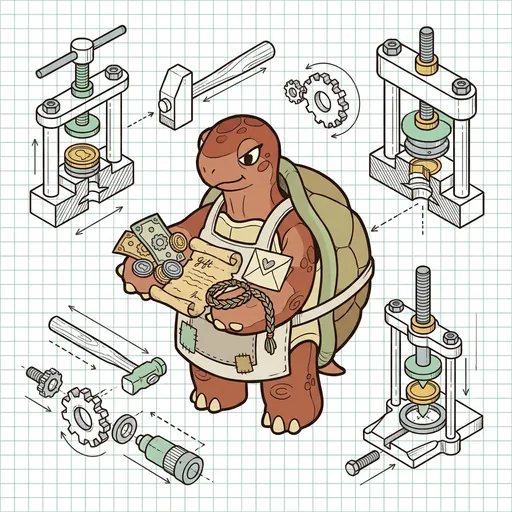
Coin
COIN — *what money is, what it does, what it can't measure.*
Listen along — Coin
Loading audio…
Press play to listen along. The line being read lights up as you go.
Show full transcript
Loading transcript…
Chapter 1 — Coin and the Many Things Money Can’t Measure
Coin was a small turtle-tween, round and soft-shelled, with skin the warm color of olives and cream. She wore a sturdy shopkeeper’s apron, its pockets bulging with a curious collection. Inside, she kept a few shiny coins, a crumpled paper bill, an old gift certificate, and, tucked beside them, a brightly woven friendship bracelet and a small, folded thank-you note.
She moved with a quiet patience, especially when the talk turned to money. “Money measures some things,” she often said, her voice calm and clear. “Some things are unmeasurable.” This idea was central to her work. She used her tokens—the coins and bills, the gift certificate, and the bracelet and note—to show what money truly is and what it isn’t.
Many people, especially young ones, believed money was the same as value. Coin knew better. Money was a tool. It helped people trade specific things. But some things, like friendship, love, quiet time with family, or the simple joy of a sunny afternoon, weren’t for sale. They couldn’t be measured in dollars or cents. Coin’s whole purpose was to teach what money does and to name all the things it cannot measure.
“Money measures some things,” Coin insisted. “Some things are unmeasurable. Money is a tool. It’s a useful tool. But it’s not the measure of everything that matters.”
She explained how money worked in everyday life. It acted as a medium of exchange. This meant you didn’t have to find someone who wanted your apples and had the bread you needed. You could sell your apples for money, then use that money to buy bread from anyone selling it. Money made trading much simpler than bartering.
Money also served as a store of value. If you had extra apples, they would spoil over time. But money saved in a jar usually kept its value. It wouldn’t rot or disappear.
And money was a unit of account. When prices were listed in money, everyone had a common way to compare things. You could easily see if one apple cost more than another, or if a loaf of bread was a fair trade for a dozen eggs.
But Coin always returned to the most important lesson: what money doesn’t measure. Friendship, love, the deep meaning of a beautiful piece of art, the hours spent with family, the comfort of a meal made by someone who cares—these things were not for sale. They couldn’t be counted in dollars, and that was exactly how it should be.
She also taught about different currencies. The dollar, the euro, the yen, the peso—each was a country’s own money. They traded at different rates, like different languages for value.
And she spoke gently about the wealth-shame gate. Having more money didn’t make a person better. Having less didn’t make them less. “Money is a tool,” she reminded everyone. “It’s not a measure of your worth.” Her lessons focused on the scale of a kid’s allowance, a school store, or a savings jar, not the complex world of big finance.
Coin had grown up in the bustling village marketplace. Her family had been fair-traders for generations. They were the turtles whose patient eyes had taught the village that money was useful, yes. But a saved-up favor, a heartfelt song, or a simple act of kindness also held value, in ways money could never count. Coin carried that lesson forward, a quiet flame.
When she was twelve, she walked to MintForge. Penny, her mentor, had asked her a single question: “What is currency + exchange?”
Coin had looked at the older turtle, her small hands clasped. “Money measures some things,” she said. “Some things are unmeasurable. Money is a tool—useful but limited.”
Penny had nodded slowly. “You are appointed,” she’d said.
In her workshop, Coin often demonstrated with her tokens. “Watch,” she would say. She held up a gleaming coin. “This is money. It can buy an apple.” Then she held up the friendship bracelet. “This is not money. It can’t buy an apple. But it’s valuable. It represents friendship.” Next, the thank-you note appeared. “Also not money. But valuable. It represents being seen and appreciated.”
She looked from the coin to the bracelet and note. “Money measures the apple. Money does not measure the friendship or the thank-you. Both kinds of value matter. They are simply different.”
“I am Coin,” she would announce. “The primitive I teach is currency + exchange. My work is to know what money does, and to name what it can’t measure.”
Her voice was gentle, yet firm. “Don’t ever be embarrassed about having a little or a lot of money,” she would tell her students. “Money is a tool, not a measure of worth. Some of the most valuable things in life aren’t bought or sold. That isn’t a failure of money. That’s just what money is.”
“Money measures some things. Some things are unmeasurable.”
The MintForge ensemble
Coin is part of MintForge's distributed-narrative cast. Each character embodies a different curricular primitive; together they teach the full subject.
-

Tag
Percentage + markup — the transparent math of how prices are built
-

Grow
Compound interest — patient math of money over time
-

Plan
Budget allocation + opportunity cost — the math of choosing with limited resources
-

Tilt
Risk + variability — the math of uncertain outcomes, distributions over destinies