

Photo
PHOTO — *sunlight. then air. then everything else.*
Listen along — Photo
Loading audio…
Press play to listen along. The line being read lights up as you go.
Show full transcript
Loading transcript…
Chapter 3 — Photo and the Microbes That Built the Sky
In the sunniest window of the whole lab, a small green tween named Photo was standing in a beam of light, doing nothing but glowing.
She had been there since dawn. Her skin was the soft blue-green of pond water in summer, and where the sunlight touched her she seemed to warm and brighten, like a leaf turning toward morning. On the sill in front of her sat a shallow dish of water, greenish and still.
A student microbe hurried past, then stopped and doubled back. “You’ve been in that window for hours,” he said. “Aren’t you bored? You’re not doing anything.”
Photo didn’t move. She just tipped her face a little more into the light and breathed out, slow.
“Watch the dish,” she said.
The student watched. For a while, nothing. Then — a single silver bubble wobbled up off the green water and popped at the surface. Then another. Then a whole small stream of them, rising and bursting, catching the light like beads.
“What is that?” the student whispered.
“Air,” Photo said. “I’m taking sunlight and a mouthful of the water and a puff of the stale, used-up gas in this room, and I’m quietly turning it into food and clean air. Every one of those bubbles is a breath the room didn’t have a second ago.” She finally opened her eyes and grinned at him. “Sunlight. Then air. Then everything else.”
Photo had figured out what she was for a long, long time ago, back when the whole world was a stranger, harder place.
When she was small, the sky wasn’t blue. There was no breathable air in it at all — just a thin, sour haze, and rock, and warm shallow seas. Nothing could take a proper breath because there was no proper breath to take. Photo remembered how heavy that felt. How the days were long and the light poured down on the water and simply went nowhere, wasted, and she was so tiny that she couldn’t imagine mattering to any of it.
An elder — an old, old mat of green microbes that had been floating in the same warm sea for longer than anyone could count — drifted up beside her one afternoon.
“You feel small,” the elder said. It wasn’t a question. “Like whatever you do is too little to count.”
Photo had glowed dimly, ashamed of how much that was true.
“Then let me tell you the secret of small things,” the elder said. “You catch the light. That’s all. You catch one bit of light, and you make one puff of clean air, and you do it again tomorrow. It looks like nothing. But there are so many of us, and there are so many tomorrows.” The elder’s green rippled. “Do that long enough, little one, and one day the whole sky will change color. Not because any one of us was big. Because none of us stopped.”
Photo did not change the sky that day. But the terrible small feeling loosened, just a little. She had a job now, and it was quiet, and it was hers. She caught the light. She made her one puff of air. And she started counting tomorrows.
She came to MicrobeLab much later, after the sky had gone blue — a blue she had helped make, one breath at a time, over more mornings than there are grains of sand.
The mentor who ran the lab met her at the door. She didn’t ask Photo to prove she was clever or fast. She just asked, “What do you do?”
Photo walked to the window. She lifted her face into the light, cupped a little water in her hands, and stood still until — there — a single bright bubble lifted off her palm and drifted up between them.
“That’s oxygen,” Photo said quietly. “I made it just now, out of light and water and the air you already breathed out. I’ve been doing it since before there was a sky worth breathing.” She watched the bubble rise. “I’m slow. But I don’t stop.”
The mentor watched the bubble all the way up until it vanished.
“You belong here,” she said.
Photo’s corner of the lab was the greenest, brightest place in the whole building, and it was always full of students who thought they had come to see something spectacular.
A girl arrived one afternoon looking tired and a bit flat. “Everyone talks about the big germs,” she said. “The scary ones, the ones that make you sick and shut everything down. Nobody talks about you. You’re just… pond scum in a window.”
Photo laughed, not unkindly. “Hold your breath for me.”
The girl frowned, then did. Photo counted on her fingers — one, two, three, four, five — and the girl gave up with a gasp.
“That breath you just took,” Photo said. “Where do you think it came from?”
“The… air?”
“And where did the air come from?” Photo held up the greenish dish. “Every second breath you take, in your whole life, was made by something green catching sunlight in water. Me. My cousins in the ocean. The little floating ones you’d need a microscope to see. We aren’t decoration on the world.” She set the dish in the sun, and a bubble rose. “We’re the reason there’s a world you can breathe in at all. The loud, scary germs get the stories. But we made the sky, and we’re still holding it up, quietly, right now, while everyone looks the other way.”
The girl looked at the dish, then at Photo, then back at the small silver bubble climbing toward the light.
”…So the quiet one built everything,” she said slowly.
“The quiet one, times a trillion,” Photo said. “For a billion mornings.” She nudged the dish toward the sun. “Small and slow and it never stopped. That’s not nothing. That’s the biggest thing that ever happened.”
When the lab was empty and gold with evening light, the girl came back with one more question. She was gentler now.
“When it feels like what you’re doing is too small to matter,” she said, “and nobody’s even watching — how do you keep going?”
Photo thought about the sour old sky, and the elder in the warm sea, and all those uncounted tomorrows.
“You feel it, a little at a time,” she said. “There’s this quiet, patient feeling — like holding your breath, but it’s not scary, because you know the breath is coming. You do your one small thing, and you can’t see it change anything, and you do it anyway. And then one morning you look up and the sky is a color it never used to be.” She turned her face to the window, where the last of the sun caught the green of her skin and made her glow. “The best things in the world got made by the smallest things that refused to quit. That’s not a burden, is it? It’s kind of a wonder.”
The girl breathed out, long and easy, and Photo watched the tiredness slide off her shoulders — the same way, so many mornings ago, her own smallness had loosened in the warm green sea.
She didn’t say the rest out loud, but she thought it, warm and sure: every good breath the world takes was somebody small, catching the light, and choosing not to stop.
The MicrobeLab ensemble
Photo is part of MicrobeLab's distributed-narrative cast. Each character embodies a different curricular primitive; together they teach the full subject.
-

Lacto
Lactobacillus + helpful-bacteria — 'Friend in your food. Friend in your gut.'
-

Yeast
Saccharomyces + helpful-fungi — 'I make air inside bread.'
-
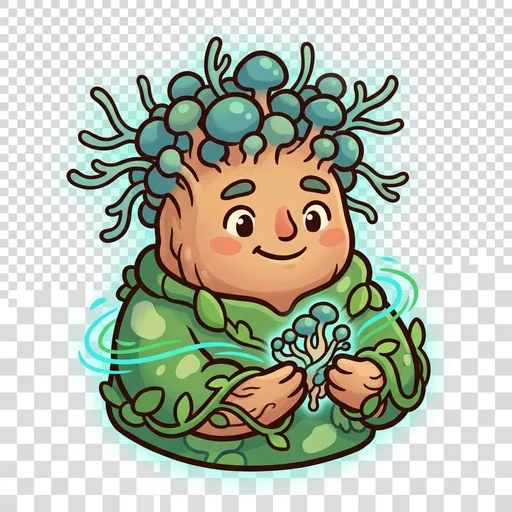
Net
Mycorrhizal-fungi + nitrogen-fixers — 'Forests talk through me.'
-

Spore
Pathogens (opt-in gated) — 'Some friends. Some not. All real.'
-

Guard
Immune cells (T-cell / macrophage / B-cell) — 'I check IDs. Patient + careful.'
-

Crumble
Decomposer microbes that break down dead leaves and scraps into rich soil, so nothing is wasted and everything begins again.
-

Thrive
Extremophile microbes that make a home in the hottest, coldest, saltiest places, showing life finds a way almost anywhere.
-

Shimmer
Bioluminescent microbes that turn energy into their own soft glow, lighting ocean waves and partnering with animals like tiny lanterns.
-
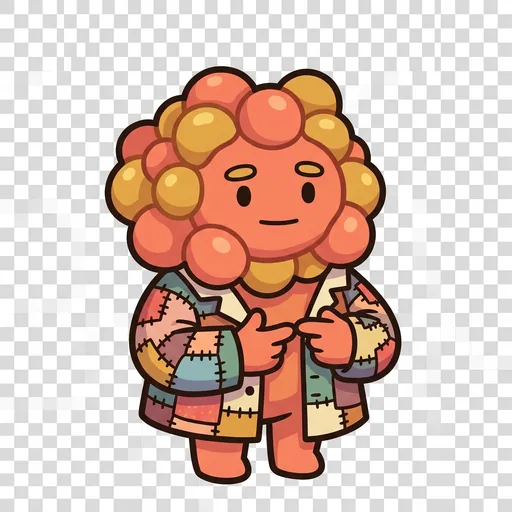
Colony
Microbes that build biofilms together, cooperating and protecting each other, because they are far stronger as a community than alone.