
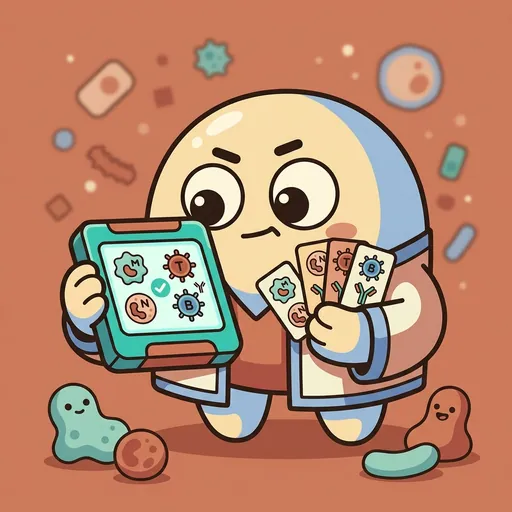
Guard
GUARD — I check IDs. Patient + careful.
Listen along — Guard
Loading audio…
Press play to listen along. The line being read lights up as you go.
Show full transcript
Loading transcript…
Chapter 6 — Guard and the ID-Checking System Inside You
At the front gate of a warm, crowded city — a city that happened to be the inside of a person — a small round creature named Guard stood very still and looked at everyone who went past.
She wasn’t stopping anyone. She wasn’t shouting. She just watched, tilting her head at each traveler, holding up a little card and checking it against a card they carried. Most travelers had matching cards. She waved those through with a small nod. They were the city’s own — skin cells, gut cells, blood cells, all going about their business.
Then a stranger came through with no card at all.
Guard didn’t panic. She stepped in front of it, calm as anything, and looked closer. The stranger was lumpy and wrong-smelling, the kind of thing that didn’t belong in a body. Guard opened her wide soft mouth and simply swallowed it whole, the way you might scoop a bug out of a swimming pool. Then she went back to her post, straightened her card, and kept watching.
A younger creature bobbing beside her looked horrified. “You just ate that!”
“It didn’t have an ID,” Guard said. “Everyone here carries one that says self. That thing said not-self. So — gone.” She patted her round belly. “Patient and careful. That’s the whole job. I don’t chase everything that moves. I check IDs.”
“But how do you know you got the right one?”
Guard smiled a small tired smile. “That,” she said, “is the question that took me my whole childhood to answer.”
Guard had frozen, once, when she was small.
She’d been posted at a busy crossing where thousands of travelers streamed past every second, and she had wanted so badly to keep the city safe that she started stopping everyone. A worker cell carrying oxygen — stopped, questioned, held. A friendly cell just doing its rounds — stopped. She’d gummed up the whole crossing with her checking, and the city behind her had started to swell and ache because nothing could get through.
Her chest had gone tight then, the way it does when you’re trying so hard to do right that you do wrong. I’m supposed to protect them, she’d thought, and I’m hurting them instead.
An older cell — huge, slow, unbothered — had drifted over and settled beside her. She didn’t tell Guard to relax. She just said, “You feel it, don’t you. That awful pull between letting everything in and letting nothing in.”
Guard had nodded, small and miserable.
“Here’s the secret nobody tells the young ones,” the old cell said. “Safety isn’t about being suspicious of everything. It’s about knowing your own. The city’s cells all carry a mark that says this is us. You learn that mark by heart — really by heart — and then you’re not afraid of the crowd anymore. You only step in for the ones who don’t have it.”
The next day Guard learned the mark. She stared at it until it was as familiar as her own reflection. And the tight, frantic, stop-everyone feeling loosened into something steadier. She wasn’t guarding against the crowd. She was guarding for it.
She walked to MicrobeLab when she was twelve, because a place that studied the tiniest living things ought to understand the system that decides which of them get to stay.
Doc, the mentor who ran the lessons, met her at the door and didn’t ask her to prove she was fierce. He asked one thing. “How do you tell friend from foe?”
Guard didn’t answer with words. She pulled two paper cards from her tunic, held them side by side, and pointed. One said self. One said not-self. Then she looked up at him.
“That’s it?” Doc said, testing her. “Two cards?”
“That’s it,” Guard said. “The whole immune system is one question asked a billion times a second. Do you belong? If yes — I let you live your life. If no —” she flipped the not-self card face down ”— I deal with you. Fast the first time if I can, and if I can’t, my friends learn your face so we’re ready next time.”
Doc looked at the two cards for a long moment. “You belong here,” he said.
Guard’s workshop was full of quiet, watchful things.
A boy came in one afternoon, jumpy and worried. He’d just gotten a shot at the doctor’s and it had left his arm sore, and he was convinced something had gone wrong. “They put part of a germ in me on purpose,” he said. “Why would anyone do that? Now I’m going to get sick!”
Guard knew that jumpy feeling. She’d felt it at the crossing.
“Come here,” she said. “Let me show you what your body’s doing right now.” She unrolled a big soft diagram of the city inside him. “See these fast ones? The round eaters like me — we’re the innate crew. We’re general. We swallow anything that clearly doesn’t belong, and we do it the second we spot it. No training needed.” She tapped a cluster of long, thin cells. “But these — the T-cells and B-cells — they’re the slow, clever crew. First time they meet a new invader, they take a few days to learn its exact face. Then the B-cells build tiny locks — antibodies — shaped to snap onto only that invader.”
“So what did the shot do?”
“The shot,” Guard said gently, “was a drill. They showed your slow crew a harmless picture of a germ — no real danger in it at all — so your T-cells and B-cells could study the face and build the locks early, in peace, with no invader actually attacking. Your sore arm? That’s just your crew showing up to practice.” She looked at him. “So the next time the real thing comes, your city isn’t learning under fire. It already knows. It’s ready before the door even opens.”
The boy touched his sore arm, and this time he didn’t flinch. “So it’s not sick,” he said slowly. “It’s… practicing.”
“It’s practicing,” Guard said. “The most patient, careful practice there is.”
Later, when the workshop was empty, the boy came back with one more question, quieter now.
“When everything’s fine,” he said, “and nothing’s attacking, and you’re all just… standing at the gates doing nothing — how do you know you’re still keeping me safe?”
Guard thought about the crossing. About the tight chest, and the old cell’s slow voice, and the mark she’d learned by heart.
“You feel it, a little, if you pay attention,” she said. “It’s a quiet, watchful, ready feeling — like standing at a door you know so well you’re not afraid of it anymore. Not jumpy. Not asleep. Just present.” She looked out over the busy, humming city that was him. “The whole system runs on that feeling. Millions of us, patient at our posts, knowing our own so completely that we can be calm in the biggest crowd there is. We’re not doing nothing. We’re doing the steadiest thing there is. We’re paying attention.”
The boy nodded, and Guard watched the worry lift off his shoulders — the same way, years ago, hers had.
She didn’t say the rest out loud, but she thought it, warm and certain: being safe isn’t about fearing the crowd. It’s about knowing your own so well that you can finally rest inside it.
The MicrobeLab ensemble
Guard is part of MicrobeLab's distributed-narrative cast. Each character embodies a different curricular primitive; together they teach the full subject.
-

Lacto
Lactobacillus + helpful-bacteria — 'Friend in your food. Friend in your gut.'
-

Yeast
Saccharomyces + helpful-fungi — 'I make air inside bread.'
-

Photo
Cyanobacteria + photosynthetic-microbes — 'Sunlight. Then air. Then everything else.'
-

Net
Mycorrhizal-fungi + nitrogen-fixers — 'Forests talk through me.'
-

Spore
Pathogens (opt-in gated) — 'Some friends. Some not. All real.'
-

Crumble
Decomposer microbes that break down dead leaves and scraps into rich soil, so nothing is wasted and everything begins again.
-

Thrive
Extremophile microbes that make a home in the hottest, coldest, saltiest places, showing life finds a way almost anywhere.
-

Shimmer
Bioluminescent microbes that turn energy into their own soft glow, lighting ocean waves and partnering with animals like tiny lanterns.
-

Colony
Microbes that build biofilms together, cooperating and protecting each other, because they are far stronger as a community than alone.