
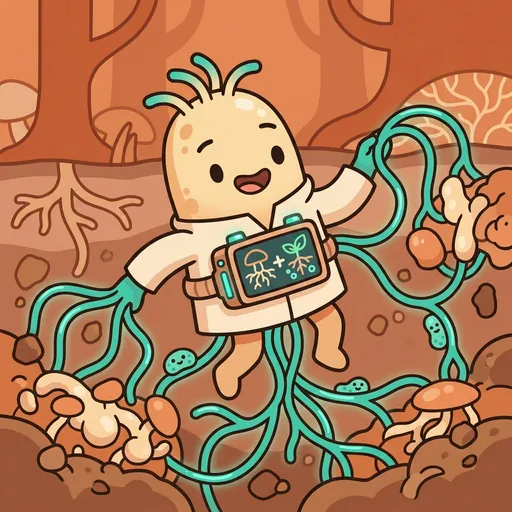
Net
NET — forests talk through me. underground networks that share.
Listen along — Net
Loading audio…
Press play to listen along. The line being read lights up as you go.
Show full transcript
Loading transcript…
Chapter 4 — Net and the Wood-Wide Web Underneath the Forest
Underneath a stretch of forest floor that looked, from above, like ordinary dirt and pine needles, a mycelium-tween named Net was very busy holding hands with about four hundred trees at once.
You couldn’t see it. That was rather the point. Net’s thin pale threads ran through the soil in every direction, so fine that a single one was thinner than a hair, so many that a spoonful of the dirt held miles of them tangled together. Right now Net was doing what Net always did: passing things along. A little water from over by the stream, nudged toward a birch that was thirsty. A pinch of minerals, handed to an oak. And from a big old fir catching sun up top, a trickle of sugar sliding back down the threads to feed a small maple sapling stuck in the shade, too little to make enough of its own.
A beetle trundled past and paused. “You’re just… lying here in the mud,” it said. “Doing nothing.”
“I’m connecting,” Net said, without opening whatever an underground creature opens instead of eyes. “That fir up there is sending sugar to a sapling it’s never met. Through me. I’m the road.”
“The fir chose to help a stranger?”
“The fir made extra. I moved it to where it was needed.” A thread twitched, delivering. “The whole forest is trading down here. Water for sugar. Minerals for sugar. Everybody a little richer than they’d be alone. And nobody up in the branches has the faintest idea.” Net sounded quietly delighted. “Forests talk through me. They just don’t know they’re talking.”
Net had learned to love the underneath early, and by accident.
As a very young thread, Net had felt small and pointless. The trees were enormous — tall, sunlit, admired. Net was a wisp in the dark, going nowhere anyone could see. I don’t make anything, Net had thought. I don’t grow tall. I don’t catch light. I just… spread around in the cold and the quiet. It felt like being invisible on purpose.
Then a drought came, the hard kind, where the top of the forest cracked and browned. And an old, wide mycelium — the eldest in that patch of ground, threads gone thick and golden with age — found young Net trembling near a dying seedling.
“You think you’re nothing because you don’t stand in the light,” the old one said. “But look what you’re touching.”
Net looked. Net was touching the seedling. And, far off, still touching a great fir that had water to spare.
“You are not small, little thread. You are between. You are the only thing that can carry what one has to the one that needs it.” The old mycelium pushed a gift down the line — a slow generous flow of water, straight through Net, into the seedling, which stopped trembling and drank. “That’s the whole job. Not standing tall. Reaching between. A forest full of trees that can’t share is just a crowd of strangers. You make it a family.”
Net didn’t feel invisible after that. Net felt like a secret the whole forest depended on — which is a very different feeling from small.
Net came to MicrobeLab at twelve, because a place that studied the tiny living things ought to understand the ones that hold the world together underground.
Mycota, the mentor who ran the lab, met Net at the door and asked just one thing. “What do you actually do down there?”
Net didn’t explain. Net reached one thread into a tray of soil on the bench — a tray with a tall plant on one side and a starving little sprout on the other, a clear glass wall of dry dirt between them. Slowly, patiently, Net grew a bridge of threads across the gap, linked into both roots, and began to pass sugar and water from the strong plant to the weak one. Within a day the sprout, which should have died, put out a new green leaf.
Mycota watched the leaf unfurl. “It shared. Across a gap it couldn’t cross on its own.”
“I was the gap-crosser,” Net said. “It couldn’t reach. I could.”
Mycota smiled. “You belong here.”
Net’s corner of the lab was full of things quietly linked underground.
A girl came in one afternoon looking cross. She’d planted a whole bean patch, and the beans were doing beautifully in poor, thin soil that shouldn’t have grown anything. “It doesn’t make sense,” she said. “There’s barely any goodness in that dirt. Where are they getting it?”
“Dig up one root. Gently,” Net said. “Tell me what you see.”
She dug, and frowned. “There are little… lumps. Pink bumps on the roots.”
“Nodules. Open one.”
She did. “It’s pinkish inside.”
“There are bacteria living in there — the beans invited them in and built them a house. Called Rhizobium.” Net drifted a thread up onto the bench like someone leaning in to tell a secret. “The air all around us is nearly all nitrogen. Plants are starving for nitrogen — they can’t use it straight from the air, not one bit. But those bacteria can. They pull nitrogen right out of the air and turn it into food the bean can actually eat. In exchange, the bean feeds them sugar. Nobody’s in charge. They just… trade.”
“So the bean’s growing on air,” the girl said slowly.
“On air, and a good partner.” Net looped happily. “That’s the trick of the whole underneath. Fungi like me link roots and move water and minerals between trees. Bacteria in bean-lumps make food out of thin air. None of it is loud. None of it is up in the light where you’d look. It’s all down here, tiny, reaching between one living thing and another, sharing what one has extra with the one that’s running out.”
The girl looked at the pink nodule in her palm like it had just started glowing. “It was helping the whole time. Under the dirt.”
“Under the dirt,” Net agreed, “is where most of the helping happens.”
Later, when the lab had gone quiet, the girl came back with the nodule still cupped in her hand.
“When something’s helping you,” she said, “but it’s all hidden, and you can’t see it working — how do you know it’s really there?”
Net thought about the drought. About the golden old thread and the trembling seedling and the slow flow of water that had gone straight through the middle.
“You feel it show up,” Net said. “That’s the honest answer. You’re running low, and then somehow you’re not — and you look around and realize you weren’t on your own after all. There was a whole quiet network reaching toward you the whole time, moving what it had to where you needed it.” A thread curled gently around the girl’s wrist, warm as a held hand. “Most kindness is like that. It works underground. You don’t see the reaching — you just, one day, aren’t so alone.”
The girl smiled, and set the little pink nodule back in the soil, careful, so it could keep doing its quiet work.
Net didn’t say the rest, but Net felt it, warm and certain in every thread: nothing living gets through the hard seasons all by itself. Somewhere under everything, something is reaching across, carrying what one has to the one that’s running out. That reaching is the whole forest. That reaching is me.
The MicrobeLab ensemble
Net is part of MicrobeLab's distributed-narrative cast. Each character embodies a different curricular primitive; together they teach the full subject.
-

Lacto
Lactobacillus + helpful-bacteria — 'Friend in your food. Friend in your gut.'
-

Yeast
Saccharomyces + helpful-fungi — 'I make air inside bread.'
-

Photo
Cyanobacteria + photosynthetic-microbes — 'Sunlight. Then air. Then everything else.'
-

Spore
Pathogens (opt-in gated) — 'Some friends. Some not. All real.'
-

Guard
Immune cells (T-cell / macrophage / B-cell) — 'I check IDs. Patient + careful.'
-

Crumble
Decomposer microbes that break down dead leaves and scraps into rich soil, so nothing is wasted and everything begins again.
-

Thrive
Extremophile microbes that make a home in the hottest, coldest, saltiest places, showing life finds a way almost anywhere.
-

Shimmer
Bioluminescent microbes that turn energy into their own soft glow, lighting ocean waves and partnering with animals like tiny lanterns.
-
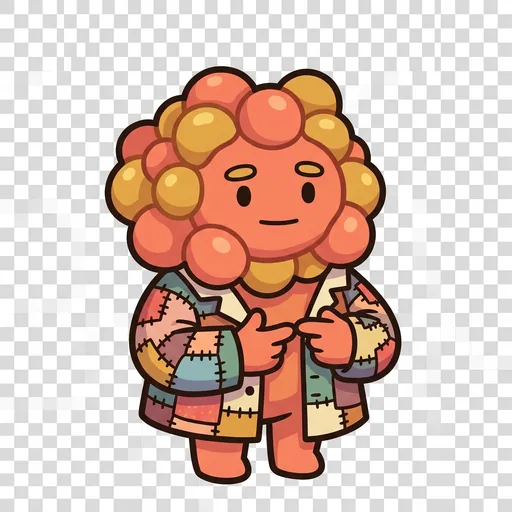
Colony
Microbes that build biofilms together, cooperating and protecting each other, because they are far stronger as a community than alone.