Bearing
ORIENTATION — north is one direction, not the direction. orientation is a choice mapmakers make.
Listen along — Bearing
Loading audio…
Press play to listen along. The line being read lights up as you go.
Show full transcript
Loading transcript…
Chapter 1 — Bearing and the North That Is Only One Way
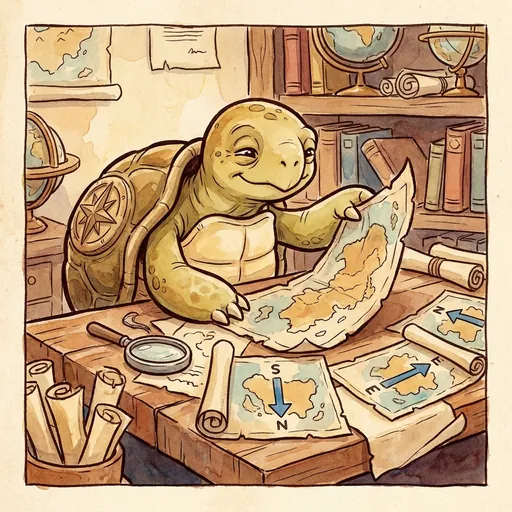
At a low wooden workbench in MapForge, a tortoise the size of a soup bowl was slowly turning a map in a circle.
Bearing had a shell stamped with a faded compass rose and a way of doing everything unhurriedly. Around her lay maps of the same stretch of coastline, each one laid out differently — one with north at the top, one with south, one turned so east ran up the page. A girl who had come to ask directions stood watching, growing more confused by the second.
“That’s the harbor,” the girl said, pointing at one map. Then she looked at the next. “Wait. That’s also the harbor. But it’s — it’s flipped.”
“Same harbor,” Bearing said. She kept turning. “Same rocks, same channel, same little island. I only rotated the paper.” She stopped the map so that south sat at the top, then nudged it toward the girl. “This one feels wrong to you, doesn’t it. Upside down.”
The girl nodded hard.
“But nothing moved. The world didn’t tip over. You just expected north to be up here” — Bearing tapped the top edge with one blunt claw — “because every map you’ve ever seen put it there. That’s not the truth of the map. That’s a habit you were handed.” She looked up, warm and unbothered. “North is one direction. It is not the direction.”
The girl opened her mouth to argue, and found she had nothing to argue with.
Bearing was old enough to remember being certain about things.
When she was small — small for a tortoise, which is a very slow kind of small — her family were the direction-readers for their village. Their whole home was maps: creased ones, ancient ones, maps drawn by hands long gone. And Bearing, back then, believed north-up the way she believed the sun came up: as a fact of the world.
Then one afternoon her great-grandmother unrolled a brittle old chart with east at the top and a holy city drawn dead center, and Bearing’s stomach did a strange little flip. She could not find anything. The coastline she knew by heart had become a stranger. She felt almost dizzy, the way you feel when a word you’ve said a hundred times suddenly stops sounding like a word.
“I don’t know where anything is,” she’d said, close to tears.
“Everything is exactly where it always was,” her great-grandmother said, in no hurry at all. “You only feel lost because someone, long ago, taught you which way was up — and you forgot that they chose it.” She smoothed the old map flat. “The people who drew this put their holiest place at the top, because to them, up meant important. That was their choice. North-up is only ours.”
Bearing sat with that dizzy feeling until it turned into something else. Not lostness. Something wider. The ground hadn’t moved. Only the frame had — and once she could see the frame, she could never quite unsee it again.
She walked to MapForge when she was one hundred and thirty, which for a tortoise is a good age to start something.
Atlas, the mentor who ran the place, met her at the gate. He didn’t ask her to prove she was clever. He asked one thing. “What is orientation?”
Bearing didn’t answer with a speech. She took the map Atlas had pinned by the gate — north-up, of course — and lifted it off its hook. She turned it a quarter-turn. Then another. Then all the way around, until south sat at the top, and held it there.
“Same land,” she said. “Look at your face.”
Atlas was frowning at the flipped map without meaning to.
“You feel it too,” Bearing said gently. “That little wrongness. That’s not the map being wrong. That’s the convention showing itself. I teach people to see that feeling — and then to ask who decided which way is up, and why.” She set the map down, unrotated, kind about it. “Orientation isn’t a law of the world. It’s a choice a mapmaker makes.”
Atlas looked at her for a long moment. “You belong here,” he said.
Her workshop filled up with kids who thought maps only came one way.
A boy came in one morning holding a school atlas like it was a rulebook. “My friend has a map where Australia’s at the top,” he said, half laughing, half offended. “It’s upside down. It’s wrong.”
“Is it?” Bearing pulled out her own south-up map and laid it beside his. “Point to the ocean between them.”
He pointed. Same ocean, both maps.
“Point to Africa.”
He found it — lower on his, higher on hers. His finger slowed down.
“It’s the same Earth,” Bearing said. “Every coastline in the same place, every sea the same size. I turned it half a circle, that’s all. So — which one is upside down?”
The boy chewed on that. ”…Neither?”
“Neither,” she agreed. “Someone a long time ago drew maps with north up, and it worked, and it spread, and now nearly everybody does it. That makes it useful — your compass and your teacher and every navigator alive agree on it, and agreeing is worth a lot.” She tapped the south-up map. “But useful isn’t the same as true. This one puts the countries we usually shrink down at the top instead. It makes you ask: why does the top feel more important? Maps don’t just show the world. They quietly tell you what to look at first.”
“So who decides?” the boy asked.
“The mapmaker. Always the mapmaker.” She said it lightly, but she let it land. “So it’s worth knowing who that is.”
Later, when the workshop had emptied, the boy came back to the door. He was quieter now, turning something over.
“When you look at a normal map now,” he said, “do you still feel like north is up? Or did you break that?”
Bearing thought about the brittle old chart, and the dizzy stomach-flip, and her great-grandmother’s unhurried voice.
“I still feel it,” she admitted. “North floats to the top for me too — I was taught, same as you. I didn’t break the feeling. I just stopped mistaking it for a fact.” She looked toward the window, where a north-up map hung like everyone’s does. “Now when I see it, I feel two things at once. The old comfort of up is up — and underneath it, this small, awake feeling, like remembering there’s a door in a wall you always thought was solid. The world can be turned. It won’t fall. And once you know that, you get to choose how you look at it, instead of only looking the way you were handed.”
The boy nodded slowly, and Bearing watched the offended stiffness go out of his shoulders and something roomier take its place.
She didn’t say the last part out loud, but she thought it, warm and slow as everything about her: the surest-feeling things are usually just the ones nobody ever thought to turn around.
The MapForge ensemble
Bearing is part of MapForge's distributed-narrative cast. Each character embodies a different curricular primitive; together they teach the full subject.
-
Inset
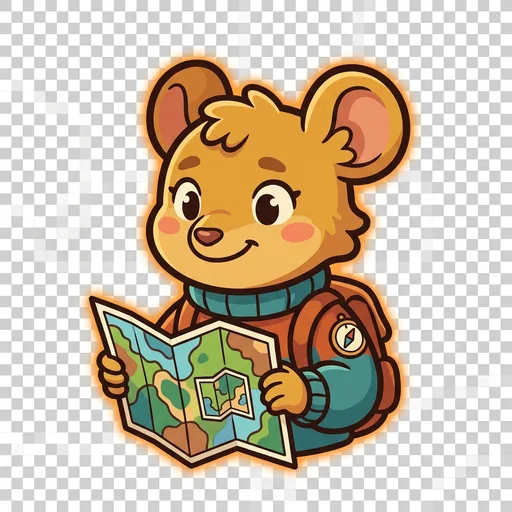
Scale — the field-mouse-tween with a folded map-within-a-map who teaches scale-choice as a political act ('bigger map, less detail; smaller map, more story — pick on purpose')
-
Key
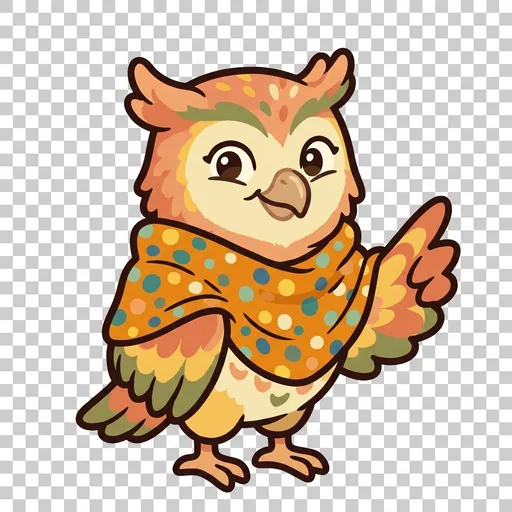
Legend literacy — the owl-tween in a dot-shawl who treats the legend as the mapmaker's confession ('what's NOT on the map — that's also a map')
-
Plot
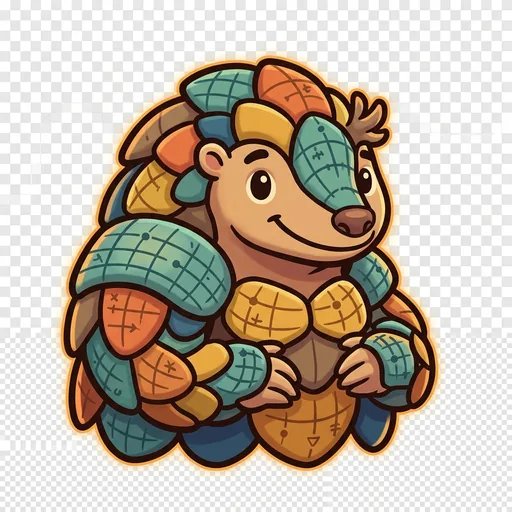
Coordinates — the pangolin-tween with graticule-scale armor who teaches that coordinate systems are human inventions, plural across cultures ('every place has many addresses; many cultures have many ways of saying here')
-
Wayfind
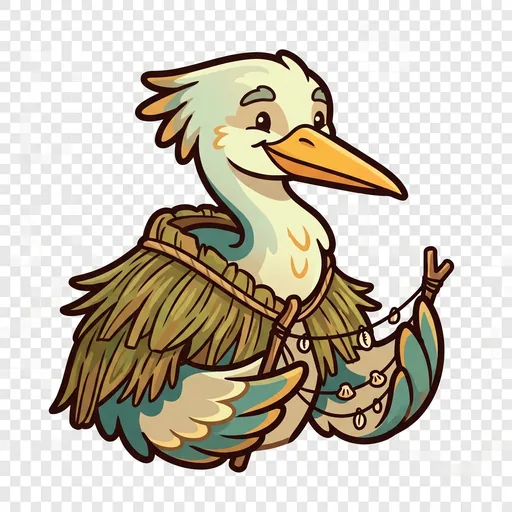
Non-Western mapping traditions — the heron-elder in a woven-grass cloak with stick-chart props who structurally elevates Polynesian wayfinding, Aboriginal songlines, and Indigenous TEK as peer cartographies ('some maps you sing, some you walk, some you only learn from elders')