
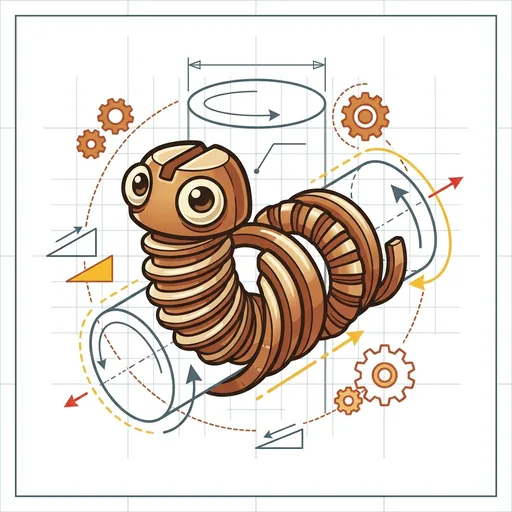
Auger
SCREW — round and round becomes step and step. spiral inclined plane.
Listen along — Auger
Loading audio…
Press play to listen along. The line being read lights up as you go.
Show full transcript
Loading transcript…
Chapter 5 — Auger and the Spiral That Climbs
In the corner of the MachineForge workshop, a small bronze creature turned slowly against a block of pine, and the whole room went quiet to watch.
Auger did not hurry. It fit the tip of its threaded body to the wood and began to spin — round, and round, and round. With each full turn it sank a little deeper into the block. Not far. Barely the width of a fingernail. But it never stopped, and it never slipped back.
A knot of students leaned in. “It’s going in so slowly,” one whispered.
“Watch the block, not me,” Auger buzzed, still turning. Sawdust curled out around its threads in a thin golden spiral. Round and round. Step and step.
After a long minute, Auger had bored clean through. It dropped out the other side and rolled to a stop, humming with satisfaction. The pine had a neat spiral tunnel through it now, threaded like the inside of a nut.
“See?” Auger said. “I only ever did one thing. I turned. Around and around, the same tiny circle, over and over.” It nudged the finished block toward them. “But every circle was also a step forward. Round and round became step and step. That’s the only trick I know — and it’s the whole trick.”
The students turned the block over in their hands, following the spiral groove with a fingertip, and could not quite believe that going in circles had gotten it anywhere at all.
Auger had learned that trick the slow way, back when it was very small and very frustrated.
There had been a shelf, once — high up, and a heavy sack of grain on the floor below it, and Auger could not for the life of it get the sack up. It shoved. It heaved. It ran at the wall and bounced off. The sack didn’t budge, and Auger sat down in the dust feeling useless and round and good for nothing.
Old Cog rolled over — the giant gear who ran the workshop, teeth worn smooth, voice like far-off thunder. Cog didn’t tell Auger to try harder.
“You keep trying to do it all at once,” Cog rumbled gently. “In one big push. But that isn’t your shape, little one.”
“Then what is my shape?” Auger said, miserable.
“A ramp,” said Cog. “Wound up. Look.” Cog set a long flat board against the shelf, a gentle slope, and rolled the sack slowly up it — no heaving, just a long, patient climb. “The ramp trades the hard-and-fast for the easy-and-long. It doesn’t lift less. It lifts the same, spread out over more distance, so each moment costs you almost nothing.”
Auger stared at the slope. Then it looked down at its own spiraled body — its threads winding around and around and around — and something turned over inside it, quiet and certain.
“That’s me,” Auger breathed. “I’m that ramp. I’m just… wrapped up.”
The stuck, useless feeling didn’t vanish, exactly. But it had a shape now, and the shape was a spiral, and Auger could work with a spiral.
Auger arrived at the MachineForge proper on a morning full of clanging hammers and flying sparks, and Cog was waiting at the gate.
Cog didn’t ask Auger to lift anything heavy. It asked one question. “What is a screw?”
Auger didn’t answer with words at first. It reached into itself and — carefully, thread by thread — uncoiled one loop of its own body until it lay flat on the bench: a thin strip of bronze, sloping gently from low to high. A plain little ramp. Nothing fancy at all.
Then Auger picked up a smooth round peg, laid the strip against it, and wound it back around, spiral by spiral, until it was a screw again.
“That’s all I am,” Auger said quietly. “A ramp, wrapped around a pole. People think I’m some clever, complicated thing. But unwind me and I’m the plainest slope you ever saw.”
Cog’s gears whirred, low and warm. “You belong here,” it said. “Go teach.”
Auger’s first student was a boy with a screw and a screwdriver and a deep scowl.
“This is stupid,” he said. “I’ve turned it like a hundred times and it’s barely gone in. A hammer would’ve been done ages ago.”
Auger didn’t argue. “Push a nail in with your bare thumb,” it said. “Go on.”
The boy pushed. The nail dented his thumb and didn’t move.
“Now turn the screw one more time,” Auger said. He did — and it bit deeper into the wood, snug and gripping, without any shove at all. “Feel how it pulled itself in?”
”…Yeah,” the boy admitted.
“Every turn you make travels a long way around,” Auger said, spinning a slow demonstration circle on the bench. “But the screw only steps forward a tiny bit — that little step is called the pitch. You spend a big, easy motion. The screw spends a small, mighty one.” It tilted. “Tight threads, close together — slow going, but they push like a giant. Wide threads — faster in, but gentler. Same bargain every simple machine makes. You trade distance for force.”
The boy turned the screw the rest of the way in, slow and steady, and this time he was almost smiling.
“So it’s not stupid,” Auger said. “It’s patient. It does with a hundred easy turns what your thumb could never do with one hard shove. And once you’ve seen the ramp hiding in the spiral —” it spun a happy little circle — “you start seeing me everywhere. In a jar lid. In a water-pump. In the thing that lifts a whole river up to a dry field.”
Later, when the others had gone, the boy came back holding the screw, quieter now.
“When it’s just sitting in the wood,” he said, “not going anywhere… how do you know the ramp’s still in there? You can’t see it once it’s wound up.”
Auger thought about the sack of grain, and the dust, and the stuck feeling that had turned into a shape.
“You feel it,” it said. “That’s the honest answer. There’s a moment — you’ve been turning and turning, and it seems like nothing’s happening, and then it just catches. Everything clicks and holds. That catch is the ramp, still doing its slow, patient work, right where you can’t see it.” It rolled gently against the bench. “The hardest jobs almost never get done in one big push. They get done in a hundred small turns, each one so easy you barely notice — until you look up and find you’ve climbed the whole way.”
The boy nodded slowly, and Auger watched the scowl melt off his face — the same way, long ago, the stuck feeling had melted off its own.
It didn’t say the rest out loud, but it hummed it to itself, round and warm and sure: the slow, going-in-circles moments are usually the ones quietly carrying you forward. You just can’t feel how far until you stop and look back.
The MachineForge ensemble
Auger is part of MachineForge's distributed-narrative cast. Each character embodies a different curricular primitive; together they teach the full subject.
-

Pry
Lever — push longer to lift heavier; the trade between force and distance
-

Hoist
Pulley — pull down here and watch it go up there; redirecting force
-

Ramp
Inclined plane — climb the long slow way; less force, same work
-

Spoke
Wheel-and-axle — one turn of the hub, many turns of the rim
-

Cleave
Wedge — push forward and split it apart; force concentrated to a sharp edge
-
Pinion
A gear train: meshing teeth trade turning-speed for turning-force and pass the motion along, faster or stronger as you choose.
-
Flex
A spring: bend it to store your push, let go and it gives every bit back — energy held, then returned.
-
Lobe
A cam: a spinning shape with a bump that turns steady spinning into a repeating push, like a music box keeping a beat.
-
Ratchet
A ratchet: lets motion go forward freely but locks when it tries to slip back, holding every bit of progress, click by click.