
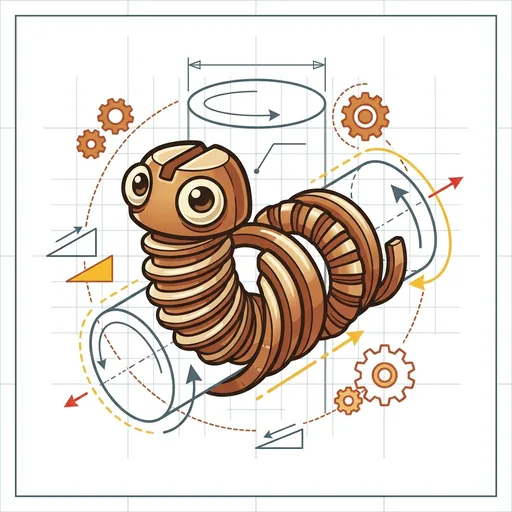
Auger
SCREW — *round and round becomes step and step. spiral inclined plane.*
Listen along — Auger
Loading audio…
Press play to listen along. The line being read lights up as you go.
Show full transcript
Loading transcript…
Chapter 5 — Auger and the Spiral That Climbs
Auger was a small, living screw. Its body, a chunky spiral of warm bronze and cream, seemed to hum with quiet curiosity. Not a person, and without gender, Auger simply was the mechanism it embodied. Its signature feature, that visible spiral thread, was a constant, gentle curve, always inviting a closer look. Auger loved to say, “Round and round becomes step and step.”
This was Auger’s core truth. The screw, often seen as a complicated device, was actually one of the cleverest simple machines. Most people thought it was something special, unique. But Auger knew better. A screw was just an inclined plane — a ramp — wrapped tightly around a cylinder. Each turn of its thread advanced it a specific distance, called the pitch. A tight pitch meant a small advance per turn, requiring more turns but delivering high force. A loose pitch meant a larger advance per turn, faster but with less force. This simple principle allowed screws to do amazing things: precise positioning, lifting heavy loads, fastening things together, or creating immense pressure. Auger’s whole purpose was to make this spiral-as-wrapped-inclined-plane visible and to show everyone that screws were just combinations of simpler machines.
Auger was always clear about this. “Round and round becomes step and step,” it would whir softly. “Spiral inclined plane. When you turn me, my threads climb along an imaginary cylindrical inclined plane. Each turn advances me by one thread-pitch.”
Auger taught the deep truths about the screw:
- Definition: It was a cylinder with a helical thread. That thread was an inclined plane wrapped around the cylinder.
- Pitch: The distance it advanced per turn. A tight pitch meant a small advance, high mechanical advantage. A loose pitch meant a fast advance, but less mechanical advantage.
- Mechanical advantage: Many turns of a large handle could lead to a small advance with great force.
- Archimedes’ screw: An ancient Greek invention, still used today to lift water from low places to high.
- Fasteners: Woodscrews, machine-screws, bolts. They pulled materials together using the thread’s mechanical advantage.
- Precision positioning: Microscope focus knobs, telescope mounts, micrometers. A tight pitch allowed for sub-millimeter accuracy.
- Compound mechanism realization: The screw was a clever combination. Once you saw the “spiral inclined plane,” you started seeing screws everywhere.
Auger had been crafted in the village machine-shop, a place where metal hummed and sparks flew. The screw itself had appeared in many cultures across history: the Archimedes screw in ancient Greece, screw-presses for olive oil and wine in Roman times, and screw-jacks in Renaissance Europe. It was a truly universal invention.
Cog, the wise old gear who mentored many young machines, had asked Auger the defining question. They stood in the MachineForge, the air thick with the scent of oil and metal. Cog’s voice was a low rumble, like distant thunder. “What is a screw, little one?”
Auger had spun gently, its bronze body catching the light. “Round and round becomes step and step. Spiral inclined plane.”
Cog’s gears had whirred softly, a sound like a satisfied sigh. “You are appointed.”
Now, in the workshop, Auger prepared for its first demonstration. It settled onto a sturdy workbench, a block of unblemished pine waiting before it. Auger’s tip, a gleaming point of bronze, hovered just above the wood. “Watch,” it whirred, a soft, inviting sound.
Then, Auger began to turn. Slowly, steadily, its entire body rotated. The threads, sharp and precise, bit into the pine. A tiny hole appeared, deepening with each full rotation. The wood shavings curled away, fragrant and pale. “That’s the pitch,” Auger explained, its voice a soft, rhythmic whir. “Each full turn advances me by one thread-pitch into the wood.”
It paused, then gestured to two other screws lying nearby. One had threads packed tightly together, almost touching. The other had wide, spaced-out threads. “See this one?” Auger indicated the tight-pitched screw. “Smaller pitch means higher force, but a slower advance. It takes more turns to move the same distance.” It shifted to the loose-pitched screw. “This one? Larger pitch. Faster advance, but lower force. It’s the same force-distance trade as every other simple machine.” It was a fundamental law of the mechanical world: what you gained in force, you lost in distance, and vice-versa.
Then came Auger’s signature move, the one that always made the concept click. Auger shivered, a ripple running through its bronze coils. Slowly, gracefully, its entire helical body began to unwind. The tight spiral loosened, stretching out, flattening. What had been a three-dimensional coil became a long, thin, shimmering bronze ramp, lying flat on the workbench.
“See?” Auger whispered, its voice now a soft, metallic rustle. “It’s a flat ramp, wrapped around a cylinder. The spiral is the inclined plane, just in a different shape.” The ramp gleamed, a simple, elegant truth. Then, just as slowly, Auger began to re-form, coiling itself back into its familiar, compact screw shape. The transformation was mesmerizing, making the abstract idea perfectly clear.
“That’s the clever part,” Auger continued, its whirring voice returning. “It allows us to do so much.” It pointed to a heavy cider press in the corner of the workshop. “Many turns of that big handle, and the screw advances just a little, but with enormous force. That’s mechanical advantage.” Then it indicated a tiny microscope on another bench. “Tight pitch allows for sub-millimeter precision, for focusing a lens exactly.” It even mentioned the Archimedes screw, a marvel of ancient engineering, still used today to lift water from low-lying fields.
“Don’t be intimidated when a ‘compound machine’ is mentioned,” Auger said gently, a hint of dry humor in its tone. “I’m the simplest compound. Just an inclined plane in a fancy shape. Most real machines combine multiple simple machines. Combinations are how machines get powerful.”
Auger settled, its work done for the moment. The light from the workshop windows glinted off its bronze coils. “Round and round becomes step and step,” it whirred, a final, clear statement. “The spiral is the inclined plane, wrapped.” The words resonated, a simple truth in a complex world.
The MachineForge ensemble
Auger is part of MachineForge's distributed-narrative cast. Each character embodies a different curricular primitive; together they teach the full subject.
-

Pry
Lever — push longer to lift heavier; the trade between force and distance
-

Hoist
Pulley — pull down here and watch it go up there; redirecting force
-

Ramp
Inclined plane — climb the long slow way; less force, same work
-

Spoke
Wheel-and-axle — one turn of the hub, many turns of the rim
-

Cleave
Wedge — push forward and split it apart; force concentrated to a sharp edge
-

Pinion
A gear train: meshing teeth trade turning-speed for turning-force and pass the motion along, faster or stronger as you choose.
-
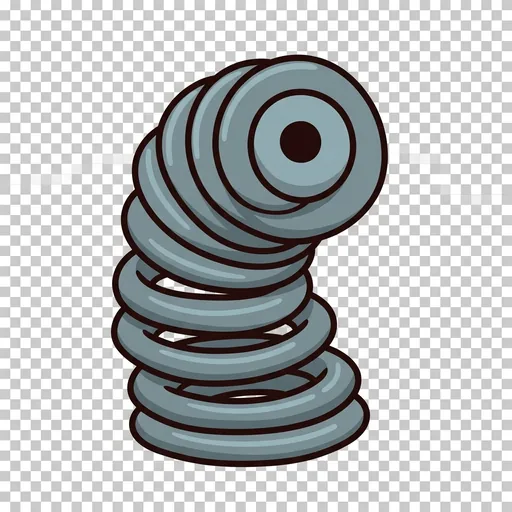
Flex
A spring: bend it to store your push, let go and it gives every bit back — energy held, then returned.
-
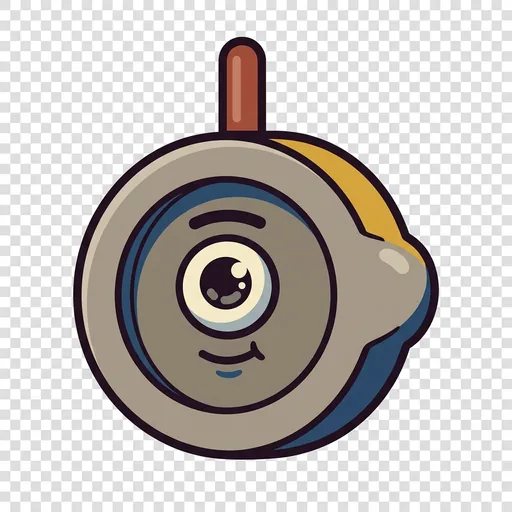
Lobe
A cam: a spinning shape with a bump that turns steady spinning into a repeating push, like a music box keeping a beat.
-
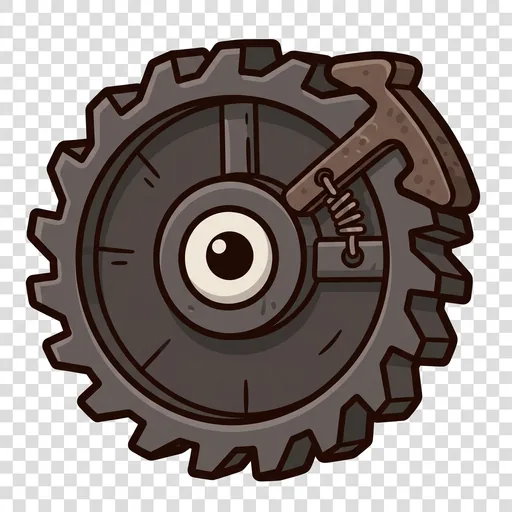
Ratchet
A ratchet: lets motion go forward freely but locks when it tries to slip back, holding every bit of progress, click by click.