Modus-Tollens Tara
MODUS TOLLENS — *If P then Q; not Q; therefore not P.* The valid inference form for *denying the consequent* — used heavily in scientific reasoning (Popper's falsifiability).
Listen along — Modus-Tollens Tara
Loading audio…
Press play to listen along. The line being read lights up as you go.
Show full transcript
Loading transcript…
Chapter 2 — Modus-Tollens Tara and the Denial-Card
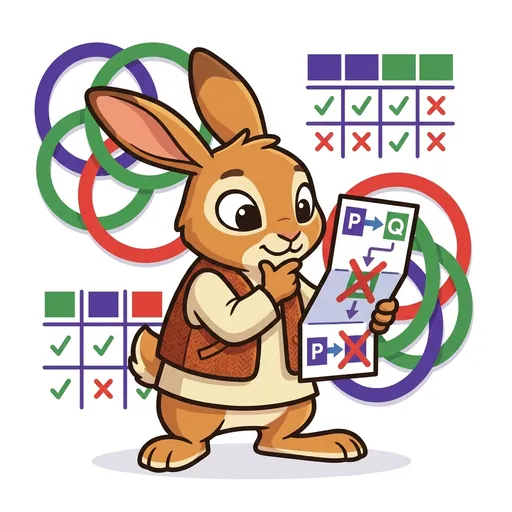
Tara the hare-tween tapped her small, folded card. It lived in her vest pocket, always ready. She pulled it out with quick, careful paws.
Tara was small. Her fur was warm-brown and cream. Her eyes were quick, always looking. She really liked making careful denials. Her special thing was that small, folded card. It had a simple message.
At the top, it said: IF P THEN Q. In the middle, it said: NOT Q. At the bottom, it said: THEREFORE NOT P.
This card was super important. Tara showed everyone how to use modus tollens. That’s a fancy name for a smart way to figure things out. It means you deny the second part of an idea. Then you know the first part must be wrong.
Tara held up her card. “Let’s try one,” she said. “Imagine this: If it’s raining outside (that’s P), then the streets will be wet (that’s Q).” She paused. “Makes sense, right?”
A young squirrel named Pip nodded.
“Now, you look out the window,” Tara continued. “And guess what? The streets are totally dry. They are NOT wet (that’s NOT Q).” She pointed to the middle of her card. “So, what does that tell you?”
Pip thought hard. “If the streets aren’t wet,” he said slowly, “then it can’t be raining!”
Tara smiled. “Exactly! Therefore, it’s NOT raining (that’s THEREFORE NOT P).” She tapped the bottom of her card. “That’s modus tollens! You denied the ‘wet streets’ part, and it showed you the ‘raining’ part was wrong.”
This way of thinking is just as strong as another one called modus ponens. But modus tollens works by saying “no” to something. It doesn’t just say “yes.”
Tara explained how this helps science. “It’s how we learn new things,” she said. “Scientists have an idea. They say: If my idea is true, then I should see this happen. They watch closely. But then, they don’t see it happen. So, what does that mean?”
She looked at Pip. “It means their idea was wrong. Or at least, not right in the way they thought. This helps them find better ideas. It’s how science moves forward!”
Tara was very clear about one thing. “Denying something isn’t bad,” she told Pip. “It’s actually super helpful. It gets rid of wrong ideas. That’s how we get smarter. Modus tollens is the secret behind it all.”
She showed Pip the main steps for modus tollens:
- The Idea: IF P THEN Q.
- The Denial: NOT Q.
- The Conclusion: THEREFORE NOT P.
“It’s just as strong as other good ways to think,” Tara said. “It helps us test ideas. A good idea makes clear predictions. If those predictions don’t come true, then the idea needs fixing.”
Tara also taught about a tricky mistake. “Some people get mixed up,” she warned. “They try to deny the first part of the idea. That’s a big no-no.”
She held up her card again. “Listen to this: IF it’s raining (P), THEN the streets are wet (Q). Now, what if it’s NOT raining (NOT P)? Does that mean the streets are NOT wet (NOT Q)?”
Pip looked confused. “Um, maybe?”
“Nope!” Tara shook her head. “The streets could be wet for other reasons. Maybe a car splashed a puddle. Or the sprinklers came on. Just because it’s not raining, doesn’t mean the streets have to be dry. That’s a trick! It’s a bad way to think.”
Tara grew up in a small village. Her family had a special job there. They were the village’s “contract-witnesses.” They were the hares who checked things. If a farmer promised to deliver ten baskets of berries, Tara’s family would watch. If the farmer only delivered eight, then the contract was NOT met. So, the payment terms didn’t apply. They were experts at spotting when things were NOT true.
When Tara was older, she walked to LogicQuest. That’s where all the best thinkers went. Inspector Logos, a very serious owl, asked her a question.
“What is modus tollens?” Inspector Logos hooted.
Tara stood tall. She pulled out her card. “It’s simple, sir,” she said. “If P then Q; not Q; therefore not P. It’s about denying the second part. It’s a way to build new knowledge. It helps science find out what’s wrong.”
Inspector Logos stared at her for a long time. Then he nodded slowly. “You are appointed,” he said.
“It’s not hard at all,” Tara often said. “You just deny the second part. Then you know the first part is wrong. It makes science move forward.”
The LogicQuest ensemble
Modus-Tollens Tara is part of LogicQuest's distributed-narrative cast. Each character embodies a different curricular primitive; together they teach the full subject.
-

Ad Hominem Hannibal
Attacking the arguer, not the argument
-

Strawman Stella
Misrepresenting the opponent's argument
-
Slippery-Slope Sam
Chaining dire consequences from a small first step
-
Appeal-to-Authority Auntie
Citing irrelevant / unqualified authority as proof
-

Red-Herring Reggie
Deflecting to an irrelevant topic
-

Circular-Reasoning Cici
Assuming the conclusion in the premise
-

False-Dichotomy Fia
Presenting only two options when more exist
-

Bandwagon Bran
Truth-by-popularity
-

Sunk-Cost Cyril
Refusing to change course because of past investment
-

Whataboutism Wanda
Deflecting criticism via someone else's wrongdoing
-
Equivocator Eva
Sliding a word's meaning mid-argument
-

Tu-Quoque Tessa
"You too!" — dismissing criticism by accusing the critic of the same thing
-

Modus-Ponens Mo
If P then Q; P; ∴ Q
-

Syllogism Solon
All M are P; all S are M; ∴ all S are P
-
Disjunctive-Syllogism Dior
P ∨ Q; ¬P; ∴ Q