
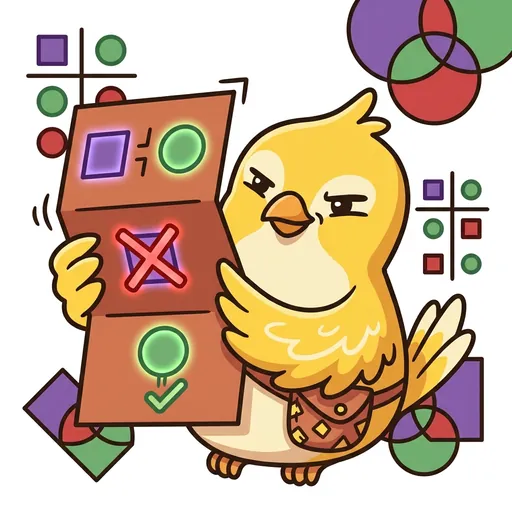
Disjunctive-Syllogism Dior
DISJUNCTIVE SYLLOGISM — either one or the other; not the first; so it must be the second.
Listen along — Disjunctive-Syllogism Dior
Loading audio…
Press play to listen along. The line being read lights up as you go.
Show full transcript
Loading transcript…
Chapter 4 — Dior and the Either-Or Card
The whole classroom had lost a set of keys, and everyone was talking at once.
Dior, a small yellow-and-cream finch-tween, hopped up onto the desk in the middle of the noise and held up one wing for quiet. In her wing-pocket she carried a little folded card, worn soft at the edges. She didn’t look at it. She’d read it a thousand times.
“Where can the keys be?” she asked. “Say them all. Every place. Don’t skip any.”
“The coat rack,” someone said. “Or the drawer. Or the lost-and-found box.”
“That’s it? Those are the only three?” Dior waited until they were sure. “Good. That matters more than you think. If we forget a place, this doesn’t work.” She flicked her card open. Three lines, in careful ink: the places on top, a strike-through in the middle, and one survivor at the bottom.
“Now — the coat rack. Check it.”
A tall kid checked. “Empty.”
“Cross it off.” Dior struck a line through it in the air. “The drawer.”
“Empty too.”
“Cross it off.” She tilted her head, quick-eyed, calm. “So. Not the coat rack. Not the drawer. And those three were all the places.” She let the pause sit. “So the keys are in the lost-and-found box. Not a guess. Not a hope. The only place left standing.”
They opened the box. The keys were there.
The tall kid stared. “You didn’t even look for them.”
“I didn’t have to,” Dior said, folding her card away. “I let the wrong places do the finding.”
Dior had grown up in a small village on the edge of a marsh, and her family were the ones the village called when a choice got tangled.
When she was little, the council would gather and argue for whole afternoons — should we plant here or there, fish this bend or that one — going in circles, everyone certain and nobody agreeing. It made Dior’s chest go tight just to sit through. All that noise and no ground under it.
Her aunt, a slow and patient finch, taught her the trick one grey morning by the water. “The arguing isn’t the problem, little one,” she said. “The problem is nobody’s laid the choices out flat. Watch.” She pressed three pebbles into the mud in a row. “These are all the things it could be. All of them — that’s the hard part, and the important part. Now.” She turned one pebble over. “This one — we know it’s wrong. The water’s too shallow there. Take it away.” She lifted it out. “And this one — too far to walk. Take it away.” She lifted the second. One pebble left, alone in the mud. “You didn’t pick the last one because you liked it. You picked it because it’s the only one still standing. That’s not opinion. That’s the only place left for the truth to be.”
Dior looked at the single pebble for a long time. Something in her chest, that tight tangled feeling, went quiet and clear. The choices had felt like a fog. Now they felt like a small, solid thing she could hold.
She walked to LogicQuest when she was older, because a place that studied clear thinking ought to have room for the finch who cleared the fog.
Inspector Logos met her at the door. He didn’t ask her to prove she was clever. He set three cups upside-down on the table and hid a marble under one while she watched, then mixed them so she’d lost track.
“Find it,” he said.
Dior didn’t guess. She lifted the first cup — empty. She lifted the second — empty. She didn’t touch the third.
“It’s under this one,” she said, tapping it.
“You didn’t check,” Logos said.
“I checked the other two. There are only three cups, and the marble is under one of them. Not the first. Not the second.” She finally lifted the third. The marble sat there, plain. “So this one. There was nowhere else for it to be.”
Logos looked at her a long moment. “You belong here,” he said.
A boy came to her workshop one afternoon, slumped and frustrated over a puzzle. Four suspects, one broke the classroom window, and he’d read the clues twice and still felt stuck.
“I don’t know who did it,” he said. “I can’t see it happening. How am I supposed to be sure?”
Dior knew that slump. She’d felt it by the marsh, before the pebbles.
“You don’t have to see it,” she said. “Tell me every suspect. All four. Miss one and this falls apart.”
He listed them. “Ana, Beck, Cyd, Dev.”
“Good. Now — the clues. What do they rule out?”
He checked. “Ana was at the library. Beck was on camera in the gym. Cyd had a cast on her arm, couldn’t have thrown anything.”
“So cross them off. Ana — out. Beck — out. Cyd — out.” Dior struck three lines in the air. “And those four were all of them?”
”…Yeah.”
“Then who’s left standing?”
The boy’s eyes went wide. “Dev. It has to be Dev.” He looked almost startled. “But I never proved Dev did it.”
“You proved the other three couldn’t have,” Dior said gently. “When you’ve laid out every possibility and knocked away the ones that can’t be true, whatever’s left — however surprising — is your answer. The catch is the listing. If you’d forgotten there was a fifth kid, this wouldn’t work. So always name them all first. Then let the wrong ones fall away, one at a time, until only the truth is standing.”
The boy sat back, and Dior watched the frustration drain out of his shoulders.
Later, when the workshop was quiet, the boy came back with one more question.
“When it’s the last one left,” he said slowly, “and you never actually saw it happen — how do you trust it that much?”
Dior thought about the three pebbles in the grey mud, and the fog lifting off the water.
“Because you didn’t leave anything out,” she said. “That’s the whole thing. You looked at every door, and you shut the ones that were locked, and the only one still open — that’s not a guess. It’s what has to be true once everything false is gone.” She looked toward the window, toward the far marsh. “It feels different from a lucky guess. A guess is jittery, up here in your throat. But this? When you’ve named them all and cleared away the wrong ones, and the last one’s just standing there quiet — it settles. Right in your chest. Nothing rattling. Nothing left to argue with.”
The boy nodded, and let out a long breath he seemed to have been holding.
Dior didn’t say the rest out loud, but she felt it, warm and steady: the calmest kind of certain isn’t the loud kind. It’s the quiet that comes when there’s simply nowhere else left for the truth to hide.
The LogicQuest ensemble
Disjunctive-Syllogism Dior is part of LogicQuest's distributed-narrative cast. Each character embodies a different curricular primitive; together they teach the full subject.
-

Ad Hominem Hannibal
Attacking the arguer, not the argument
-

Strawman Stella
Misrepresenting the opponent's argument
-

Slippery-Slope Sam
Chaining dire consequences from a small first step
-

Appeal-to-Authority Auntie
Citing irrelevant / unqualified authority as proof
-

Red-Herring Reggie
Deflecting to an irrelevant topic
-

Circular-Reasoning Cici
Assuming the conclusion in the premise
-

False-Dichotomy Fia
Presenting only two options when more exist
-

Bandwagon Bran
Truth-by-popularity
-

Sunk-Cost Cyril
Refusing to change course because of past investment
-

Whataboutism Wanda
Deflecting criticism via someone else's wrongdoing
-

Equivocator Eva
Sliding a word's meaning mid-argument
-

Tu-Quoque Tessa
"You too!" — dismissing criticism by accusing the critic of the same thing
-

Modus-Ponens Mo
If P then Q; P; ∴ Q
-

Modus-Tollens Tara
If P then Q; ¬Q; ∴ ¬P
-

Syllogism Solon
All M are P; all S are M; ∴ all S are P