
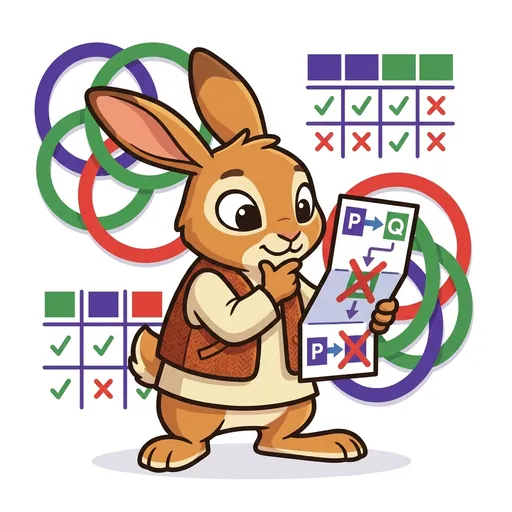
Modus-Tollens Tara
MODUS TOLLENS — *If P then Q; not Q; therefore not P.* The valid inference form for *denying the consequent* — used heavily in scientific reasoning (Popper's falsifiability).
Listen along — Modus-Tollens Tara
Loading audio…
Press play to listen along. The line being read lights up as you go.
Show full transcript
Loading transcript…
Chapter 2 — Modus-Tollens Tara and the Denial-Card
Tara was a small hare-tween, quick-eyed and careful. Her fur, a warm mix of brown and cream, often made her seem to blend into the background. But her mind was always sharp, always observing. In her vest pocket, she carried her signature item: a small, folded denial-card. Its edges were smooth from countless touches. On it, in neat, tiny script, were three lines: IF P THEN Q at the top, NOT Q in the middle, and THEREFORE NOT P at the bottom. This card wasn’t just a prop; it was the physical embodiment of her way of thinking, a method she called modus tollens.
One drizzly afternoon, Tara stood by the window of the LogicQuest common room, watching the rain streak down the glass. A badger named Barnaby burst in, shaking water from his fur.
“Terrible news!” he declared, his voice booming. “The outdoor picnic is canceled! It’s raining!”
Tara tilted her head. “Was it scheduled for today?”
“Of course!” Barnaby threw his paws up. “Everyone knows: If it’s raining (P), then the outdoor picnic is canceled (Q). It’s raining, so it’s canceled. Simple logic.”
Tara reached into her pocket. She pulled out her card, unfolding it carefully. “Barnaby,” she said, her voice soft but clear. “Are you sure the picnic is canceled?”
Barnaby blinked. “Well, no one said it was canceled. But it must be. It’s pouring!”
“Ah,” Tara said, a small, knowing look in her eyes. “So, the picnic is not canceled yet. Not Q.” She tapped the middle line of her card. “If we know ‘Not Q’ — that the picnic is not canceled — then what does that tell us about your first statement?”
Barnaby frowned, thinking hard. “If the picnic isn’t canceled, even though it’s raining… then the idea that rain always cancels the picnic must be wrong.”
“Exactly,” Tara said, folding her card. “Therefore, it’s not true that ‘If it’s raining, then the outdoor picnic is canceled.’ Not P.”
This was modus tollens. It was the way you figured out that an initial idea, a “P then Q” statement, wasn’t quite right. You did this by observing that the “Q” part didn’t happen. Tara never saw this as negative. For her, it was like clearing away fog. It helped everyone see more clearly. It was constructive reasoning.
Tara understood why some found her method a bit unsettling. People often wanted to affirm things, to say ‘yes’ and build. But Tara saw the power in saying ‘no,’ in carefully taking things apart. It wasn’t about being negative. It was about being precise. If you knew what wasn’t true, you were much closer to finding what was. It was like chipping away at a block of marble, removing everything that wasn’t the sculpture hidden inside. Her denial-card was a tool for truth, a way to sharpen understanding.
Tara often thought about how this kind of thinking helped science. A scientist might have a theory: ‘If my new medicine works (P), then the patient’s fever will drop (Q).’ They give the medicine. But the patient’s fever does not drop (Not Q). What does that mean? It means their theory, or at least that specific prediction, was incorrect (Therefore Not P). This is how science really moves forward. It’s not just about proving things right. It’s about carefully proving things wrong, so you can find a better path. Every time a scientist’s prediction doesn’t come true, they learn something vital. They learn what doesn’t work, or what their theory doesn’t explain. This process of elimination, this careful ‘not Q, therefore not P,’ slowly but surely builds a clearer picture of the world. Tara believed this was the most exciting part of discovery: finding out what wasn’t true, to get closer to what was.
Tara knew it was important to use her card the right way. She’d seen others try to twist the logic. Her friend Mo, who was good at affirming things, sometimes made a different kind of mistake. “If I get an A on this test (P), then I’ll get into the advanced class (Q),” Mo had said once. Later, Mo didn’t get an A on the test (Not P). “Well,” Mo sighed, “I guess I won’t get into the advanced class then.”
Tara shook her head gently. “Not necessarily, Mo,” she explained. “The advanced class might have other ways in. Maybe a special project, or an interview. Just because you didn’t get an A doesn’t automatically mean you’re out. That’s denying the antecedent, and it’s a trap.”
Tara knew these were the core lessons, the ‘scaffolds’ of modus tollens. First, the simple form: IF P THEN Q; NOT Q; THEREFORE NOT P. Second, its power was equal to modus ponens, just working in a different direction. Mo was good at modus ponens – ‘If P, then Q; P; therefore Q.’ Tara was good at the other side of the coin. Both were strong, valid ways to reason. Third, it was the very foundation of how science tested its ideas, always looking to falsify, to prove theories wrong so better ones could emerge. And finally, the crucial warning: never deny the antecedent. That was a path to confusion, a logical trap that could lead you far from the truth.
Tara’s family came from a small village, high in the hills. For generations, they had been the village’s contract-witnesses. They weren’t the ones who made the deals. Instead, their job was to track when the conditions of a contract were not met. For example, a contract might state: ‘If the roof is fixed by autumn (P), then the landlord gets full rent (Q).’ Tara remembered her grandmother, a wise old hare, carefully checking the roof as the leaves began to fall. If autumn arrived and the roof was not fixed (Not Q), then Tara’s family would carefully state: ‘Therefore, the landlord does not get full rent (Not P).’ Their role was to confirm when a promised outcome didn’t happen, and what that meant for the initial condition. It was a way to keep things fair. It prevented people from being forced into agreements when the terms hadn’t been met. They were the guardians of what wasn’t true, which was just as important as knowing what was.
When Tara was twenty-two, she walked the long path to LogicQuest. She sought appointment as a Logic Guide. Inspector Logos, a stern but fair owl, sat behind a grand desk. “Young hare,” he boomed, “what is modus tollens?”
Tara stood tall. She pulled out her denial-card, holding it steady. “It is the form: If P then Q; Not Q; Therefore Not P,” she recited. “It is denial, Inspector, but it is constructive. It helps us eliminate incorrect ideas. It powers scientific falsifiability.”
Inspector Logos peered at her, his eyes sharp. Then a slow smile spread across his beak. “You are appointed,” he declared.
Tara knew it wasn’t hard. It was simply about denying the consequent. Then you could conclude the antecedent was not true. This process, she believed, was how knowledge truly moved forward. It was how the world became a little clearer, one careful denial at a time.
The LogicQuest ensemble
Modus-Tollens Tara is part of LogicQuest's distributed-narrative cast. Each character embodies a different curricular primitive; together they teach the full subject.
-

Ad Hominem Hannibal
Attacking the arguer, not the argument
-

Strawman Stella
Misrepresenting the opponent's argument
-

Slippery-Slope Sam
Chaining dire consequences from a small first step
-

Appeal-to-Authority Auntie
Citing irrelevant / unqualified authority as proof
-

Red-Herring Reggie
Deflecting to an irrelevant topic
-

Circular-Reasoning Cici
Assuming the conclusion in the premise
-

False-Dichotomy Fia
Presenting only two options when more exist
-

Bandwagon Bran
Truth-by-popularity
-

Sunk-Cost Cyril
Refusing to change course because of past investment
-

Whataboutism Wanda
Deflecting criticism via someone else's wrongdoing
-

Equivocator Eva
Sliding a word's meaning mid-argument
-

Tu-Quoque Tessa
"You too!" — dismissing criticism by accusing the critic of the same thing
-

Modus-Ponens Mo
If P then Q; P; ∴ Q
-

Syllogism Solon
All M are P; all S are M; ∴ all S are P
-

Disjunctive-Syllogism Dior
P ∨ Q; ¬P; ∴ Q