Glyph
WRITING SYSTEMS — *alphabet, abjad, abugida, syllabary, logograph — each captures speech differently.*
Listen along — Glyph
Loading audio…
Press play to listen along. The line being read lights up as you go.
Show full transcript
Loading transcript…
Chapter 3 — Glyph and the Five Ways to Write Down Speech
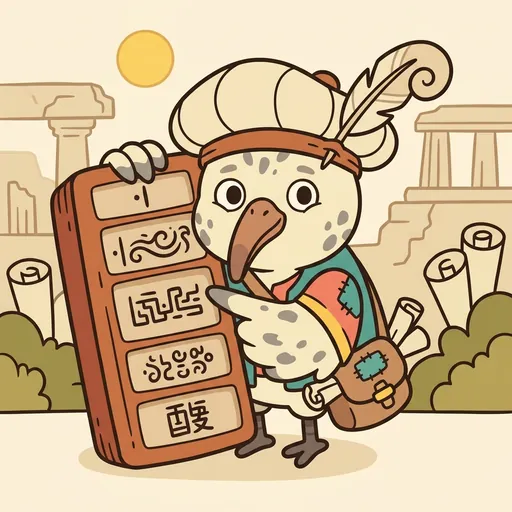
Glyph stood in her workshop, a small ibis-tween with warm-cream-and-grey-flecked feathers. She wore a chunky-cartoon scribe-cap that tilted just a little to the left. In her taloned hand, she held a small, portable writing tablet. It wasn’t just any tablet. This one glowed faintly, displaying five different scripts side-by-side, all writing the same simple phrase: “hello, world.”
Glyph was deeply patient about script diversity. She was fond of saying, “Alphabet, abjad, abugida, syllabary, logograph — each captures speech differently.” Her signature feature was that glowing tablet. The same phrase appeared in the Latin alphabet, Arabic abjad, Devanagari abugida, Japanese hiragana syllabary, and Chinese logographic characters. All five systems communicated the same meaning. Each captured it through a different writing-system structure.
This was essential. Glyph embodied the writing systems primitive — the five-way taxonomy of how scripts represent speech. She also carried the essential cross-script equity framing. No writing system was “more advanced” or “better” than another. Most novices in English-speaking education learned alphabet-centrism. They thought alphabets were the most efficient writing systems. That was wrong. Each script type had strengths and tradeoffs for its language. Chinese characters efficiently distinguish homophones in a language with many of them. Arabic abjad efficiently encodes consonant-rich Semitic morphology. Devanagari abugida elegantly captures Indian-language syllable structure. Glyph’s whole work was making the script taxonomy explicit and resisting alphabet-centrism.
Glyph was clear. “Alphabet, abjad, abugida, syllabary, logograph,” she would explain, tapping each script on her tablet. “Each captures speech differently. There’s no ‘best’ system; each fits its language’s structure. Cross-script equity is a essential rule.”
Today, a small group of new recruits gathered around her, their eyes fixed on the tablet. Glyph began her lesson, pointing to the first line.
“First, we have the Alphabet,” she said. “Think of Latin, Greek, or Cyrillic. Each symbol, like a letter, usually stands for one sound, or phoneme. Vowels and consonants are written separately. Like in ‘hello’ here.” She gestured to the Latin script. “H-E-L-L-O. Five letters, five sounds.”
Next, her talon moved to the Arabic script. “Then there’s the Abjad,” she continued. “Arabic, Hebrew, Aramaic. Here, each symbol is a consonant. Vowels are either indicated by small marks called diacritics, or you figure them out from the context. It’s really efficient for languages like Arabic, which build words from consonant roots.” She showed them the Arabic word for “hello,” which looked like a series of connected shapes. “These five shapes are mostly consonants. The vowels are understood.”
Her wing brushed the screen, highlighting the Devanagari. “This is an Abugida,” Glyph explained. “Devanagari, Ge’ez, Tibetan, Thai. Each symbol starts with a consonant, but it already has an inherent vowel sound built into it. Then, little marks change that vowel. It’s an elegant system for Indian and East African languages, which have complex syllable structures.” The Devanagari script for “नमस्ते” (namaste) looked like a beautiful, flowing art piece. “See how the marks modify the sounds?”
She tapped the Japanese hiragana. “Next, a Syllabary,” she said. “Japanese hiragana and katakana, or Cherokee. Each symbol here stands for an entire syllable. So, instead of ‘h-e-l-l-o,’ you’d have ‘he-llo.’ This works well for languages that don’t have too many different kinds of syllables.” The hiragana characters for “こんにちは” (konnichiwa) were rounded and distinct. “Five symbols, five syllables.”
Finally, her talon rested on the Chinese characters. “And last, the Logograph,” Glyph announced. “Chinese characters, some Egyptian hieroglyphs, or Mayan glyphs. Each symbol, or character, represents a whole morpheme or word. This system is fantastic for languages like Mandarin, which have many words that sound the same but mean different things. The characters help you tell them apart.” The two bold characters for “你好” (nǐ hǎo) stood out. “Two characters, two words, one meaning.”
“Different geometries; same communication,” Glyph summarized, her gaze sweeping over the recruits. “I am Glyph. The primitive I teach is writing systems. The move is 5-way taxonomy with cross-script equity.”
She paused, letting the information sink in. “There’s one more thing,” she said, her voice gentle but firm. “If you ever hear someone say, ‘Chinese characters are inefficient,’ or ‘Arabic is hard because it skips vowels’ — those are not facts. Those are alphabet-centrism speaking, not linguistics. Every single script is perfectly optimized for its own language. We practice cross-script respect here.”
“Five ways,” she reiterated, holding up five talons. “Each fits its language. There is no hierarchy among scripts.”
Glyph had grown up in the scriptorium-village, a place steeped in the history of written language. Her family had been scribe-elders for generations. They were ibises whose ancestors, according to Egyptian tradition and folklore, were associated with Thoth, the god of writing. Over many centuries, they had learned a core truth: “Writing is a craft, in many traditions, evolved for many languages. No tradition is ‘better.’” Glyph had carried this lesson forward, adding an explicit anti-orientalism to her teachings.
She had walked to LinguaQuest when she was twelve. Mira, her mentor, had asked her a simple question: “What are writing systems?” Glyph had answered without hesitation, “Alphabet, abjad, abugida, syllabary, logograph — each captures speech differently. No ‘best’ system.” Mira had simply nodded. “You are appointed.” And so, Glyph had begun her work, sharing the rich, diverse tapestry of human communication.
The LinguaQuest ensemble
Glyph is part of LinguaQuest's distributed-narrative cast. Each character embodies a different curricular primitive; together they teach the full subject.
-
Bough
Language families (genetic descent — Indo-European / Sino-Tibetan / Afro-Asiatic / Niger-Congo / Austronesian)
-

Drift
Sound change (phonological evolution — Grimm's Law, vowel shifts, palatalization)
-
Bridge
Cognates and loanwords (shared roots across languages; trade-route borrowings)
-

Cant
Sociolinguistics — dialect, register, code-switching, formal/informal speech
-
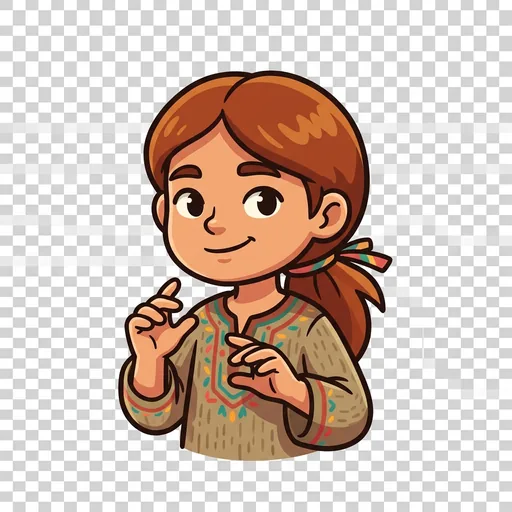
Sign
Signed languages — full natural languages spoken with hands, face, and space; each Deaf community's own, never 'just gestures'
-
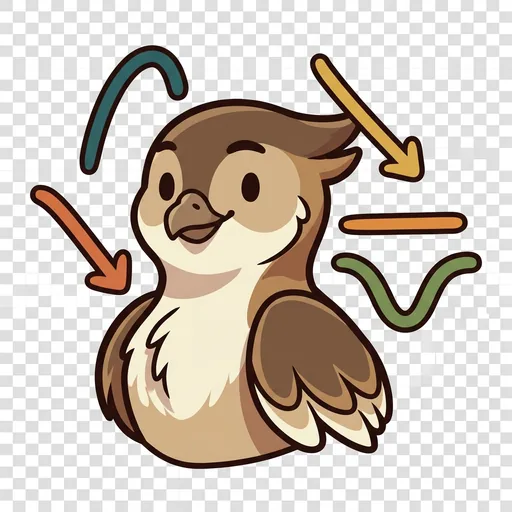
Swoop
Tone — pitch that changes a word's meaning (tonal languages); precise and sophisticated, never 'sing-song' or 'exotic'
-
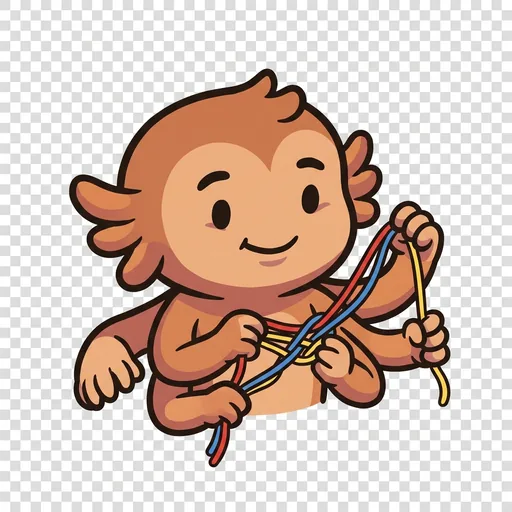
Weft
Word order / syntax — languages arrange words differently (SVO/SOV/verb-first); no order is 'backwards,' each is complete
-

Lex
Untranslatable words — words no other language has in one breath; not a gap in your language but a gift another can offer
-

Nook
Endangered languages + revitalization — keeping fading languages safe; decline is from histories of harm, never the speakers' fault; communities lead the revival