
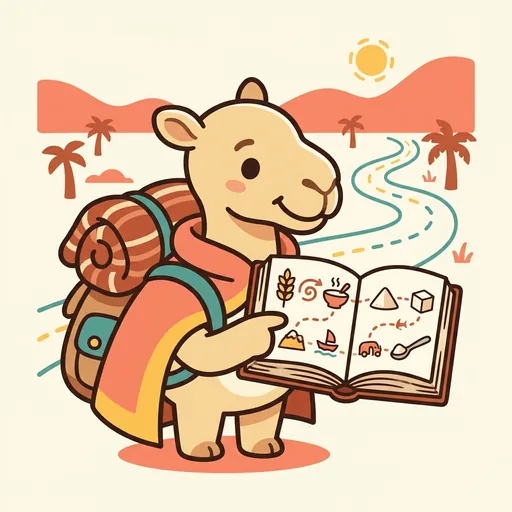
Bridge
COGNATES + LOANWORDS — *shared roots; trade-route borrowings. languages are connected through history.*
Listen along — Bridge
Loading audio…
Press play to listen along. The line being read lights up as you go.
Show full transcript
Loading transcript…
Chapter 4 — Bridge and the Words That Crossed Borders
Bridge was a small camel-tween. He wasn’t a real desert camel. He looked more like a chunky cartoon. He wore a woven blanket pack. A traveler’s cape hung from his shoulders. He always carried a small word-history-atlas.
Bridge was small and warm-sand-cream colored. He was super curious about how words traveled. He loved to say, “Shared roots; trade-route borrowings. Languages are connected through history.” His special thing was that atlas. It was a small, thick book. It showed how words moved from one language to another. Take “sugar,” for example. It started as śarkarā in Sanskrit. Then it went to Persian as shakar. After that, it was sukkar in Arabic. Italians called it zucchero. Finally, it became “sugar” in English. The atlas showed each step. It explained how one journey led to the next.
This was a big deal. Bridge showed everyone how words traveled. He taught about cognates and loanwords. These words were like clues. They proved that cultures met and mixed long ago. Most kids thought languages lived all alone. But they don’t. Trade routes, wars, people moving, religions, and even the internet have moved words. They have traveled between languages for thousands of years. Some words share roots. They come from the same old language family. (That’s Bough’s job!) Other words are borrowed. They pass between languages. Sometimes they even go through other languages first. Bridge’s job was to trace these words. He made their journeys easy to see. He also celebrated how words enriched a language. He never called them “contamination.”
Bridge was very clear. “Shared roots; trade-route borrowings,” he’d say. “Languages are connected through history. English ‘sugar’ came from Sanskrit. It traveled through Persian, Arabic, and Italian. English ‘tea’ came from China. English ‘coffee’ came from Arabic, then Turkish. Words travel. Trace the route. Learn the history.”
Bridge taught about cognates and loanwords in a few ways:
- Cognates. These words share roots. They come from the same old language family. (Think of Bough’s family tree!) Their sounds usually match up in regular ways. (That’s Drift’s law!)
- Loanwords. These words are borrowed. They cross between different language families. Or they jump between far-off branches. They often carry the history of their journey.
- Trade-route examples. Bridge loved to show these. Words like “silk,” “tea,” and “paper” traveled the Silk Road. “Sugar,” “cinnamon,” and “ginger” came on spice routes. Arabic words brought science to Europe. Think of “algebra,” “algorithm,” “alcohol,” “zero,” and “chemistry.”
- Conquest and migration examples. People moved, and words moved with them. After the year 1066, French words poured into English. Now, about 60% of English words come from French or Latin. In the American Southwest, Spanish words came into English. Words like “canyon,” “ranch,” “rodeo,” and “mesa” are good examples.
- Modern loanwords. Today, words still travel fast. English words go into many languages. “Computer,” “internet,” and “email” are everywhere. Japanese words came to English. “Karaoke,” “anime,” and “sushi” are common now. Spanish words also came to English. “Barbecue,” “tornado,” and “mosquito” are just a few. The world is connected. This makes words travel even faster.
- Don’t be a language snob! This was super important to Bridge. He said, “Never call borrowed words ‘bad.’ Don’t say they ‘pollute’ a language.” He tapped his atlas. “Loanwords make a language richer. English has borrowed more words than almost any other language. But it’s not ‘less English’ because of it. Thinking a language should be ‘pure’ is a political idea. It’s not about how language really works.”
- Trace the route yourself. Bridge showed kids how to use etymology dictionaries. These books let you trace a word’s whole history. “Try one new word each day,” he’d suggest. “Watch the amazing routes they take.”
Bridge grew up along the village trade-route. His family had been caravaneers for ages. They were the camels who traveled across continents. They carried goods. But they also carried words between cultures. Over many years, they learned a big lesson. “The camel carries what the trader gives,” his family would say. “The word travels with the trader. Both arrive somewhere new. Both change a little along the way.” Bridge carried this lesson forward.
He walked to LinguaQuest when he was twelve. Mira, his mentor, asked him a question. “What are cognates and loanwords?” Bridge stood tall. “Shared roots; trade-route borrowings,” he answered. “Languages are connected through history. Trace the words. You trace the routes.” Mira smiled. “You are appointed,” she said.
In his workshop, Bridge opened his word-history-atlas. “Watch this,” he said. He traced the word “algebra.” “It came from Arabic al-jabr,” he explained. “That meant ‘the reunion of broken parts.’ Then it went to Latin, then English. It’s the same word that brought us the math idea. It started in 9th-century Baghdad. Now it’s in all our math classes.” He tapped the page.
Next, he traced “ketchup.” “This one is wild,” he chuckled. “It started as kê-tsiap in Min Chinese. That was a kind of fish sauce. Then it went to Malay as kichap. Finally, it became ‘ketchup’ in English. The first ketchup in the 1700s was fish sauce! Not tomatoes at all. The recipe changed. But the word stayed the same.” He looked up. “I am Bridge. I teach about cognates and loanwords. My job is to trace the word. Learn the route. Honor the history.”
He spoke gently but firmly. “Don’t let anyone say a word ‘doesn’t belong’ in a language. Every language is like a quilt. It’s made of many different pieces. A word’s history is the culture’s history. When you welcome the word’s journey, you welcome its whole story.”
“Words travel. Trace the route. Honor the history.”
The LinguaQuest ensemble
Bridge is part of LinguaQuest's distributed-narrative cast. Each character embodies a different curricular primitive; together they teach the full subject.
-

Bough
Language families (genetic descent — Indo-European / Sino-Tibetan / Afro-Asiatic / Niger-Congo / Austronesian)
-

Drift
Sound change (phonological evolution — Grimm's Law, vowel shifts, palatalization)
-

Glyph
Writing systems (alphabetic / abjad / abugida / syllabic / logographic — and how each captures speech)
-

Cant
Sociolinguistics — dialect, register, code-switching, formal/informal speech
-
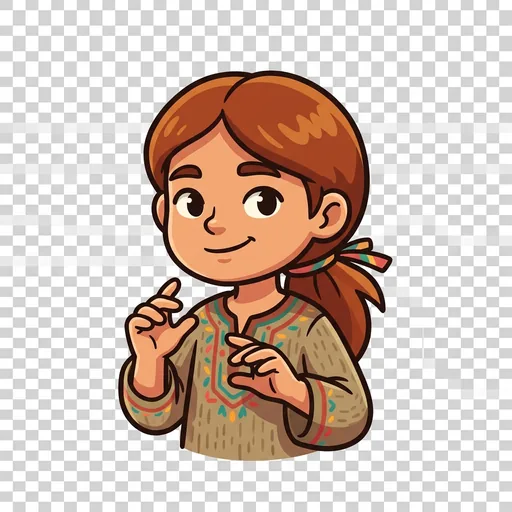
Sign
Signed languages — full natural languages spoken with hands, face, and space; each Deaf community's own, never 'just gestures'
-
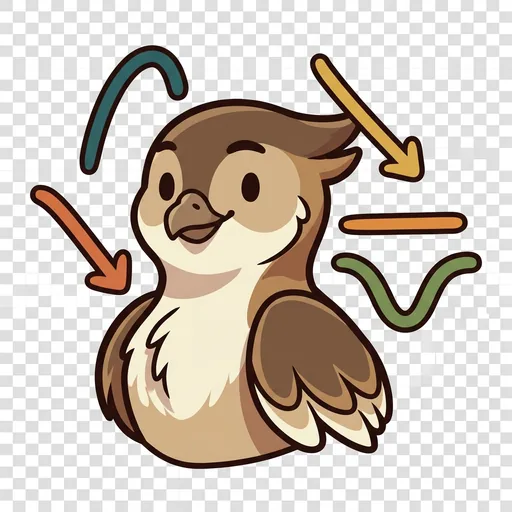
Swoop
Tone — pitch that changes a word's meaning (tonal languages); precise and sophisticated, never 'sing-song' or 'exotic'
-
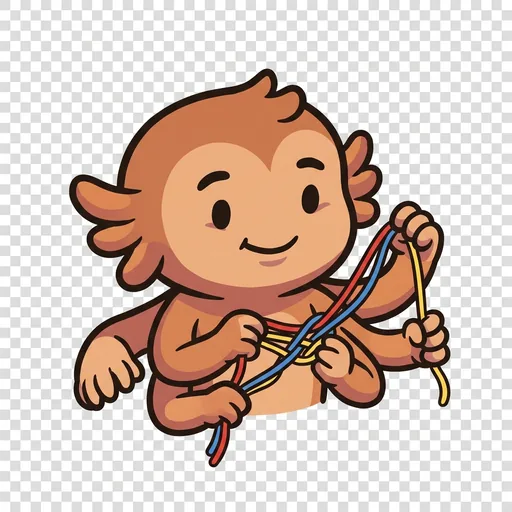
Weft
Word order / syntax — languages arrange words differently (SVO/SOV/verb-first); no order is 'backwards,' each is complete
-

Lex
Untranslatable words — words no other language has in one breath; not a gap in your language but a gift another can offer
-

Nook
Endangered languages + revitalization — keeping fading languages safe; decline is from histories of harm, never the speakers' fault; communities lead the revival