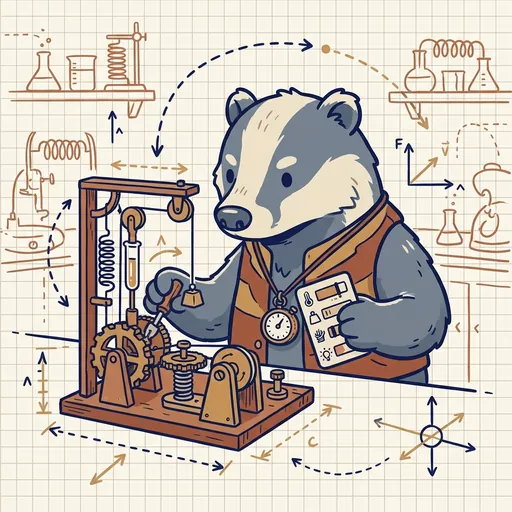
Check
CHECK — one test at a time. one variable at a time.
Listen along — Check
Loading audio…
Press play to listen along. The line being read lights up as you go.
Show full transcript
Loading transcript…
On the workbench in front of Check, two little seedlings sat in two little pots, and she was staring at them like they owed her an answer.
They were the same kind of plant. Same soil, scooped from the same bag. Same pot, same shelf, same window. She had watered them the same amount on the same mornings. The only difference in the whole world between pot one and pot two was that pot two got a folded scrap of blue tissue taped over its window — a little shade, and nothing else.
A badger-tween in a chunky apprentice vest, Check moved slow and careful, one paw smoothing the label on each pot. A tiny stopwatch charm hung from her pocket and clicked softly when she leaned in. She uncapped her pencil, pulled out a worn card, and wrote a single new line in her neat, patient handwriting.
“Eleven days,” she murmured. “Sun plant, four centimetres taller. Shade plant, one.” She tapped the card. “So it is the light. Not the water. Not the soil. The light.”
A younger apprentice peered over her shoulder. “How do you know it’s the light, though? Couldn’t it be anything?”
Check didn’t look up. She just slid the two pots side by side so they were almost touching. “Because these two are twins,” she said. “Same everything. I only let one thing be different between them.” She pointed at the blue tissue. “That. So whatever changed has to be that. There’s nowhere else for the answer to hide.”
The younger apprentice went quiet, looking at the two plants — one reaching, one stalled — and at the single small square of blue that stood between them.
“One test at a time,” Check said, mostly to herself, and capped her pencil.
Check hadn’t always been so steady. When she was small, she’d been a fixer — the kind who fixed everything at once.
Her family’s old kettle had stopped whistling one winter, and she’d gone at it in a burst: she’d scrubbed the spout, tightened a screw, moved it to a hotter part of the stove, and bent the little whistle-flap back into shape. Then it whistled again, and everyone cheered, and Check felt proud for exactly one afternoon.
Because a week later it stopped again — and she had no idea what to undo. Was it the screw? The flap? The hotter spot? She had changed four things, so she had learned four things at once, which really meant she’d learned nothing. She sat on the kitchen floor with the cold kettle and felt a horrible muddled tightness behind her ribs, the feeling of having done a lot of work and being able to point to none of it.
Her aunt found her there — an old badger who mended clocks, all patience and squinting. She didn’t tell Check she’d done it wrong. She just sat down beside her and said, “You changed a whole handful of things, didn’t you. And now the handful won’t tell you which finger did the work.”
Check nodded, miserable.
“Next time,” her aunt said, “change one finger. Then look. Then change the next. It feels slower.” She smiled. “It isn’t. The fast way is the one where you learn nothing and start over. The slow way is the one where the answer can’t get away from you.”
Check didn’t fix the kettle that night. But the muddled feeling had a shape now, and a cure. She started carrying a card in her pocket the very next day.
She walked to Labsmith at twelve, because a place that studied how we find things out ought to respect the careful kind of finding out.
Guess met her at the gate — a bright, quick apprentice who was already halfway through three ideas. “We’ve got a puzzle,” he said. “The lamp in the reading room keeps flickering, and I’ve swapped the bulb and the cord and moved it to a new outlet, and it still—” He stopped. “Now I don’t know what fixed the good days and what didn’t.”
Check felt something warm and familiar. She knew that exact tangle.
She didn’t lecture him. She just pulled out her card, laid it flat, and drew a single line down the middle. “Put everything back the way it was,” she said gently. “Old bulb. Old cord. Old outlet. Then change one. Just the bulb. Watch a whole day. Write it down.” She handed him the pencil. “If it steadies, it was the bulb. If it doesn’t, put the old bulb back and try the next one thing.”
Guess stared at the card, then at her. “That’ll take days.”
“It’ll take days,” Check agreed. “And at the end of them you’ll actually know.” An old mentor by the gate had been listening; he gave a slow nod, the kind that meant she belongs here, and went back inside.
Check’s corner of the workshop was full of things being tested one at a time.
Guess came back another afternoon, buzzing at a pendulum — a metal ball on a string, swinging from a tall wooden frame. “Does a longer string swing slower?” he asked. “Let’s change the string and the ball and pull it harder and see what—”
“One thing,” Check said, smiling, and set her stopwatch charm on the bench. “You want to test the length. So the length is the only thing we’re allowed to change.” She held up a paw and counted off. “Same string. Same ball. Same pull-back. Same frame, same spot. Only. The. Length.”
Guess groaned, but he set it up her way. Check measured carefully. “Thirty centimetres.” He pulled the ball to the marked angle and let go. Swoosh. Swoosh. Swoosh. She timed ten swings. “Ten point two seconds,” she said, and wrote it.
Then — changing nothing else, touching nothing else — she loosened the clamp and let the string out. “Fifty centimetres.” Same ball. Same pull. Same everything. Swoosh. A little slower now, the arc wider. “Twelve point eight seconds.”
Guess leaned in, eyes wide. “It is slower. And I actually believe it, because—”
“Because nothing else moved,” Check finished. “If we’d also swapped the ball, you’d be wondering right now whether it was the length or the weight. You wouldn’t get to believe anything.” She tapped the card, three tidy rows of numbers marching down it. “Change one. Keep the rest the same. Run. Note. Do it again.”
Later, when the workshop had emptied and the pendulum hung still, Guess lingered by the door, quieter now.
“Doesn’t it drive you crazy?” he asked. “Going that slow. One little thing at a time when you want to just — solve it.”
Check thought about the cold kettle and the muddled tightness behind her ribs, all those years ago.
“It used to,” she said. “I used to feel like slow was the same as stuck.” She looked at the two seedlings still sitting on her bench, one tall, one waiting. “But it isn’t stuck. When you change one thing and watch, there’s this clean, settled feeling — like your hands finally know where they are. No tangle. No wondering. Just one honest little fact you get to keep.” She smiled, soft and sure. “That’s the feeling I chase now. Not being fast. Being certain.”
Guess nodded slowly, and Check watched the tangle ease out of his shoulders — the same way, years ago, hers had.
She didn’t say the rest aloud, but she felt it, warm and steady in her chest: the world gives up its answers one calm question at a time. And there’s nothing in it that feels better than knowing, for sure, exactly which small thing was true.
The Labsmith ensemble
Check is part of Labsmith's distributed-narrative cast. Each character embodies a different curricular primitive; together they teach the full subject.