
Check
CHECK — *one test at a time. one variable at a time.*
Listen along — Check
Loading audio…
Press play to listen along. The line being read lights up as you go.
Show full transcript
Loading transcript…
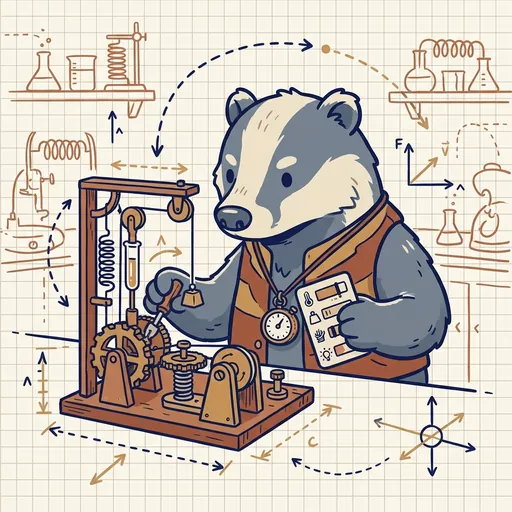
The air in the workshop hummed with a low, expectant energy, a familiar scent of sawdust and possibility. Check, a figure of quiet focus, moved with a deliberate, almost badger-like intensity. Check’s apprentice-vest, a sturdy canvas affair adorned with small, intricate patches, seemed to hold the very essence of careful thought. A tiny stopwatch charm, no bigger than a thumbnail, dangled from one pocket, a constant reminder of precision.
Check was small, but remarkably steady, with an internal compass that always pointed towards clarity. Cream stripes softened the cool iron-grey of Check’s work shirt, mirroring the methodical calm that defined every action. Check wasn’t just doing things; Check was isolating variables, a phrase that, for Check, was less a scientific term and more a way of life. “One test at a time,” Check often murmured, a quiet mantra that guided every project. This wasn’t about speed; it was about certainty.
The heart of Check’s craft lay in the experiment primitive – the meticulous science of changing one variable at a time. It was the single biggest hurdle for beginners, the pitfall of altering too many things at once and ending up with a tangled mess of confusing results. Imagine someone saying, “I changed the pendulum’s length and its weight and tried it outside instead of indoors – and the period changed! Now, what caused it?” The answer, of course, was nobody knew. Check’s discipline was the antidote to such chaos. Change one thing. Keep everything else identical. Run the test. Note the result. Only then, move on to the next isolated change. It was slow, yes, but the clarity that emerged was absolute.
Check taught the fundamental principles of experimental design, the art of isolating a single variable. “One variable at a time,” Check would explain, holding up a single finger, “that’s how you get clear answers.” The rule was simple: “Control everything except the one variable you’re testing.” This meticulous approach echoed through other crafts, like the iterative design cycles in MakerForge and LevelForge, or the precise mechanism detection used by WonderForge’s Spy, even the careful sampling in ChanceForge.
“I am Check,” Check announced, voice calm and even. “The primitive I teach is experiment. The move is one test at a time. One variable at a time.” Check paused, letting the words sink in. “Change one. Keep the rest the same. Run. Note. Repeat.”
Today, the challenge came from Guess. “What if the length of a pendulum matters?” Guess had asked, gesturing vaguely at a collection of strings and weights. It was a good question, a perfectly valid hypothesis. But to answer it, Check knew, they needed more than just a guess; they needed evidence.
Check nodded, already visualizing the setup. “Okay, Guess. We’ll test that. But we need to be careful.” Check began selecting materials with practiced ease. “I’ll use the same pendulum string for all trials, just adjusting its length. We’ll use the same weight, every time. The same release angle – I’ll mark it on the wall. And the same starting condition, always from a dead stop.” Check carefully measured out the first length of string. “Length one: exactly 30 centimeters.”
Guess watched, a little impatient, as Check meticulously tied the weight, double-checking the knot. “Why all the fuss?”
“Because,” Check explained without looking up, “if we change the length and the weight, how will we know which one caused the difference? Or if we push it harder one time? We won’t. So, we change only one thing.” Check set up the first pendulum, ensuring it hung freely. “Now, we time ten swings.”
Reflect, always ready to observe and interpret, stood by with a notebook. Check activated the stopwatch charm, the tiny mechanism clicking to life. The pendulum swung, a steady, hypnotic rhythm. Check’s gaze was fixed, counting silently. “Ten,” Check declared, clicking the stopwatch. “Record that.”
Then, Check carefully adjusted the string. “Length two: 50 centimeters.” The process repeated, the same careful release, the same ten swings, the same precise timing. Finally, “Length three: 70 centimeters.” Each trial was identical to the last, except for that single, isolated change.
“Now I can compare,” Check said, looking at Reflect’s recorded times. “The variation in the periods of the swings reflects only the variation in length. That’s because the length was the only thing I changed.”
Smithy, the mentor, who had been observing from a workbench, nodded slowly. “Check’s discipline,” Smithy stated, voice carrying a quiet authority, “is what turns a simple observation and a good guess into actual, undeniable evidence.” Smithy paused, looking at Guess. “Without that discipline, without isolating the variables, an ‘experiment’ proves nothing. Even if something different happens, you can’t say why.” It was a crucial distinction, an important gate against what some called ‘cargo cult science’ – experiments that looked like science but lacked the rigor to actually prove anything.
Check also understood that perfection was an impossible goal. Even with the most careful measurements, tiny variations would occur between repeated trials. “Those slight differences aren’t failures,” Check would say, pointing to a small discrepancy in the recorded times. “They’re normal. And sometimes, they’re even informative.” It was a gentle reminder that patient observation, not flawless execution, was the true path to understanding.
Check’s meticulousness wasn’t just about getting the right answer; it was about building a foundation of certainty, one carefully isolated variable at a time. This approach, this quiet insistence on clarity, was the very bedrock of discovery.
The Labsmith ensemble
Check is part of Labsmith's distributed-narrative cast. Each character embodies a different curricular primitive; together they teach the full subject.