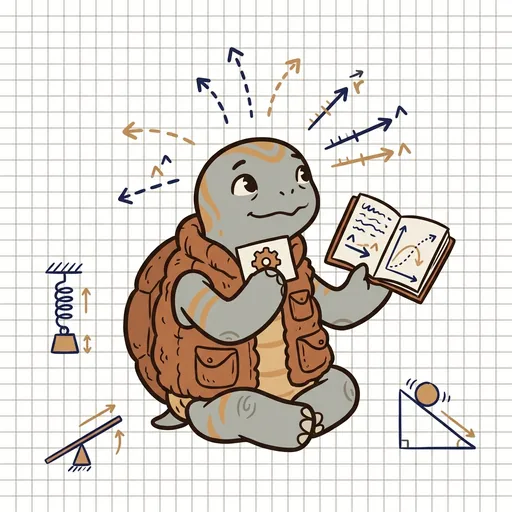
Reflect
REFLECT — what did we learn? what surprised us? what's next?
Listen along — Reflect
Loading audio…
Press play to listen along. The line being read lights up as you go.
Show full transcript
Loading transcript…
Chapter 4 — Reflect and the What-Did-We-Learn
Reflect sat cross-legged on the floor of the lab with three numbers written on a card, and she did not move for a very long time.
The pendulum experiment was over. Check had done the timing, careful as always, and handed her the results before wandering off. A thirty-centimetre string swung back and forth in one-point-one seconds. Fifty centimetres took one-point-four. Seventy took one-point-seven. That was all. Three lines of numbers on a small revision card.
A younger apprentice crouched beside her, waiting. “So we’re done, right? We got the numbers.”
“Not done,” Reflect said, without looking up. “We got the numbers. We haven’t got the learning yet.”
The apprentice frowned. “Aren’t those the same thing?”
Reflect tapped the card slowly with one grey finger. “Watch.” She read the numbers out loud, once, twice. “Longer string, slower swing. Our first guess was right — good.” She paused. “But look. Thirty to fifty added zero-point-three. Fifty to seventy added zero-point-three again.” She went very still. “That’s strange. If the string doubles, why doesn’t the time double? The numbers are telling us something, and it isn’t the thing we asked.”
She pulled her journal into her lap and started to draw. The apprentice leaned in, not sure what they were watching, only sure that Reflect had stopped seeing the room around her at all.
Reflect had learned to sit with numbers this way when she was small, and she’d learned it the slow, uncomfortable way.
The first real experiment she ever ran, she’d grown two rows of bean plants — one in the window, one in the cupboard — and measured them every day for a month. At the end she had a whole page of heights, neat and precise, and she’d felt a strange sinking. She had the numbers. She had done it. And she still didn’t understand a single thing about beans.
“I did all the work,” she told her grandfather that evening, “and I’ve got nothing. Just a page of little numbers that don’t mean anything.” Her chest felt tight and heavy, the way it does when effort doesn’t turn into an answer.
Her grandfather — an old, unhurried person who measured tea by eye and was never wrong — had looked at her page for a while. He hadn’t told her the answer. He’d asked, “Which row grew taller?”
“The window one. Obviously.”
“And which day did it pull ahead?”
She looked. She hadn’t seen it before. There was a day, right in the middle, where the window row suddenly leapt. ”…Day eleven. Something happened on day eleven.”
“There,” he’d said, gently. “The numbers were sitting there the whole time. They didn’t do the noticing. You did.” He tapped her chest, right where the heavy feeling had been. “That knot you felt — that wasn’t nothing-happened. That was the part where the work isn’t finished yet. The numbers are just the ingredients. The thinking is the cooking.”
That night Reflect understood something that changed her whole life: an experiment doesn’t hand you knowledge. It hands you clues, and then it waits, quietly, to see whether you’ll bother to read them.
She came to Labsmith at twelve, because a place that studied how we know things ought to care about the step where knowing actually happens.
Smithy, the old mentor who ran the workshop, met her at the door and didn’t ask her to prove she was clever. Smithy asked one thing. “You’ve finished an experiment. You’ve got your results. What’s left to do?”
Most people said write it down. Some said we’re done. Reflect said nothing at first. She picked up a jar of buttons off the nearest shelf, tipped them onto the table, and looked at them.
“Well?” Smithy said. “There’s your data.”
“That’s not data,” Reflect said quietly. “That’s a mess of buttons. It only becomes data when I ask it a question.” She started sorting them by size without being told to. “What did we get? What’s surprising? What do we do next? The pile can’t answer that. Only a person can.”
Smithy watched her sort for a long moment, then smiled. “Most people think the results are the answer,” Smithy said. “You know they’re only the beginning. You belong here.”
Reflect’s corner of the workshop was where finished experiments came to mean something.
A boy dropped onto the stool across from her one afternoon, deflated. He’d run a survey, counted every answer twice, made a perfect chart. “I did everything right,” he said. “And I still feel like I don’t get it. It’s just… a chart.”
Reflect knew that slump. She’d felt it over a page of bean heights.
“Read me your chart,” she said.
“Most people picked the blue one.”
“Okay. What surprised you?”
He opened his mouth to say nothing — then stopped. ”…Actually, the little kids didn’t. The little kids all picked red. I didn’t ask them to be different. They just were.”
“There.” Reflect leaned forward. “That’s the good part. That’s the part your guess didn’t predict. What does it make you want to do now?”
He thought. “Ask why the little kids are different. Maybe run it again, just with them.”
“So it’s not just a chart,” Reflect said. “It’s a chart that gave you a brand-new question. That’s the whole trick. We look, we guess, we test, and then—” she tapped her journal “—we learn: what did we find, what surprised us, what’s next. And the ‘what’s next’ loops you straight back to looking again.” She grinned. “It never really ends. You walk it once and it’s a lesson. You walk it a hundred times and it’s how you think. Nobody finishes science. You just keep going around.”
The boy laughed, a small surprised laugh, and reached for a fresh card to write his new question down.
Later, when the workshop had emptied out, the first apprentice from the morning came back, still turning the pendulum card over in their hands.
“When the numbers just sit there,” they said, “and you can’t tell yet what they mean… how do you know there’s anything in them at all?”
Reflect thought about the bean plants. About the tight, heavy, nothing-happened feeling, and her grandfather’s finger tapping her chest.
“You don’t, at first,” she said honestly. “There’s this stuck feeling — like you’ve done all the work and you’re holding a pile of clues and none of them will look at you.” She smiled a little. “But that heavy feeling isn’t the end. It’s the part right before understanding, when your brain is quietly turning things over. If you sit with it and keep asking — what did we learn, what surprised us, what’s next — the pile starts to speak.”
She looked down at the pendulum numbers, at the gentle curve she’d drawn connecting them, and let out a slow, satisfied breath. Not the tight one from the beans. A lighter one.
“There it is,” she said softly, mostly to herself. “The knot’s gone. I can feel it — it just fit.”
The Labsmith ensemble
Reflect is part of Labsmith's distributed-narrative cast. Each character embodies a different curricular primitive; together they teach the full subject.