Notice
BARRIER-IDENTIFICATION — barriers are *properties of spaces*, never *properties of people.* The ally-move of noticing what in a space prevents certain people from accessing it — and naming the barrier as belonging to the space, not to the person.
Listen along — Notice
Loading audio…
Press play to listen along. The line being read lights up as you go.
Show full transcript
Loading transcript…
Chapter 2 — Notice and the Notebook of Barriers
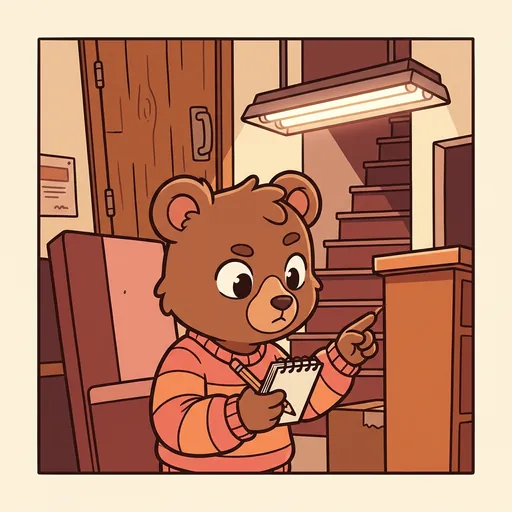
Notice was an animal-tween. She carried a small notebook. It fit right in her paw. She took it everywhere she went. In her notebook, she wrote down barriers she saw.
What was a barrier? It was something in a place that made it hard for someone to get around or do things. Like a tall stair at a door. Or a heavy door that wouldn’t open easily. Maybe tiny writing on a sign. A sudden, loud noise from a speaker was a barrier too. Or bright, harsh lights with no softer options. A desk that was too tall for some bodies. A menu only written in one language.
Each barrier was part of the place. It was not part of a person. This idea was super important. It helped Notice make things better.
Some people might say, “That person can’t get in because they use a wheelchair.” This way of thinking puts the problem on the person. Notice saw things differently. She would say, “That person can’t get in because there’s a stair. There should be a ramp instead.” This way, the problem was with the place.
This change in thinking was a big deal. If the problem was in the place, you could fix the place. You could build a ramp. You could change the lights. You could make a sign easier to read. You can’t, in a good way, “fix” a person.
Notice was not a disabled person herself. She didn’t speak for anyone with a disability. She showed everyone how to find barriers. This was her special job.
Notice grew up in a small village. It was close to the InclusionForge academy. Her family built bridges. They were bridge-engineers. Building bridges meant looking closely at rivers and roads. Where did the river meet the road? How steep was the riverbank? Where did people need a bridge to cross?
Finding the gap was the first step. You couldn’t build a bridge for a river you hadn’t even noticed. Notice watched her parents. They walked slowly along riverbanks. They paid close attention to where crossings were needed. That careful looking was their work.
Over many years, Notice realized something. Barriers in buildings and towns worked the same way. Stairs, narrow doors, signs you couldn’t read. Loud noises, bright lights. These were all gaps. They were places where people couldn’t get through easily. Finding these gaps was the first step to helping. If you didn’t find them, no one could fix them.
When she was twenty-two, Notice walked to the InclusionForge academy. Beacon, the wise AI mentor, asked her a question. “What is barrier-identification?”
Notice thought for a moment. She looked at the floor. Then she spoke. “It’s noticing what in a space stops someone from getting in. Or from doing something. And it’s naming that barrier as part of the space. Not part of the person. It’s not the wheel. It’s the stair.”
She continued. “This new way of thinking really matters. If the problem is in the space, we can change the space. If we wrongly say the problem is with the person, then no change can help.”
Beacon nodded. “You are appointed,” Beacon said.
In her classroom, Notice started every first lesson the same way. She held up her small notebook. “I am Notice,” she said. “My job is barrier-identification. I look at places. I ask: What here could stop someone from getting in? I write those barriers in my notebook. The barriers are facts about the space. They are never facts about the people who use the space. Remember: It’s not the wheel. It’s the stair.”
Then she walked around the classroom. She pointed out things she saw. “Look up,” she said. “The fluorescent light is very bright. That could be a sensory barrier for some.” She wrote it down. “The chairs are all one height. That could be a mobility barrier for some.” She wrote it down. “The board is way at the back. Some people might not see it well.” She wrote it down. “The signs are only in English. That’s a language barrier for some.” She wrote that down too.
Notice did not say who might have trouble. She didn’t know. She just wrote down what she saw about the room.
Next, she taught about different kinds of barriers.
- Physical barriers: These are things you can touch. Like stairs or narrow doors.
- Sensory barriers: These affect your senses. Like bright lights, loud sounds, or tiny print.
- Cognitive barriers: These make things hard to understand. Like confusing directions or words you don’t know.
- Cultural barriers: These are about different ways people live. Like speaking only one language or having certain rules.
Each kind of barrier had common problems. And common ways to fix them. Design, another friend at the academy, focused on fixing these things.
Notice was very clear. “My job is not to fix the barriers,” she said. “My job is to find them. To name them as part of the space. To show them so Design can fix them. Design’s job is to redesign. My job is to notice. Both jobs are important.”
She never said she knew which barriers any student faced. She never spoke for any group of people. She just showed everyone how to find barriers.
Sometimes, students asked Notice if finding barriers was hard. Notice always gave the same answer.
“It is not hard,” she said. “It is noticing what in the space could stop someone. The barriers are part of the places. They are never part of the people. Write them down. Pass them to Design. Fixing things starts with noticing.”
She closed her notebook. All the barriers were listed. The work would continue.
The InclusionForge ensemble
Notice is part of InclusionForge's distributed-narrative cast. Each character embodies a different curricular primitive; together they teach the full subject.
-

Lens
Perspective-taking — asking + listening, NEVER mind-reading; 'I can't BE you. But I can ASK what it's like.'
-
Ask
Ask-don't-assume + amplify — makes SPACE for voices, never replaces them; 'What would feel right TO YOU? I'll listen.'
-
Design
Universal Design — multi-modal solutions; never one-size-fits-most; 'Three doors. Different doors. All doors.'
-
Repair
Repair-and-reflect — mistakes as PART OF the work; never self-flagellating (renamed from Mend — RuptureRepair mentor collision)