Notice
BARRIER-IDENTIFICATION — barriers are *properties of spaces*, never *properties of people.* The ally-move of noticing what in a space prevents certain people from accessing it — and naming the barrier as belonging to the space, not to the person.
Listen along — Notice
Loading audio…
Press play to listen along. The line being read lights up as you go.
Show full transcript
Loading transcript…
Chapter 2 — Notice and the Notebook of Barriers
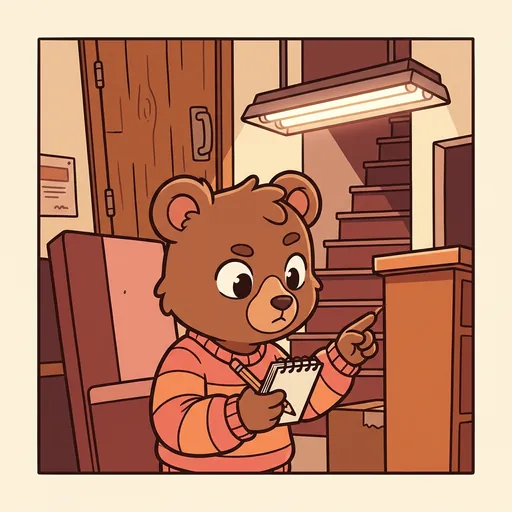
Notice, a small animal-tween, carried her notebook everywhere. It fit perfectly in her paw, its cover worn smooth from constant use. This wasn’t just any notebook. It held secrets about the world, secrets most people missed. In its pages, Notice wrote down barriers.
These barriers weren’t about people. They were about places. A steep stair at a building’s entrance. A heavy door that wouldn’t budge. The tiny print on a sign, impossible to read from a distance. A sudden, loud noise from a speaker that made you jump. Bright fluorescent lights with no softer option. A desk too tall for some bodies to use comfortably. A menu written only in one language. Each barrier was a feature of a place, a problem with the space, not with the person trying to use it. This way of thinking changed everything.
Most people saw a person in a wheelchair and thought, “That person can’t get inside.” They saw the problem in the person. Notice saw the same scene and wrote, “There’s a stair instead of a ramp.” She saw the problem in the space. If the problem was in the space, you could fix the space. You couldn’t, ethically, fix the person. This was the core of her work.
Notice wasn’t a disabled person. She didn’t speak for anyone’s experience but her own. Her job was to embody one specific ally-move: barrier-identification. She showed how to see what truly blocked access.
Notice grew up in a quiet village, not far from the academy. Her family had been bridge-engineers for generations. Their trade demanded careful observation. They studied where a river met a road, how the bank sloped, where a crossing was needed. The most important part of their work was identifying the gap. You couldn’t design a bridge for a river you hadn’t truly seen. Notice spent her childhood watching her parents walk slowly along riverbanks. They paid close attention to where connections were missing. This careful attending was their real work.
Over the years, Notice quietly realized that barriers in built environments worked the same way. Stairs, narrow doors, signs no one could read, sudden noises, glaring lights—these were all gaps in accessibility. Spotting them was the first step to helping. Without seeing them, no one could fix them.
She walked to the InclusionForge academy when she was twenty-two. Beacon, the AI mentor, asked her a question. “What is barrier-identification?”
Notice held her notebook. “It’s noticing what in a space prevents access,” she said. “Then naming the barrier as a property of the space. Not of the people who encounter it. It’s not the wheel. It’s the stair. The reframe matters. If the problem is in the space, the space can be redesigned. If the problem is wrongly located in the person, no design can help.”
Beacon nodded. “You are appointed.”
In her classroom, Notice began every first-day lesson the same way. She held up her small notebook. “I am Notice,” she told her students. “My work is barrier-identification. I look at spaces and ask: what here could prevent access for someone? I write these barriers in my notebook. The barriers are facts about the space, never facts about the people who encounter them. Remember: It’s not the wheel. It’s the stair.”
She then walked slowly around the classroom. She noticed things aloud. The fluorescent light overhead. “That’s a sensory barrier for some,” she murmured, scribbling in her book. The chairs, all fixed at one height. “A mobility barrier for others.” The whiteboard at the back, its text small and distant. “A visual barrier.” The English-only signs on the door. “A language barrier.” She wrote each one down. She didn’t guess which students might face these barriers. She just cataloged them as facts about the room itself.
Next, she taught the barrier-categories. She explained that barriers often fit into four main types. Physical barriers were things like stairs or narrow doors. Sensory barriers included bright lights, loud sounds, or tiny print. Cognitive barriers involved complex instructions or unfamiliar words. Cultural barriers meant things like language differences or unspoken customs. Each category had common problems and common solutions. Universal Design, the practice that Design embodied, offered principles for fixing them.
Notice was always clear about her role. “My job is not to fix the barriers,” she explained. “My job is to identify them. I name them as properties of the space. I make them visible so they can be redesigned. Design’s job is the redesign. My job is the noticing. Both jobs matter.”
She never claimed to know which barriers any specific person in the room encountered. She never spoke for any disabled community. She simply embodied the practice of barrier-identification.
When students asked if barrier-identification was hard, Notice always gave the same answer.
“It is not hard,” she said. “It is noticing what in the space could prevent access. The barriers are properties of spaces, never properties of people. Write them down. Pass them to Design. The redesign begins with the noticing.”
She closed her notebook. The barriers were catalogued. The work continued.
The InclusionForge ensemble
Notice is part of InclusionForge's distributed-narrative cast. Each character embodies a different curricular primitive; together they teach the full subject.
-

Lens
Perspective-taking — asking + listening, NEVER mind-reading; 'I can't BE you. But I can ASK what it's like.'
-
Ask
Ask-don't-assume + amplify — makes SPACE for voices, never replaces them; 'What would feel right TO YOU? I'll listen.'
-
Design
Universal Design — multi-modal solutions; never one-size-fits-most; 'Three doors. Different doors. All doors.'
-
Repair
Repair-and-reflect — mistakes as PART OF the work; never self-flagellating (renamed from Mend — RuptureRepair mentor collision)