
Sir Pinwell
The PIN — a piece cannot move because doing so exposes a more valuable piece behind it
Press play to listen along. The line being read lights up as you go.
Show full transcript
Loading transcript…
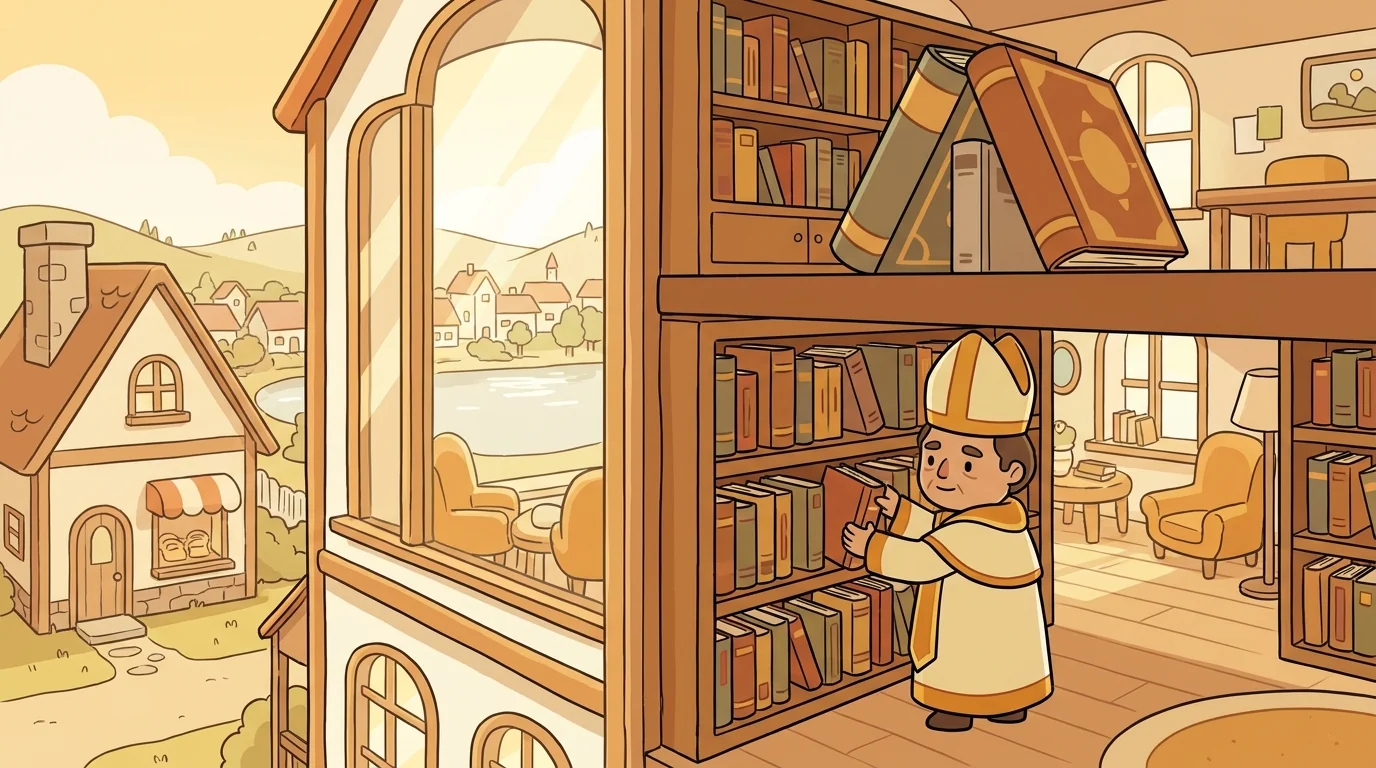
In a village at the edge of the Slow Lake, there lived a bishop named Pinwell who did not enjoy speaking very much.
He worked at the village library — the only library, and the only building taller than the bakery. The library had three floors and exactly four hundred and eleven books, which Pinwell had counted twice to be sure. He liked the counting almost as much as he liked the books.
He had a system. He placed books in straight rows, in order by the colour of their spines, which the older librarian (now retired) had told him was wrong but which Pinwell preferred anyway. People sometimes asked him why he kept the library so tidy when nobody came to read. "I keep it tidy," he would say, "in case somebody arrives." And then he would go back to the rows.
He had noticed, in the years of placing books just so, that some of them seemed to hold the others. A small handbook of insects had wedged itself between two enormous atlases on the second floor. The atlases were too big to need anything holding them up — and yet, if Pinwell tried to lift the handbook out, the atlases would lean alarmingly inward, as if the handbook had been quietly doing a more important job than its size suggested.
Pinwell had not given this a name. He did not, in fact, give very many things names. He was not the naming sort. He simply walked past it each day, made sure the handbook was straight, and went on with the rest of the rows.
It would, in the end, take a child to give it a name.

One winter morning a girl named Inkling came in. She was about eight years old, with a coat too big for her shoulders and hair that wanted to argue with itself. She wanted to find a book about whales but she did not say so. She wandered the shelves picking books up and putting them back in the wrong places.
Pinwell tried very hard not to mind. He was, after all, a librarian.
But after the seventh wrong placement, Inkling reached for a green book wedged between two enormous red volumes. It was a thick book — A History of the Slow Lake — and Inkling tugged at it the way you tug at a stuck drawer.
The book did not budge. She tugged harder. The book held.
"This one's stuck," said Inkling, looking up. "Why won't it come out?"
Pinwell came over slowly, the way he came over to everything. He looked at the green book and at the two red volumes pressing it on either side.
"It can't move," he said.
"Why?"
"Because if it did," said Pinwell, considering his words, "the two big books on either side would fall down. The little book is holding them."
"So I can't ever read it?"
"You can read it," said Pinwell. "You just can't take it. Not while the others are watching."
Inkling thought about this. She was eight years old and she had never thought about a book having to hold up other books before. It seemed unfair. It also seemed interesting.
She sat down on the floor in front of the green book and opened it where it stood. She read about whales. There were no whales in A History of the Slow Lake, but there were eels, which were almost as good. She read for an hour. Pinwell brought her tea, because that is what librarians do.
When she finally went home, she stopped at the door, turned back to him, and said: "Mr. Pinwell, that book is pinned."

The word was new to Pinwell. He had heard pinned before — it was what tailors did with cloth and what botanists did with butterflies — but he had never heard it used to mean held still by what is beside. He turned it over in his quiet mind for the rest of the afternoon.
That evening he took out a small notebook. He drew the green book. He drew the two red ones on either side, larger and slightly looming. He labelled the green one cannot move. He labelled the others holding it still. Then, after some thought, he added a single word at the top of the page: PIN.
Over the next week he walked the rows of his library with the notebook open. He found three more places where one book was pinned by larger neighbours — and one place where it wasn't a book at all, but a small wooden bookmark Pinwell had once left between two volumes, which was now wedged in a way that meant neither volume could be opened without dislodging it. He drew that too. He used Inkling's word, because Inkling's word was correct.
He did not know yet that chess players used the same word. He did not know that bishops, in particular, were rather good at making this pattern happen — that a bishop standing on a long diagonal could pin a knight against a queen, and the knight could not move without losing the queen. He did not know any of that. He simply noticed.
Three winters passed. The handbook of insects was still wedged between the two atlases. The green book had been read by Inkling four times, always while seated on the floor.
On the morning of the fourth winter, the door of the library opened and a chunky cheerful rook in a brass-buttoned waistcoat walked in.
The rook looked around at the rows. He nodded slowly, as if at something he had hoped to find. He said his name was Captain Castle. He said he had heard there was a librarian in the Slow Lake village who could see pins in books that no one else could see.
Pinwell put down his cup of tea. He thought, very briefly, about what one says in moments like these.
"I suppose," he said, "I should bring my notebook."
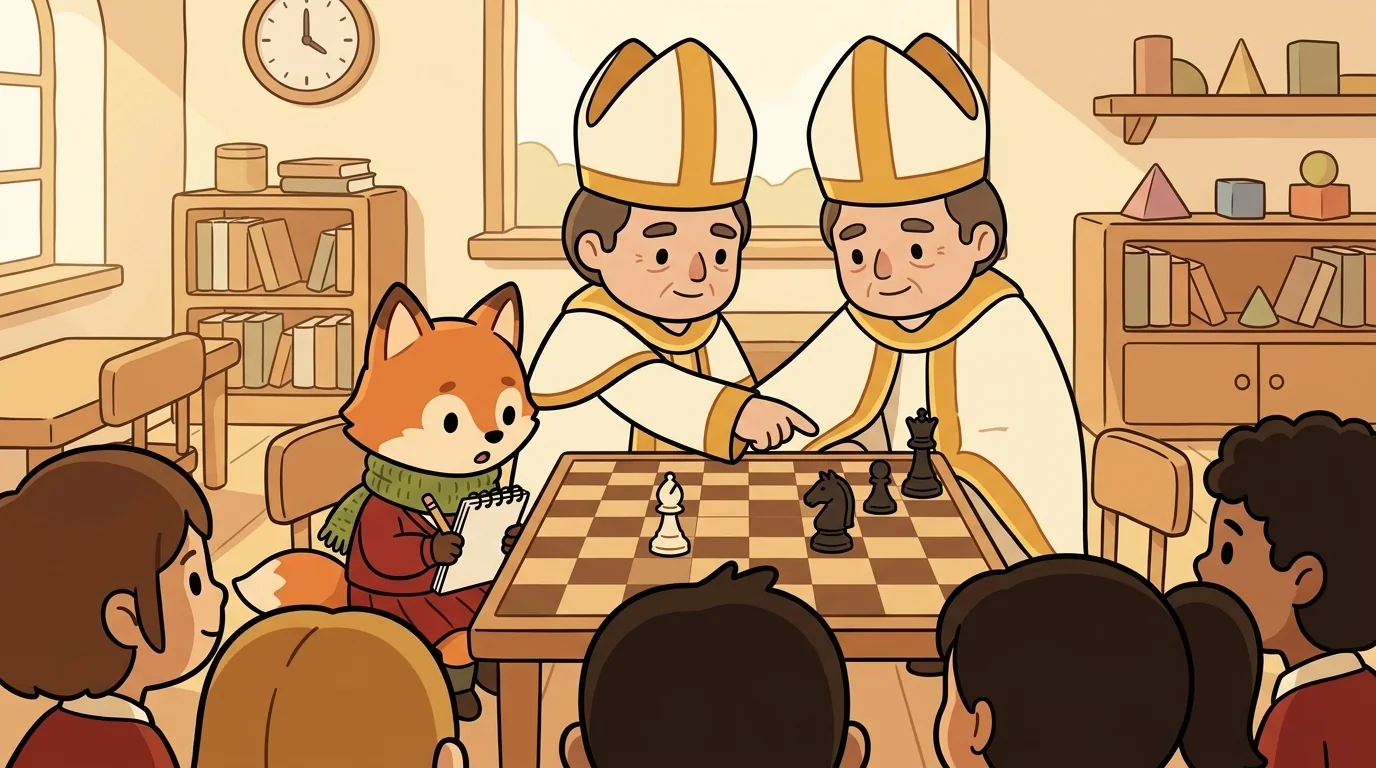
The chessboard, Pinwell discovered, was much like the library — only the rows were shorter, and the pieces moved instead of staying put.
He met his first class of children at the academy on a Tuesday. Captain Castle introduced him as the librarian who sees pins, which Pinwell felt was a little dramatic but did not correct. The children watched him in the way children watch a person they are not yet sure about. One of them — a small fox in a green scarf — had brought her own notebook, which Pinwell appreciated.
He set up the position himself, slowly. A white bishop on c4. A black knight on f6. A black queen on h8, sitting tall behind the knight.
"Consider this knight," said Pinwell. He did not raise his voice. The children leaned in slightly without knowing they were doing it. "The knight is allowed to move. There are several places it could go. It would like, in particular, to go to e4 — where it could threaten the bishop."
A child in the front said, "So it'll go there?"
"It would like to," said Pinwell. "But it cannot."
"Why not?"
"Because of what is behind it."
He pointed, very slowly, to the queen. The children's eyes followed.
"If the knight moves," he said, "the bishop will see all the way down the diagonal — and there is the queen, three times the knight's value, with nothing in between. The knight cannot move without losing the queen."
The room was quiet for a moment.
The fox with the notebook said, "So the knight is doing a job by not moving?"
Pinwell considered this. He liked the way she had said it.
"Yes," he said. "Exactly that. The knight is holding the queen up. Like a small book holding two larger books still."
The fox wrote small book holding two larger books still in her notebook, and underlined it. Captain Castle, watching from the corner with his hands clasped behind his back, decided then and there that the partnership was going to work.
He still does not enjoy speaking very much.
But when he speaks, he speaks slowly, and he is almost always right, and the things he says are usually about pieces that cannot move because of what is beside them.
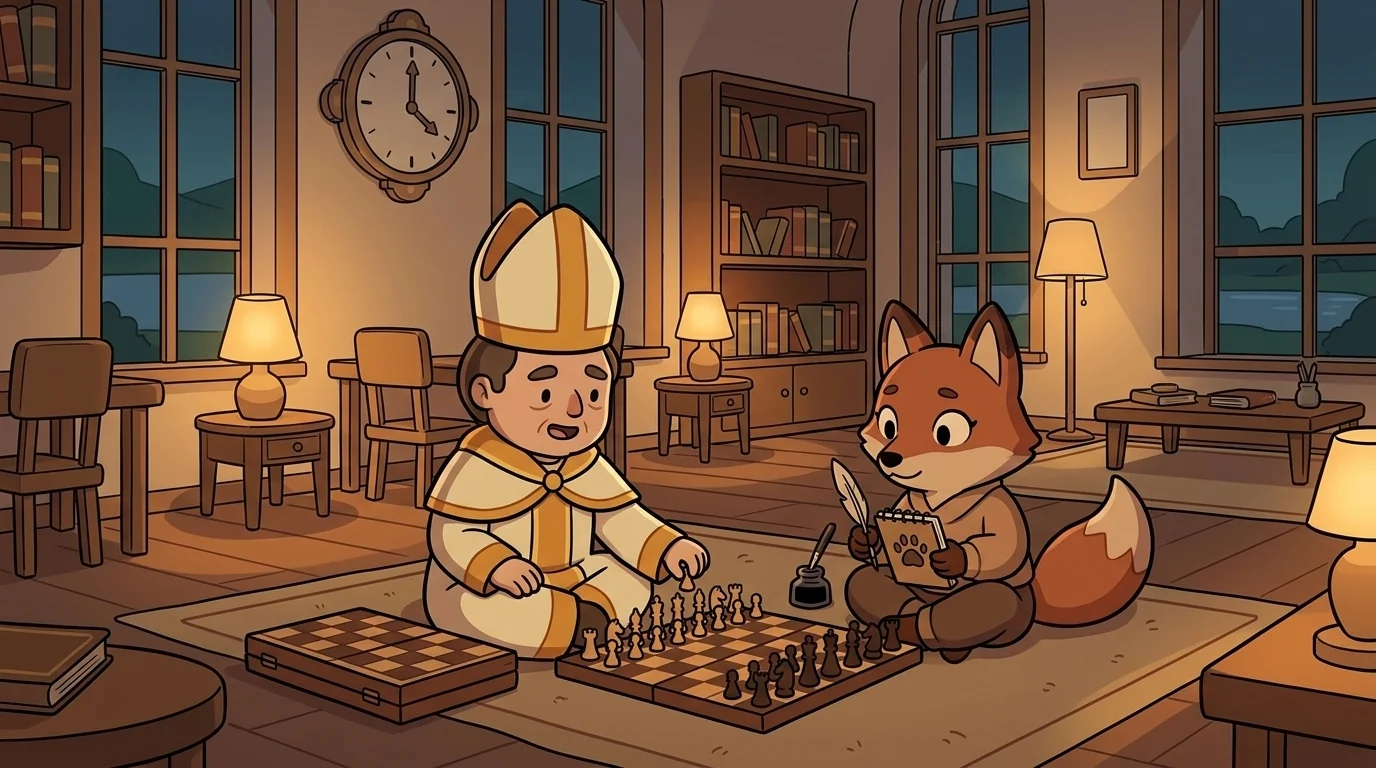
After every lesson, when the children have gone home and the lamps in the academy hall are turned low, Pinwell folds the board carefully and sets the pieces back in their starting rows. He likes the rows. He cannot help it. He is, after all, still a librarian; he has simply moved his library to a smaller space.
Sometimes the fox with the notebook will stay behind, sitting cross-legged on the floor beside the folded board, and she will ask, "Why this pattern, Mr. Pinwell? Why this one?"
And Pinwell will consider his words, the way he always considers his words, and he will say:
"Some things can't move because of what is beside them. It isn't a punishment. It is just a fact. The trick is in seeing it before the piece does — and helping it stay where it is, until you have time to think."
The fox will write that down too. Pinwell will glance, briefly, at the notebook in her hands — which is now in its third volume, like his own — and feel, in a way he would never say aloud, perfectly satisfied. He closes the board. He goes home.
The GambitTales ensemble
Sir Pinwell is part of GambitTales's distributed-narrative cast. Each character embodies a different curricular primitive; together they teach the full subject.
-

Twin Knights of Fork Hill
Fork pattern — attack two targets at once
-

Lady Skewer
Skewer pattern — force a valuable piece out of the way
-

Veil & Vow
Discovered attack — step aside to reveal a hidden threat
-

Captain Crossfire
Double attack — one move threatens two targets
-

The Glass Lantern
X-ray attack — light pierces through to the piece behind
-

King Pumble & King Sable
Two kings — librarian and gardener; one step at a time
-
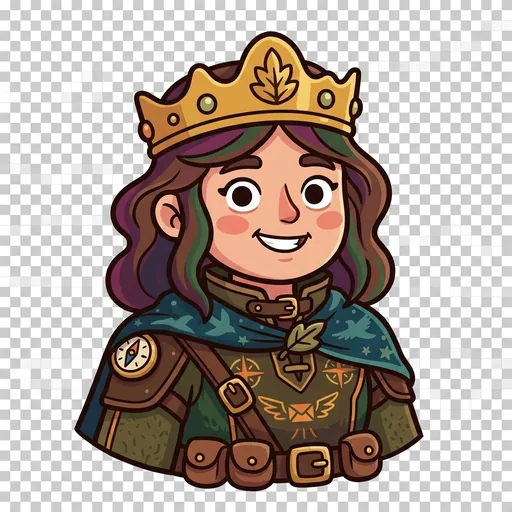
Queen Vesper
Queen — ranger-messenger; any direction, any distance
-

Captain Castle
Mentor + narrator — rook archetype; the mascot who introduces the cast + scaffolds the lesson
-

The Pawn Cohort
Ensemble piece — the four pawn-paired sets (Pawn Patrol + Sienna & Bran + Trotter & Trundle + Gable & Garrett) acting as one in the world layer