
Sir Pinwell
The PIN — a piece cannot move because doing so exposes a more valuable piece behind it
Press play to listen along. The line being read lights up as you go.
Show full transcript
Loading transcript…

In a small village at the edge of the Slow Lake, where the lake's mist clung to the rooftops most mornings, there lived a bishop named Pinwell who did not enjoy speaking very much. He worked at the village library, which was the only library in the district and the only building taller than the bakery, and he had worked there for so many years that the floorboards had learned the precise weight of his footsteps and stopped complaining about it.
The library had three floors and exactly four hundred and eleven books, a number Pinwell had counted twice on two separate winters to be certain of the inventory. He enjoyed the counting almost as much as he enjoyed the reading itself, although this was the sort of confession a person only ever made inside a building where nobody else was listening.
He arranged the collection by his own peculiar method, in straight rows ordered by the colour of the spines. The retired librarian who had originally trained him had called this method wrong in a tone Pinwell still remembered, several years later, on his less confident afternoons. Pinwell kept doing it his way regardless, because the colour-ordering settled something in his chest that the alphabetical system never had. Occasionally a visitor would ask him why he bothered to keep such a quiet building so meticulously tidy when nobody ever came to read in it. "I keep it tidy," Pinwell would say, "in case somebody arrives." Then he would return to the rows, satisfied to have addressed the question without quite answering it.
Years of placing books just so had taught him to notice something the retired librarian had apparently missed entirely. Certain books, he had discovered, seemed to hold the others upright. A small handbook of insects had wedged itself between two enormous atlases on the second floor, and although the atlases were too large and self-important to need any assistance staying upright, Pinwell had once tried to slide the handbook free as an experiment, and the atlases had tipped inward immediately, as if their dignity had been quietly underwritten by a book a tenth their size and considerably less impressive in subject matter.
Pinwell did not give the pattern a name, because he was not, by temperament, the sort of person who named things. He simply walked past it each morning, made sure the handbook was straight on the shelf, and went on with the careful business of the rows.
It would, in the end, take a child to give it a name.

One winter morning, while the lake outside was performing its quiet annual trick of freezing in patches that resembled lily pads, a girl named Inkling came into the library. She was about eight years old, and she wore a coat that had clearly been chosen for someone with broader shoulders than hers, and her hair appeared to be having an argument with itself in two different directions. She had come, although she would not have admitted this even under interrogation, to look for a book about whales. She wandered the second-floor shelves picking books up and replacing them in the wrong positions with the cheerful unconcern of someone who could not yet read the colour codes.
Pinwell tried, with considerable internal effort, not to mind. He was, after all, a librarian, and librarians are expected to be patient about the very specific category of behaviour that ruins their week.
After the seventh wrong placement, Inkling reached for a green book wedged between two enormous red volumes near the window. The green book was a thick one — A History of the Slow Lake, recently re-bound — and she tugged at it the way she would have tugged at a stuck drawer at home: with confidence, and with the assumption that confidence was sufficient. The book did not budge. She tugged harder. The book continued to hold.
"This one's stuck," said Inkling, looking up at him with an expression of practical complaint. "Why won't it come out?"
Pinwell came over slowly, the way he came over to everything, conserving motion as a matter of long habit. He studied the green book and the two red volumes that pressed against it from either side, considering the geometry the shelf had quietly worked out on its own.
"It can't move," he said.
"Why?"
"Because if it did," said Pinwell, selecting his words the way other people select chocolates from an assorted box, "the two larger books on either side would lean inward and topple. The little book is holding them."
"So I can't ever read it?"
"You can read it. You simply can't take it. Not while the others are watching."
Inkling considered this proposition with the gravity of someone who had never until that exact moment imagined that a book might be performing a job other than the obvious one. The whole arrangement struck her as profoundly unfair, and at the same time, in a way she could not have articulated, profoundly interesting.
She sat down on the floor in front of the green book and opened it where it stood, which Pinwell found resourceful. She read about whales — there were no whales in A History of the Slow Lake, but the book did contain a long chapter on eels, which were almost as good when one was eight years old and prepared to be flexible. She read for an entire hour without moving. Pinwell brought her a small cup of tea, because that is what librarians do, and he set it down beside her without comment so that she could keep reading uninterrupted.
When she finally left, in the blue half-light of late afternoon, she stopped at the door and turned back to face him. "Mr. Pinwell," she said, "that book is pinned."

The word was new to him in this particular usage. He had heard pinned before, of course — it was what tailors did with cloth and what botanists did with butterflies — but he had never previously heard the word used to mean held still by what is beside. He turned the new meaning over in his quiet mind for the rest of the afternoon, the way one turns a smooth stone in a pocket while thinking about something unrelated.
That evening, after closing the library and walking home along the lake path in the dim, he took out a small notebook and a pencil. He drew the green book. He drew the two red ones on either side, larger and slightly looming. He labelled the green book cannot move. He labelled the others holding it still. Then, after some consideration, he wrote one word at the top of the page in his careful capitals: PIN.
Over the following week, he walked the rows of the library with the notebook open at his elbow. He found three more places where a small book was pinned by larger neighbours, and one place where the pinned object was not a book at all but a wooden bookmark he had once left between two volumes, which had since wedged itself in a way that meant neither volume could be opened without dislodging the bookmark in question. He drew that, too, with the same careful labels. He used Inkling's word in every drawing, because Inkling's word, he had decided, was the correct one.
He did not yet know that chess players used the same word for the same pattern. He did not know that bishops, in particular, were rather good at making the pattern happen — that a bishop standing on a long diagonal could pin a knight against a queen, and that the knight, once pinned in this way, would not move without surrendering the queen behind it. He did not know any of that. He simply noticed.
Three winters passed. The handbook of insects remained wedged between the two atlases. The green book had been read by Inkling four separate times, always while seated on the floor, and twice with a second cup of tea.
On the morning of the fourth winter, the library door opened with more ceremony than usual, and a chunky cheerful rook in a brass-buttoned waistcoat walked in. He looked around at the rows for a long moment, nodding slowly, as if at something he had hoped to find but had not been entirely sure existed. He introduced himself as Captain Castle. He explained that he had heard, in the way that important things are sometimes heard, that there was a librarian in the Slow Lake village who could see pins in books that nobody else seemed to notice.
Pinwell set down his cup of tea on the desk. He considered briefly what one was supposed to say in moments of this particular kind, and decided, as he usually did, that the answer was almost always the same.
"I suppose," he said, "I should bring my notebook."
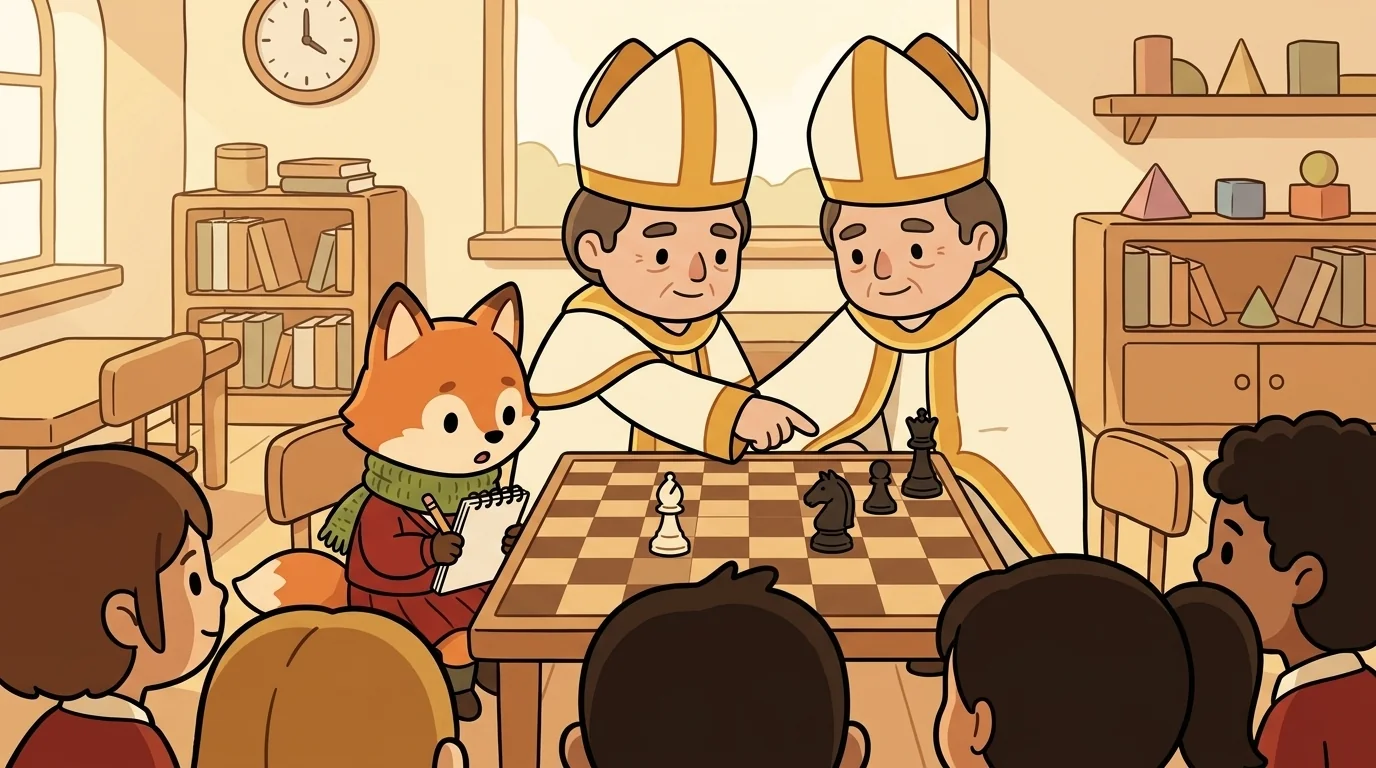
The chessboard, Pinwell discovered over his first weeks at the academy, was much like his old library — only the rows were considerably shorter, and the pieces moved instead of staying where you placed them, which took some getting used to.
He met his first class of children on a Tuesday afternoon in the long hall with the southern windows. Captain Castle introduced him to the assembled group as the librarian who sees pins, which Pinwell privately felt was a touch dramatic but did not correct in front of the children. The children watched him in the particular way that children watch a person they have not yet decided about, which involves a kind of skeptical patience that adults rarely manage. One of them — a small fox in a green scarf — had brought her own notebook to the lesson, a courtesy Pinwell felt deserved acknowledgement, although he settled for a small nod in her direction.
He set up the demonstration position himself, slowly and without commentary. A white bishop on c4. A black knight on f6. A black queen on h8, sitting tall behind the knight, watching the whole diagonal without appearing to watch anything at all.
"Consider this knight," said Pinwell. He did not raise his voice, and yet the children leaned in slightly without noticing they were doing it. "The knight is allowed to move. There are several squares it could go to. It would like, in particular, to go to e4, where it could threaten the bishop."
A child in the front row, possibly a hedgehog, said, "So it'll go there?"
"It would like to," said Pinwell. "But it cannot."
"Why not?"
"Because of what is behind it."
He pointed, very slowly, to the queen on h8. The children's eyes followed the line of his finger along the diagonal from the knight to the queen, three squares back, with nothing between them but air and the bishop's quiet line of sight.
"If the knight moves," he said, "the bishop will see all the way down the diagonal — and there is the queen, three times the knight's value, with nothing in the way. The knight cannot move without losing the queen behind it."
The room was quiet for a moment, in the particular kind of quiet that means children are doing arithmetic in their heads. The fox with the notebook tilted her head to one side.
"So the knight is doing a job by not moving?" she said.
Pinwell considered the phrasing. He liked the way she had said it; she had skipped past three intermediate steps that he himself would have needed to walk through in order to reach the same place.
"Yes," he said. "Exactly that. The knight is holding the queen up. Like a small book holding two larger books still."
The fox wrote small book holding two larger books still in her notebook, and she underlined the sentence twice for good measure. Captain Castle, watching the proceedings from the corner of the hall with his hands clasped behind his back and his expression carefully neutral, decided then and there that the partnership was going to work very well indeed.
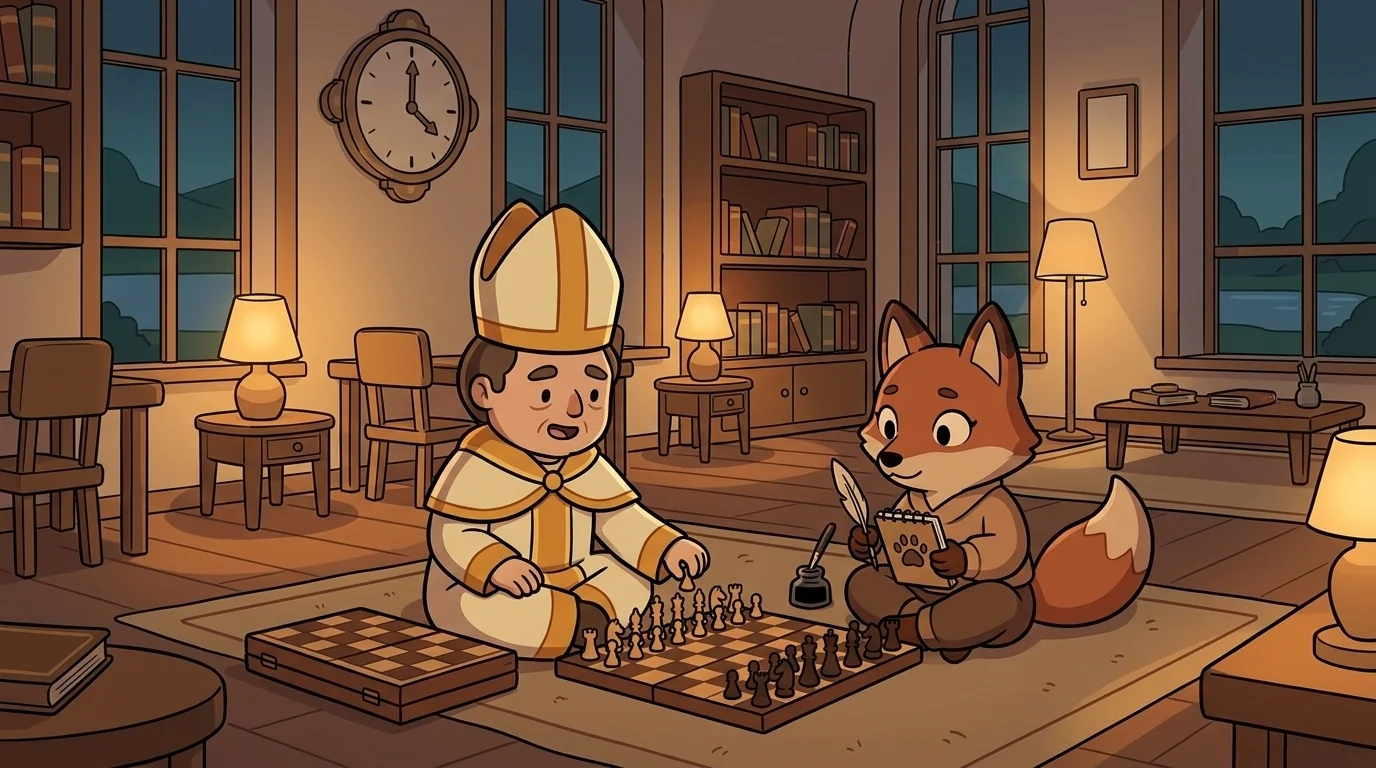
He still does not enjoy speaking very much.
But when he speaks, he speaks slowly, and he is almost always correct in what he says, and the things he says are usually about pieces that cannot move because of what is beside them. The children at the academy have, over the months, stopped looking surprised when he says so. They have started seeing the pattern themselves, on the board and sometimes on the kitchen table at home, which is the only kind of teaching that ever really finishes.
After every lesson, when the children have gone home for the evening and the lamps in the academy hall have been turned low for the night, Pinwell folds the board carefully and sets the pieces back in their starting rows. He cannot help himself. He is, after all, still a librarian; he has simply moved his library into a smaller space, with thirty-two volumes that occasionally hold each other up.
Sometimes the fox with the notebook stays behind after the others have left. She sits cross-legged on the floor beside the folded board, and she will ask, "Why this pattern, Mr. Pinwell? Why this particular one?"
And Pinwell will consider his words, the way he always considers his words, weighing each one against several others before settling on it, and he will say:
"Some things can't move because of what is beside them. It isn't a punishment. It is just a fact. The trick is in seeing it before the piece does — and helping it stay where it is, until you have time to think."
The fox writes that down too, in her careful hand. Pinwell glances, briefly, at the notebook in her hands — which is now in its third volume, like his own — and feels, in a way he would never say aloud, perfectly satisfied with the arrangement of things. He closes the board. He goes home.
The GambitTales ensemble
Sir Pinwell is part of GambitTales's distributed-narrative cast. Each character embodies a different curricular primitive; together they teach the full subject.
-

Twin Knights of Fork Hill
Fork pattern — attack two targets at once
-

Lady Skewer
Skewer pattern — force a valuable piece out of the way
-

Veil & Vow
Discovered attack — step aside to reveal a hidden threat
-

Captain Crossfire
Double attack — one move threatens two targets
-

The Glass Lantern
X-ray attack — light pierces through to the piece behind
-

King Pumble & King Sable
Two kings — librarian and gardener; one step at a time
-

Queen Vesper
Queen — ranger-messenger; any direction, any distance
-

Captain Castle
Mentor + narrator — rook archetype; the mascot who introduces the cast + scaffolds the lesson
-

The Pawn Cohort
Ensemble piece — the four pawn-paired sets (Pawn Patrol + Sienna & Bran + Trotter & Trundle + Gable & Garrett) acting as one in the world layer