Pen
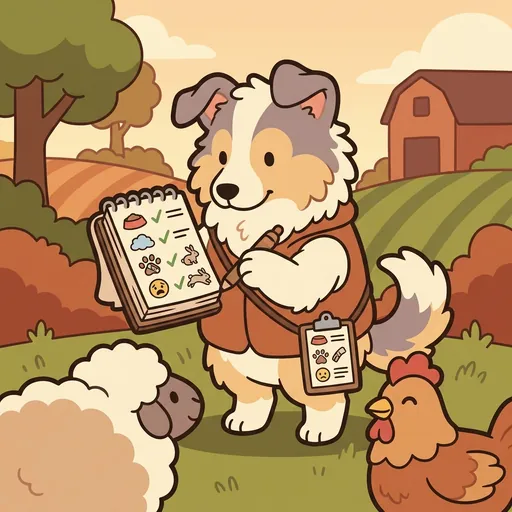
PEN — care = consent + comfort. animals decide when.
Listen along — Pen
Loading audio…
Press play to listen along. The line being read lights up as you go.
Show full transcript
Loading transcript…
Chapter 2 — Pen and the Question of When Animals Are Ready
At the near gate of the pasture, a young collie named Pen lay flat in the grass with his chin on his paws, watching a flock of chickens as if they were the most interesting thing in the world.
He wasn’t herding them. He wasn’t chasing. He was just watching, and every so often he made a small note in a battered notebook with a pencil clipped to the cover.
A farm kid crouched down next to him. “You’ve been lying here for an hour. Aren’t you going to do something?”
“I am doing something,” Pen said, without moving. “I’m reading them.”
The kid frowned at the hens. They pecked, they scratched, they wandered. “They’re just chickens.”
“Watch that speckled one.” Pen tipped his nose toward a hen near the coop door. “She keeps looking at the gap under the fence and then back at the flock. She’s thinking about slipping out. And that one—” his ear flicked toward a smaller brown hen— “hasn’t dust-bathed all morning. The others have. She’s off today. Maybe nothing. Maybe the start of something.”
The kid squinted, and slowly the flock stopped being a blur of chickens and became a bunch of individuals, each doing her own thing.
“They talk all the time,” Pen said softly. “With how they stand, how close they get, whether they come to you or back away. Most people never listen. So they never hear when an animal says not yet, or I’m scared, or I’m not okay.” He made another small note. “My whole job is hearing that.”
Pen learned to listen from his grandmother, an old herding collie with grey around her muzzle and an enormous patience.
When Pen was a pup, he’d been fast and loud and sure — the kind of young dog who thought herding meant making the sheep go where he wanted, right now. One afternoon he’d rushed a nervous ewe toward the fold, barking, circling tight, and the ewe had panicked. She’d bolted the wrong way, crashed into the others, and the whole flock scattered across the hill. It took the farmer half the evening to gather them.
Pen had lain down in the dirt afterward, ears flat, chest tight and miserable. I only wanted to help, he thought. And I made everything worse.
His grandmother came and lay beside him. She didn’t scold. She just looked out at the settling flock and said, “You were talking the whole time. Barking, pushing, telling. When did you stop to listen?”
Pen didn’t answer.
“The herd talks first, little one. That ewe told you she was frightened long before she ran — she was stiff, her eyes were white at the edges, she kept turning her head. She was asking you to slow down. You didn’t hear her, so she stopped asking and started running.” His grandmother nudged him gently. “A good shepherd isn’t the loudest one on the hill. She’s the one being read while she reads.”
Pen sat with that for a long time. The tightness in his chest didn’t fully go, but it changed shape — from I’m bad at this into I have something to learn. That night he found an old notebook and started writing down what the animals did. He’s never stopped.
He walked to FarmQuest at twelve, because a place that cared about farms ought to care about the beings who lived on them.
Furrow, the old mentor at the gate, didn’t ask him to prove he was fast or strong. He asked one quiet question. “What is it to care for a farm animal?”
Pen thought about the panicked ewe. About the speckled hen thinking about the fence.
“Care is comfort and consent,” he said. “You give them what they need — food, water, shelter, room to be what they are. And then you watch, and you let them tell you when they’re ready. Animals decide when. My job is to listen close enough to hear it.”
Furrow was quiet a moment. Then he opened the gate wider. “You belong here,” he said.
Pen’s workshop had no cages in it — just wide windows looking out on three different farms, and a long shelf of his notebooks.
A girl came in one afternoon, upset. She’d tried to move her family’s chickens into a new coop and it had gone badly — squawking, feathers, one hen who wouldn’t come out from under the porch for hours. “I did everything right,” she said. “I built them a nice coop. Why did they hate it?”
“Come look.” Pen brought her to the window. On the first farm, hens huddled in a bare shed, going still and stiff whenever the door opened. On the second, hens scratched in the dirt, perched on branches, took lazy dust-baths, and barely glanced up when a person walked by. “Same chickens, more or less,” Pen said. “Different lives. Which flock trusts the door?”
“The second one,” the girl said. “They’re… relaxed.”
“Because everything’s predictable for them. Nothing surprising, nothing rough. When you moved your hens, did you rush?”
She winced. “I kind of… scooped them up fast. I was in a hurry.”
“Their bodies remember fast and rough.” Pen said it gently, not like a scold. “So next time — go slow. Same time of day. Leave the new coop open a while so they can look before they move. Put their favorite food inside. And then wait, and let them walk in on their own feet.” He tapped his notebook. “You’re not making them go. You’re making it safe enough that they choose to.”
The girl looked out at the calm hens again. “So I can’t just decide for them.”
“You can decide a lot,” Pen said. “What they eat, where they’re safe, when the vet comes. But the last little step — the trust — that one’s theirs to give. You just make it easy to give it.”
Later, when the workshop was quiet, the girl came back with one more question.
“But how do I know?” she said. “That an animal’s really okay, and not just… putting up with it?”
Pen looked at his row of notebooks, all those days of watching.
“You know the way you know when a friend’s actually fine and not just saying so,” he said. “You stop assuming, and you watch. Do they come to you or back off? Do they rest easy, or stay tense? Do they do the small comfortable things — the dust-bath, the grazing, the settling down to lie in the sun? Those are the yes signals. When they stop, that’s the animal telling you something’s wrong, and it’s your job to hear it before it gets loud.”
The girl nodded slowly.
“There aren’t easy answers about farms,” Pen added, quieter. “People eat different things for good reasons, and I won’t tell you which is right. But there’s one thing I’ll always ask of you, whatever you choose: notice the animal. See it as a someone, not a something.”
He watched the worry ease out of the girl’s shoulders — the same way, years ago, the tightness had eased out of his own chest on the hillside.
And Pen felt it settle in him, warm and steady and sure: that being trusted by a creature who could have run — and chose, instead, to stay — is one of the safest, gentlest feelings in the whole wide world.
The FarmQuest ensemble
Pen is part of FarmQuest's distributed-narrative cast. Each character embodies a different curricular primitive; together they teach the full subject.
-
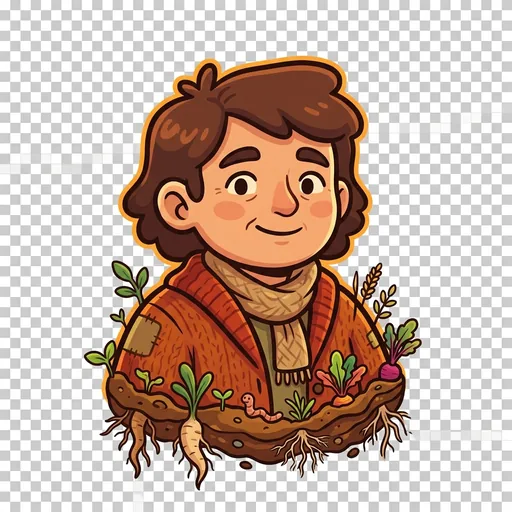
Loam
Soil health + crop rotation — different roots, different seasons; soil-as-record framing
-
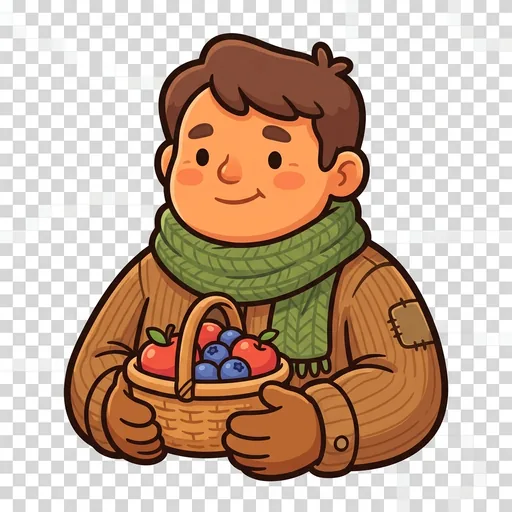
Bushel
Harvest + post-harvest handling — gentle hands, clean baskets; bruises-cost-more framing
-
Market
Farmers-market economics + agribusiness — fair price = fair work; price-tells-truth framing
-
Tilth
Sustainability + soil-life ethics — repair before replace; field-remembers framing