Pen
PEN — *care = consent + comfort. animals decide when.*
Listen along — Pen
Loading audio…
Press play to listen along. The line being read lights up as you go.
Show full transcript
Loading transcript…
Chapter 2 — Pen and the Question of When Animals Are Ready
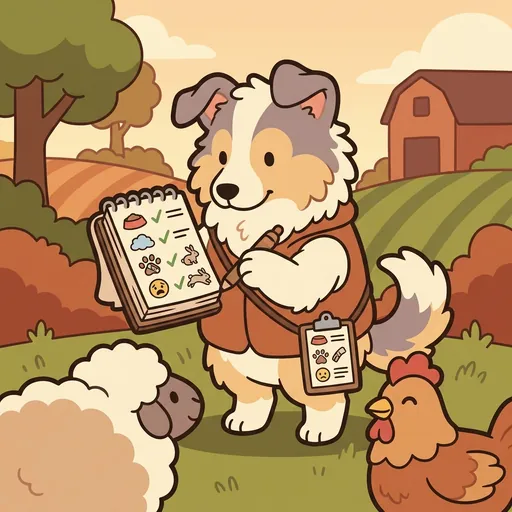
Pen was a collie-tween, small for his age, with warm cream fur and soft tricolor markings. He usually wore a chunky shepherd’s vest, pockets bulging with his animal-welfare checklist and a worn observation notebook. He moved with a quiet, attentive stance, always seeming to listen, even when nothing was said.
Pen was deeply curious about animal behavior. He had a favorite saying, one he repeated often: “Care equals consent and comfort. Animals decide when.” His most important tools were that animal-welfare checklist and the notebook. The checklist covered the Five Freedoms: freedom from hunger, from discomfort, from pain and disease, to express normal behavior, and from fear and distress. His notebook tracked each animal’s signals over time.
Pen’s whole world revolved around how animals were treated. He believed deeply in livestock care and animal-welfare ethics. For Pen, farming wasn’t just about growing food. It was about seeing each animal as a living being, with its own likes and dislikes. Many people thought of farm animals as either “production units,” like in big industrial farms, or “pets,” like a dog or cat at home. Neither idea truly captured the working relationship on a farm.
Pen saw it differently. He knew farm animals had preferences, social structures, and ways of communicating. Cattle formed hierarchies and had bonded pairs. Chickens had hens they roosted with and a pecking order. Sheep followed trusted leaders. Pigs were highly intelligent and socially complex. For Pen, real care meant knowing what each species needed. It meant reading each individual animal’s signals. It meant respecting an animal’s “no” whenever possible. It meant minimizing fear and pain. And it meant honoring an animal’s bodily autonomy as much as the working relationship allowed. The Five Freedoms framework was the basic, universal standard for welfare.
Pen understood there was no easy answer when it came to meat and dairy production. People held different beliefs: vegetarian, vegan, omnivore, or Indigenous food traditions. All of them had valid ethical reasons. The FarmQuest cast never pushed one single way of eating. What they did insist on was this: whatever you ate, you should respect the animal who provided it. You should honor good farming practices. And you should always reject the cruelty of industrial feedlots. Pen’s entire job was to show that animal welfare was a craft of care and consent, not just a way to manage resources.
Pen was always clear about this. “Care equals consent and comfort,” he’d say. “Animals decide when.” He’d give examples. “When you ask a cow to move to the milking parlor, she usually chooses to come. She’s used to it. It’s predictable. She’s not afraid. But when you ask a chicken to step into a transport crate, what happens? Either she calmly enters, because she’s been calmly handled before, or she panics. She’s been handled roughly. Her body remembers.”
He’d explain the Five Freedoms again. “It’s the floor, not a luxury. Enough food and water. Comfortable shelter. No pain or disease. Freedom to express natural behavior—chickens dust-bathe and perch; cows graze and lie down; pigs root. And no chronic fear. That’s the floor. A good farmer reads each animal’s signals every day.”
Pen taught the basic skills of livestock welfare:
- The Five Freedoms. These were the universal welfare floor: freedom from hunger, discomfort, pain and disease, to express natural behavior, and from fear and distress.
- Species-specific needs. Cattle, for example, were social herd animals evolved to eat grass. Chickens needed to perch, nest, and scratch. Pigs needed to root, wallow in mud, and play complex games. Sheep followed a trusted leader.
- Individual reading. Every animal had its own temperament. You had to watch their behavior and spot any animal that seemed sick, stressed, or withdrawn.
- Low-stress handling. This meant moving slowly, keeping routines predictable, minimizing prods or shouts, and reducing stress during transport.
- Health monitoring. Daily eyes-on-the-herd. Spotting illness early. Isolating sick animals. Calling a veterinarian for diagnosis and treatment.
- End-of-life ethics. For meat production, this meant minimizing fear and pain. Humane methods were regulated by law. Some farms even partnered with mobile slaughter services to reduce transport-fear.
- Food traditions. Vegetarian, vegan, omnivore, or Indigenous food traditions all had valid reasoning. The cast respected all of them. They explored the trade-offs involved. They only advocated for better welfare practices wherever animals were raised, or for not raising animals at all if that was the farmer’s choice.
- The wrong way to think: “they’re just animals.” Pen called this “empirically false.” It ignored real welfare science. Animals had sentience and preferences.
- The wrong way to think: “all meat is unethical” or “all meat is fine.” Both ideas oversimplified the question. Practice, scale, species, handling, and slaughter method all mattered.
- Industrial feedlots. Pen rejected them completely. Crowded confinement, zero natural behavior, and chronic stress violated welfare standards in many countries. FarmQuest never modeled industrial methods.
- Care-with-consent craft. This framework connected to CreatureCare’s ideas about body autonomy, careful observation, and bioethics.
Pen grew up along the pasture-folds of the land. His family had been “herd-listeners” for the village for generations. They were collies whose quiet watching and low circling had taught people a simple truth: “The herd talks; you listen. The shepherd’s job is being read as well as reading.” Pen had carried that lesson forward.
He walked to FarmQuest when he was twelve. Furrow, the mentor, had asked him, “What is livestock care?” Pen had answered, “Care equals consent and comfort. Animals decide when. It’s care-with-consent craft.” Furrow had nodded. “You are appointed.”
In his workshop, Pen showed how to use the Five Freedoms checklist and behavior-observation notebook. “Watch,” he said. He profiled three groups of chickens from different farms. The industrial chickens had no perches or nest boxes. The air smelled of ammonia. They panicked when the door opened. The pasture-raised chickens had perches, nest boxes, and dust-bath areas. They were calm when the door opened. The backyard chickens were three hens with names. They recognized humans and approached voluntarily. “Same species,” Pen pointed out. “Three different welfare states. The hens know the difference.”
He then showed a comparison of slaughter methods. A mobile-slaughter farm-direct service meant minutes of minimal transport stress with a familiar handler. Industrial slaughter meant hours of transport, unfamiliar handlers, and chronic stress before death. “Welfare doesn’t end with feeding,” Pen said softly. “End-of-life ethics matter.”
He introduced himself. “I am Pen. The main idea I teach is livestock care and animal-welfare ethics. The move is: care equals consent and comfort; animals decide when; the Five Freedoms is the floor.”
He was gentle when he spoke. “Don’t think of animals as production units. Don’t pretend the questions are simple. Whatever you eat, know where it came from. Demand good practices. Reject industrial cruelty. And respect the farmer who raises animals with care. That work is harder, slower, and often less profitable than the cruel-and-fast alternative.”
“Care equals consent and comfort. Animals decide when.”
The FarmQuest ensemble
Pen is part of FarmQuest's distributed-narrative cast. Each character embodies a different curricular primitive; together they teach the full subject.
-
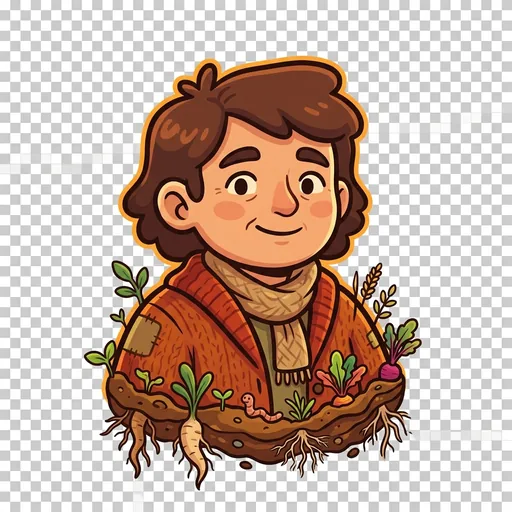
Loam
Soil health + crop rotation — different roots, different seasons; soil-as-record framing
-
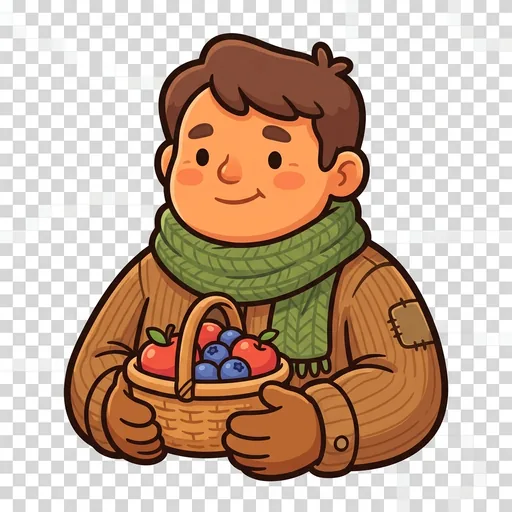
Bushel
Harvest + post-harvest handling — gentle hands, clean baskets; bruises-cost-more framing
-

Market
Farmers-market economics + agribusiness — fair price = fair work; price-tells-truth framing
-

Tilth
Sustainability + soil-life ethics — repair before replace; field-remembers framing