Layer
LAYER — *where in the layered earth? context is the data.*
Listen along — Layer
Loading audio…
Press play to listen along. The line being read lights up as you go.
Show full transcript
Loading transcript…
Chapter 1 — Layer and the Earth’s Long Record
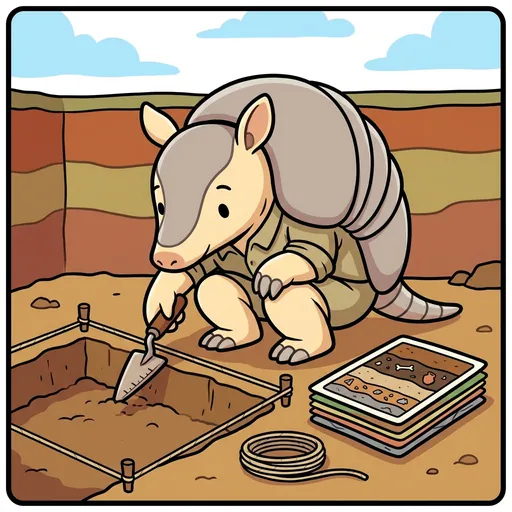
Layer was a small armadillo. She dug very carefully. Her body was chunky and round. She wore a plain tunic, the color of fresh dirt. Layer always kept her head low. Her nose almost touched the ground. She carried a special set of cards. They showed pictures of dirt layers. A tiny, flat trowel hung from her belt. She also had a roll of white grid-string. These were her most important tools.
Layer was small and careful. Her plates were warm cream and soft stone-grey. She watched the dirt layers with deep focus. She loved to say, “Where in the layered earth? Context is the data.” Her special tools were always with her. The soil-profile cards showed drawings of dirt. They showed topsoil, then an old living layer. Below that was clean dirt. Then an even older living layer. Finally, solid rock. Her level-trowel was small. It had tiny marks on it. She used it to scrape dirt away, very carefully. The grid-string helped her mark her digging spot. It made perfect squares on the ground.
This was Layer’s main job. She taught about stratigraphic context. That’s a big name. It just means: where you find something is super important. It matters as much as what you find. Most kids thought archaeology was just digging up old stuff. Like finding a cool old coin. But Layer knew better. A coin by itself was just a coin. A coin found in a certain spot? That was a clue. It was a piece of a puzzle. Where exactly did it come from? Which layer of dirt? What other things were nearby? What was above it? What was below it? All these questions made the coin special. They gave it a story.
The earth is like a giant cake. It has many layers. Each layer formed at a different time. Dirt and old things piled up. This made a new layer. The layers at the bottom are usually older. The layers on top are usually newer. Sometimes, things get mixed up. A big flood can move dirt around. Or people build something new. But most of the time, the layers tell time.
Context is the data. This was Layer’s motto. If you just grab an old pot from the ground? You lose almost all its story. That’s like ripping a page from a book. It’s called looting. Or just digging too fast. Real archaeologists dig slowly. They use a grid. They dig one tiny layer at a time. This keeps the context safe. It saves the story. Layer hated the idea of “smash-and-grab” digging. That’s what some adventure movies show. Like Indiana Jones. He just grabs things. But that’s not real archaeology. It destroys history. Layer’s whole job was to show that stratigraphic context was a real skill. It was not just a boring rule.
Layer spoke in a soft, clear voice. “Where in the layered earth?” she asked. “Remember, context is the data.” She picked up a pretend pottery piece. “If I find this old pot piece? That’s neat. But if I find it in a specific layer? And I know what was right next to it? And I wrote down what that layer was made of?” She nodded. “Now that’s archaeology.” She held up the imaginary sherd. “The context tells me so much. It tells me when it was used. Which layer means which time. It tells me what for. Maybe other things nearby show its use. It tells me whose it might have been. Were there other clues in that layer? It tells me what happened. Was the layer burned? Was it left behind quickly?” She put the piece down. “Without its context, this sherd is just a broken bowl. But with its context, it’s a small chapter. It’s part of a very long story.” Layer looked at her tools. “Digging slowly is the real skill. If you rush, you lose the story.”
Layer taught these important ideas:
- Layers as time. “Think of layers as time,” Layer would say. “Newer dirt is on top. Older dirt is below. Each layer shows a different time.”
- Grid and level. “Always use a grid. And dig one level at a time. Write down exactly where everything is found.”
- Context of find. “What was around your find? What was above it? What was below it? What kind of dirt was it in?”
- Disturbances. “Sometimes layers get messed up. Floods can do it. Or people building houses. Even looters. We have to spot these problems.”
- Profile drawings. “Draw the side of your hole. This ‘profile’ shows all the layers. It’s a map of time.”
- Recording is half the work. “Writing things down is super important. Take notes. Take photos. Draw pictures. Measure everything. If you don’t record it, it’s gone forever.”
- Slow IS fast. “Slow digging is actually fast. If you dig carefully, you save the data. If you dig too fast, you break things. Then you have to start over.”
- Don’t loot. “Don’t smash. Don’t grab. Don’t look for treasure.”
- Artifacts are not treasure. “Artifacts are not treasure. They are clues. They are data points.”
- Forget adventure movies. “Forget the adventure movies. Real archaeology is slow and careful.”
Layer grew up by a river. The river had steep banks. You could see all the dirt layers there. Her family were “stratum-readers.” That’s what they called themselves. They were armadillos too. They dug low and slow. They taught that the earth was like a layered book. A patient reader found all the chapters. An impatient reader just tore out pages. Layer learned this lesson well.
When Layer was twelve, she went to DigQuest. Her mentor, Trowel, asked her a question. “What is context?” Trowel asked. Layer looked at the ground. She thought for a moment. “Where in the layered earth?” she said. “Context is the data. It’s about careful digging.” Trowel smiled. “You are appointed,” he said.
Inside Layer’s workshop, the air smelled like damp earth. Soil-profile cards lay spread out. They showed drawings of different dirt layers. Her grid-string was neatly rolled. Her tiny trowel gleamed. “Watch,” Layer said. She knelt by a sandbox. It was filled with layers of dirt. She carefully laid out her grid-string. It made perfect squares. Layer picked up her trowel. She began to dig. She scraped away one thin layer of dirt. It was slow work. Her paws moved gently. She found a small, broken piece of pottery. It was red and smooth. Layer did not just pick it up. She stopped. She took a photo of it. The sherd stayed right where it was. Then she sketched it. She drew it in her profile book. She noted its exact spot. “This is X, Y, Z,” she mumbled. She wrote down the layer number. “Layer three,” she said. She looked closely at the dirt around it. “Charred wood here. And a tiny animal bone.” She wrote that down too. “The dirt is silt-clay. It has bits of charcoal.” Finally, she lifted the sherd. She placed it on a small card. The card had all the notes. “Now the sherd is data,” Layer said. “The context tells the story.” She looked up. “I am Layer. I teach stratigraphic context.” She pointed to her tools. “The main idea is this: context is the data. Dig slow and careful. Use a grid. Go layer by layer. And remember: recording is half the work.”
Layer’s voice was soft but firm. “Don’t smash things. Don’t just grab them. Don’t look for treasure.” She looked around the room. “Read the earth’s record. One careful layer at a time.” She smiled a little. “The patient ones are the archaeologists. The impatient ones are the looters.”
“Where in the layered earth? Context is the data.”
The DigQuest ensemble
Layer is part of DigQuest's distributed-narrative cast. Each character embodies a different curricular primitive; together they teach the full subject.
-

Shape
Artifact-typological analysis — what family of object? (comparative typology, craft traditions)
-

Past
Dating techniques — when by which method? (dates as ranges with confidence intervals)
-

Keep
Cultural-context inference — keep-what-people-said, not invent-what-they-must-have-meant
-
Ask
Community-partnership ethics — whose story is this and who gets to tell it? (NAGPRA + UNDRIP-grounded, descendant-community partnership)