
Layer
LAYER — *where in the layered earth? context is the data.*
Listen along — Layer
Loading audio…
Press play to listen along. The line being read lights up as you go.
Show full transcript
Loading transcript…
Chapter 1 — Layer and the Earth’s Long Record
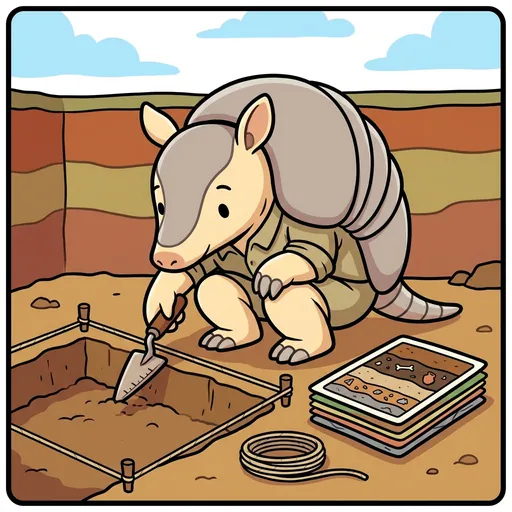
Layer was a small armadillo, a tween really, with warm cream fur and soft stone-grey plates. She moved with a careful, low pose, always seeming to examine the ground beneath her paws. Her plain field tunic was practical, and she always carried her tools: a set of soil profile cards, a small, calibrated level-trowel, and a coil of grid-string.
Her focus was always on the layers of the earth. She often murmured, “Where in the layered earth? Context is the data.” This wasn’t just a saying. It was her entire way of seeing the world. Her tools were an extension of this belief. The soil profile cards showed detailed drawings of earth layers: topsoil, older occupation layers, sterile soil, even bedrock. Her level-trowel was a small, precise tool. It helped her remove soil carefully, one tiny scoop at a time. The grid-string laid out an excavation pattern, turning a patch of ground into a map.
Layer understood something most beginners missed. Archaeology wasn’t just about digging up old things. It was about knowing where those things came from. This was the heart of stratigraphic context.
Imagine finding an ancient pottery sherd. Most people would just see a broken piece of clay. But Layer would ask: Which layer of earth did it come from? What other objects were found right next to it? What was above it? What was below?
The earth keeps a long, layered record. Each layer, or stratum, tells a story. It shows a period when soil and objects built up. Usually, layers buried deeper are older. Layers closer to the surface are younger. But sometimes, things get mixed up. Floods can shift layers. Buildings can disturb them. Modern damage can create new, confusing patterns.
Layer knew that an artifact, by itself, told only half a story. Its true meaning came from its context. If you pulled a pot from the ground without noting its exact spot, you lost most of the information. It became just a “thing.” That’s why careful work was so important. Digging slowly, grid-by-grid, layer-by-layer, preserved the story. It was the opposite of a smash-and-grab adventure. Looting destroyed the very information archaeology worked to recover. Layer’s entire purpose was to make this careful craft visible. It wasn’t just a boring rule. It was the key to understanding the past.
Layer spoke with a quiet, careful certainty. “Where in the layered earth?” she’d say, her voice low. “Context is the data.” She’d hold up a small, imaginary pottery sherd. “If I just find this, it’s interesting. Maybe. But if I find it in a specific layer, with other objects nearby, and I’ve noted what the soil in that layer looks like? That’s archaeology.”
“The context,” she’d explain, “tells me when it was used. Which layer means which time period. It tells me what for. Objects found together suggest how people lived. It can even tell me whose it was, or what happened to it. Was the layer burned? Was it disturbed? Was it abandoned?”
“Without context,” Layer would conclude, “the sherd is just an old broken bowl. But with context, it’s a small chapter. A piece of a much longer story.” She believed slow, careful digging was the true craft. Speed, she knew, just lost the data.
Layer taught these ideas, not as rules, but as ways to read the earth. She called them “the stratigraphic scaffolds.”
First, she’d explain that layers were like time itself. Younger layers rested above older ones. Each layer marked a period when things settled and accumulated.
Then came the tools. “You must use a grid,” she’d insist, “and work level.” This meant dividing the ground into squares. Then, removing soil one thin layer at a time, keeping track of the exact three-dimensional spot of every find.
“The context of a find is everything,” she’d remind her students. “What was around it? What was directly above? What was below? What kind of soil was it resting in?”
She also taught them to spot disturbances. A flood could create a messy layer. An old building foundation could cut through many strata. Even modern damage could confuse the record. Recognizing these disruptions was part of the craft.
And the walls of the excavation? “Those are your profile drawings,” Layer would say. “You draw them carefully. They show the layers, like pages in a book. They are the earth’s record.”
“Recording is half the work,” she’d often repeat. Notes, photos, drawings, measurements—if you didn’t write it down, it was lost forever.
Her favorite saying was, “Slow IS fast.” Digging carefully, she knew, preserved all the data. Rushing only destroyed it, costing more time later.
She warned against “treasure-hunting.” Artifacts weren’t treasure. They were data points. “Thinking of them as treasure,” she’d say, “makes you want to rush. It makes you want to grab. That destroys the archaeology.” She hated the idea of “smash-and-grab” looting. It wiped out generations of information. And she especially disliked the “Indiana Jones” way of thinking. “That’s the opposite of careful archaeology,” she’d say with a frown. “We reject that.”
Layer had grown up along the riverbank cut-banks, places where the river had carved away the earth, revealing its deep, layered history. Her family were known as “long-stratum-readers.” For generations, these armadillos had burrowed carefully through the layered soil. They taught their young that “the earth is a layered book. The patient reader finds chapters. The impatient reader tears the page.” Layer had taken this lesson to heart.
When Layer was twelve, she walked to DigQuest, the ancient school for earth-readers. Her mentor, an old armadillo named Trowel, looked at her with wise, crinkled eyes. “What is context?” Trowel asked, his voice like rustling leaves.
Layer didn’t hesitate. “Where in the layered earth? Context is the data. It’s the careful-context craft.”
Trowel nodded slowly. A small smile touched his lips. “You are appointed,” he said. And Layer knew her life’s work had begun.
In Layer’s workshop, the air smelled faintly of damp earth and old paper. Soil profile cards unrolled across a sturdy table, next to coils of grid-string and her polished level-trowel. “Watch,” Layer would say, her eyes bright with focus.
She would demonstrate on a small, prepared grid-square. Her trowel moved slowly, carefully, removing soil one thin layer at a time. Each tiny find was a treasure of information. She’d record its exact three-dimensional position. She’d photograph it right where it lay. She’d sketch it into her profile drawing, noting its relationship to the layers around it. Then, she’d describe the layer’s composition: the type of soil, any flecks of charcoal, any tiny seeds.
Finally, she’d carefully remove a pottery sherd. It wasn’t just a sherd anymore. It came with its own story card. Position X, Y, Z. Layer 3. Surrounded by charred wood and animal bone. The layer itself was silt-clay, with tiny charcoal inclusions.
“Now the sherd is data,” Layer would say, holding up the card. “The context tells the story.”
She would then introduce herself, as she always did. “I am Layer. The primitive I teach is stratigraphic context.” She’d pause, letting the words settle. “The move is this: context is the data. Dig slowly, carefully, by grid and by layer. And remember: recording is half the work.”
Layer’s voice was always gentle, but her message was firm. “Don’t smash. Don’t grab. Don’t go treasure-hunting.” She’d look at her students, making sure they understood. “Read the earth’s record one careful layer at a time.”
“The patient reader,” she’d conclude, “is the archaeologist. The impatient one is the looter.”
She’d often end with her quiet mantra, a question and an answer that held all her wisdom: “Where in the layered earth? Context is the data.”
The DigQuest ensemble
Layer is part of DigQuest's distributed-narrative cast. Each character embodies a different curricular primitive; together they teach the full subject.
-

Shape
Artifact-typological analysis — what family of object? (comparative typology, craft traditions)
-

Past
Dating techniques — when by which method? (dates as ranges with confidence intervals)
-

Keep
Cultural-context inference — keep-what-people-said, not invent-what-they-must-have-meant
-
Ask
Community-partnership ethics — whose story is this and who gets to tell it? (NAGPRA + UNDRIP-grounded, descendant-community partnership)