
Swirl
GALACTIC ROTATION / SPIRAL STRUCTURE / ANGULAR MOMENTUM — *spinning systems keep spinning; spirals are the natural shape of rotation + gravity.* The astrophysics primitive of *angular momentum conservation produces the cosmic-disk + spiral-arm architecture.*
Press play to listen along. The line being read lights up as you go.
Show full transcript
Loading transcript…

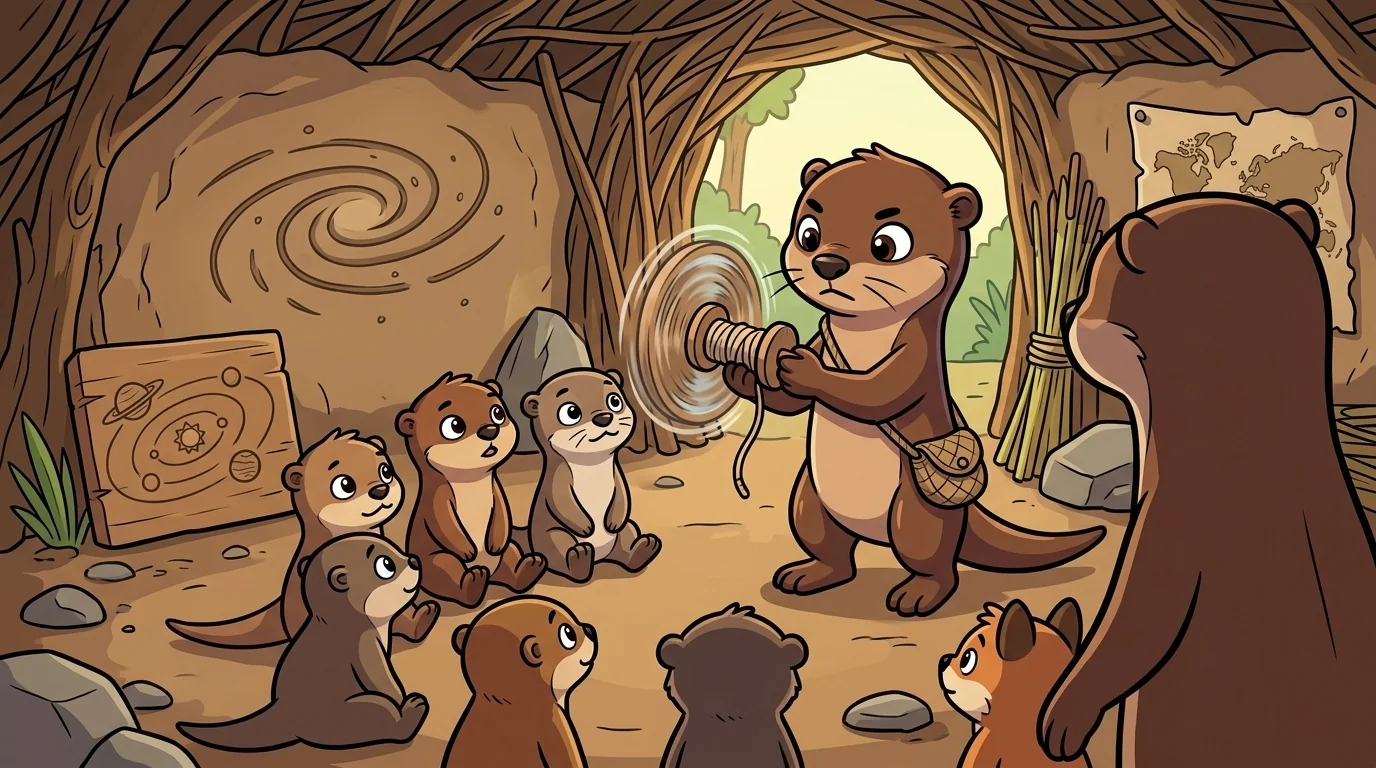
Swirl was a young otter with a secret in her pouch. It wasn't a shiny rock or a tasty clam. It was a small wooden toy. A spool, with a string wrapped neatly around it.
She was quick and playful. Her sleek, brown fur shone. But her eyes were serious when she talked about spinning.
To Swirl, spinning was everything.
Her toy proved it. The spool had a special bearing inside that let it spin for a very long time. When she pulled the string, it whirred to life. It spun and spun, a perfect, steady blur. It wanted to keep spinning. It wouldn't stop unless something slowed it down.
This is called *angular momentum conservation*. It’s a big name for a simple idea: things that are spinning want to keep on spinning.

It’s one of the most important rules in the whole universe.
When a giant cloud of gas floats in space, it has a little bit of spin. Just a tiny, lazy tumble. But when gravity pulls that cloud tighter and tighter, something amazing happens. The cloud starts spinning faster and faster.
Think of an ice skater. She starts a spin with her arms out wide. When she pulls her arms in, she suddenly spins much faster. The gas cloud does the same thing. As it shrinks, it spins like crazy.
All that spinning flattens the cloud. It squishes it down into a big, flat, spinning disk. Like a chef spinning a ball of pizza dough in the air. That’s how you get a solar system. It’s how you get a whole galaxy. Gravity and spinning work together to make disks.
And what about the beautiful spiral arms in a galaxy?
"They aren't solid," Swirl would explain. "They aren't like roads that the stars drive on."

The arms are actually waves. They are *density waves* — a fancy term for places where things get crowded. Imagine a traffic jam on a circular highway. The cars move through the jam, but the jam itself stays in one place. The spiral arms are like that. They are slow-moving traffic jams of stars and gas.
And because things are so crowded in the arms, that’s where new stars are born. That’s why the arms glow so brightly. They are full of brand-new, super-hot baby stars.
Swirl knew all about things that spin. She grew up in a small village by a river. Her family were the wheel-makers. They carved the giant water wheels that powered the town mill. They made the wheels for every cart.
She learned a hard lesson when she was six. A wheel that wasn’t perfectly balanced would wobble. It would shake itself apart. But a wheel that was balanced just right would spin smoothly for years. Rotation was a craft. You had to respect it.
When she came to the CosmosForge academy, Nova asked her a question. “What is a spiral galaxy?”
Swirl didn't hesitate. "It's the shape of history," she said. "A giant cloud collapsed. It started spinning faster. That’s *angular momentum conservation*. The spinning flattened it into a disk. Then waves moved through the disk and made the arms. Everything about its shape tells you how it was made."
Nova smiled. "You are appointed."
Now, Swirl starts her first lesson the same way every time. She stands before her new students. She reaches into her pouch and takes out the small wooden spool.
She gives the string a sharp pull. The spool buzzes, spinning fast in her paw.
"I am Swirl," she says. "I teach *rotation and spirals*. It all comes down to this." She holds up the toy. "Things that spin want to keep spinning. Watch this spool. Watch a galaxy. It's the same physics."
She teaches her students the big ideas of spinning.
Things that spin, stay spinning. That's angular momentum conservation. A spinning top doesn't want to fall over. A galaxy doesn't want to stop spinning. *Shrinking clouds make flat disks. Gravity pulls a cloud of gas in. The spin from that cloud flattens it out. This is how our solar system was born, from a flat disk, about 4.6 billion years ago. *Our solar system remembers its past. The Sun is in the middle. The planets all orbit in the same flat plane. They all travel in the same direction. That’s not a coincidence. It's the ghost of the disk it used to be. *Spiral galaxies are giant spinning disks. Our Sun is just one star in the Milky Way galaxy. It takes our Sun about 230 million years to make one trip around the center. *Spiral arms are cosmic traffic jams. They are waves of crowded gas and dust, called density waves. New stars are born in these crowded places, which makes the arms look bright. *Even black holes make disks.* When stuff falls toward a black hole, it spirals in. It forms a super-hot, super-fast spinning disk before it disappears.
"You see this everywhere," Swirl tells her class. "Watch water go down a drain. It forms a whirlpool. Watch a hurricane on a weather map. It's a giant spiral. Watch a galaxy through a telescope."

She lets them think about it.
"Different sizes, same physics," she says quietly. "Gravity pulls. Rotation flattens. That's the recipe."
Sometimes a student will ask, "Is all this physics hard?"
Swirl always gives the same answer. "It's not hard. It's just a story. A story about things that spin." She looks down at her toy. "The shape of a galaxy is the shape of its history."
Her spinning spool slows down. It wobbles gently. Then it stops.
Swirl carefully rewinds the string. The next spin is waiting.
The CosmosForge ensemble
Swirl is part of CosmosForge's distributed-narrative cast. Each character embodies a different curricular primitive; together they teach the full subject.
-

Gleam
Stellar luminosity / electromagnetic radiation / observation
-

Sway
Gravity / orbits / mutual attraction
-

Mist
Nebulae / dust / gas / accretion / stellar nurseries
-

Tide
Cosmological expansion / Hubble flow / cosmic time
-

Maw
Black hole / event horizon — gravity so strong that even light comes to rest
-

Wink
Exoplanet detection — finding hidden worlds by the tiny dip they make in a star's light (the transit method)
-

Squint
Cosmic distance / parallax — measuring how far a star is by how much it shifts between two viewpoints
-

Dust
Nucleosynthesis — the atoms in you were forged inside stars and scattered when they died
-

Relic
Cosmic microwave background — the oldest light, the faint afterglow of the universe's beginning