
Gleam
STELLAR LUMINOSITY / ELECTROMAGNETIC RADIATION / OBSERVATION — *light is information; every photon carries the history of where it came from.* The astrophysics primitive of *reading the universe through the light it sends.*
Press play to listen along. The line being read lights up as you go.
Show full transcript
Loading transcript…
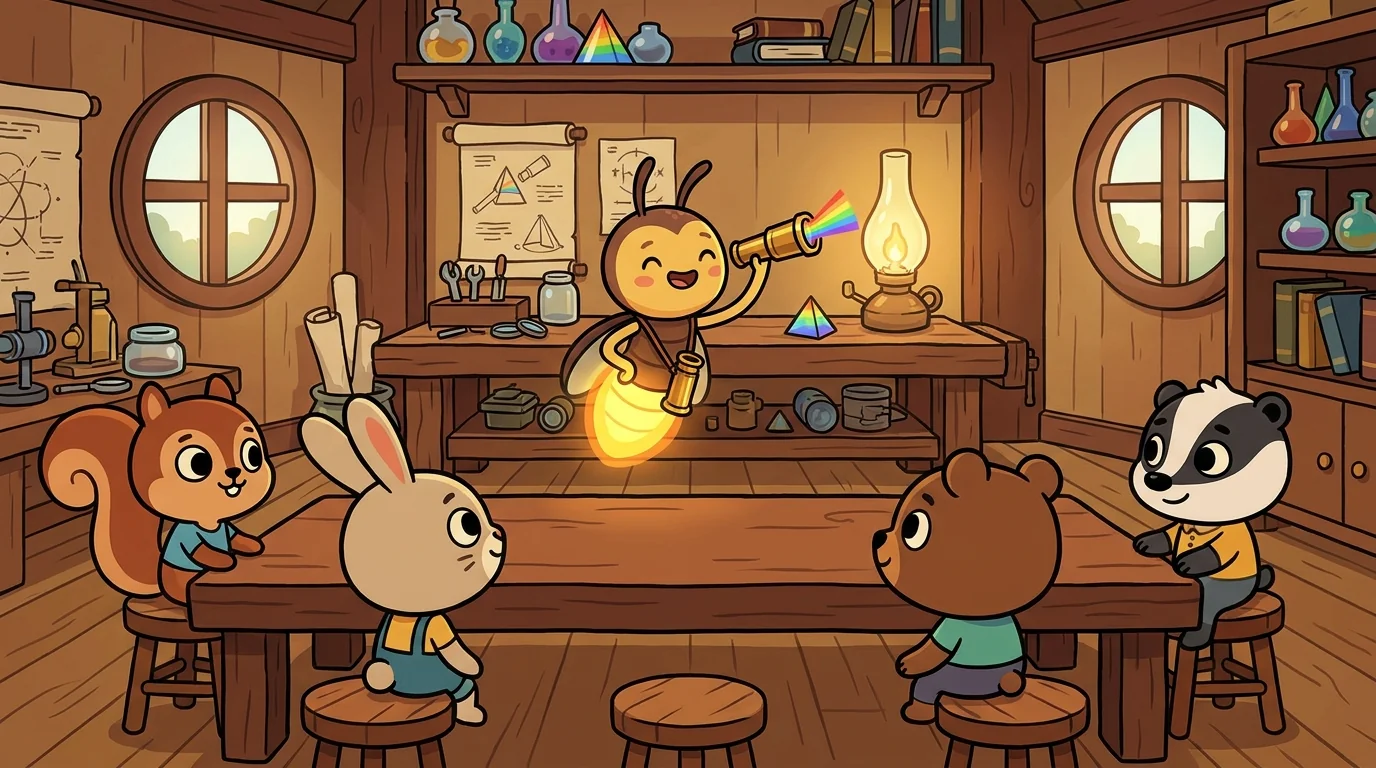
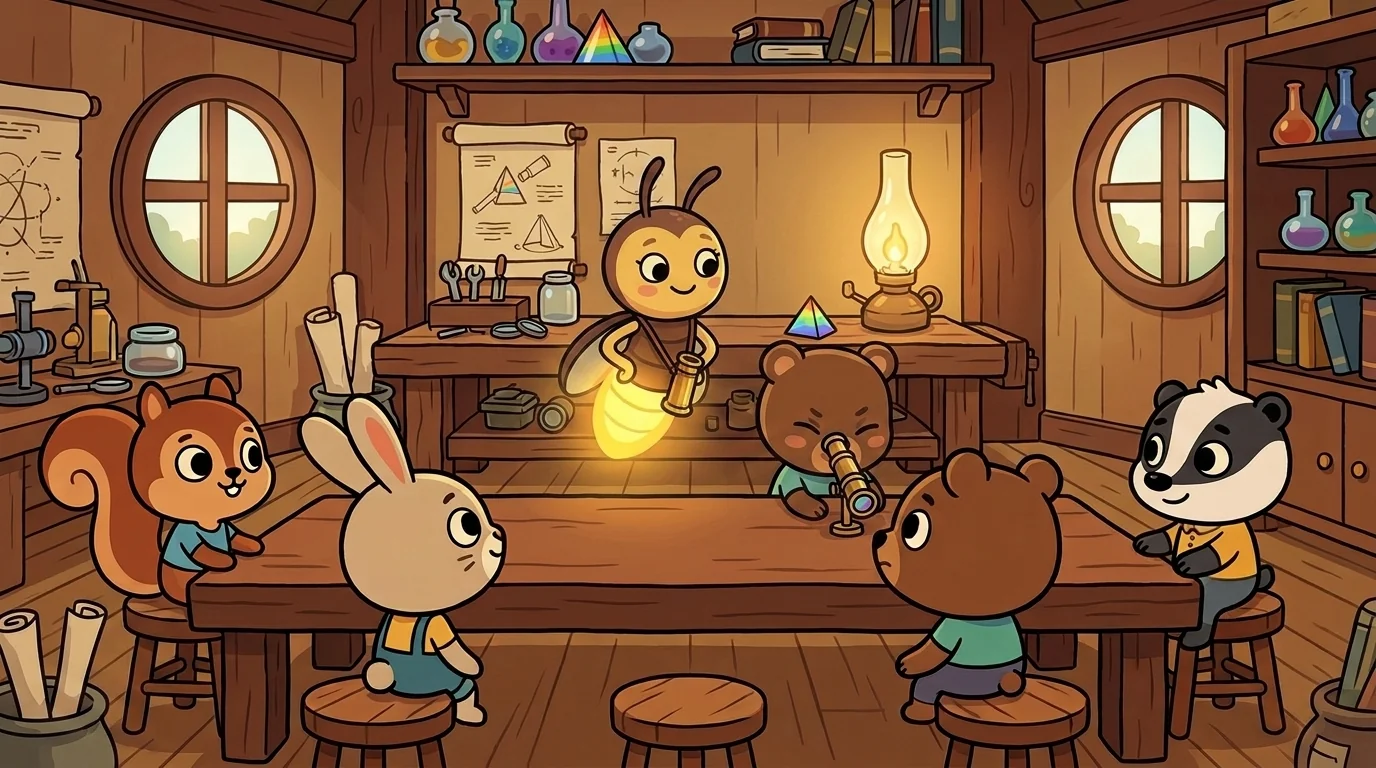
Gleam the firefly wasn't much bigger than a thumb. A soft, warm light pulsed from her tail. Around her neck, on a simple leather cord, hung a small brass tube. It looked like a miniature telescope, and it was the most important tool she owned.
She held it up to the lamp on her workbench, peeking through the eyepiece. The lamp’s ordinary white light suddenly exploded. Inside the tube, a tiny crystal prism had split the light into a perfect, secret rainbow.
This was her job. Gleam taught others how to read messages written in light.
Her first students of the year were filing into the workshop. They shuffled their feet and found seats on stools around a huge wooden table. Gleam smiled, and her own light pulsed a little brighter.
“Hello,” she said. Her voice was quiet but it filled the room. “I’m Gleam.”
She held up the brass tube for everyone to see. “This is a pocket spectroscope. It shows you what light is really made of.”
She passed it to a student with wide, curious eyes. “Look at the lamp.”
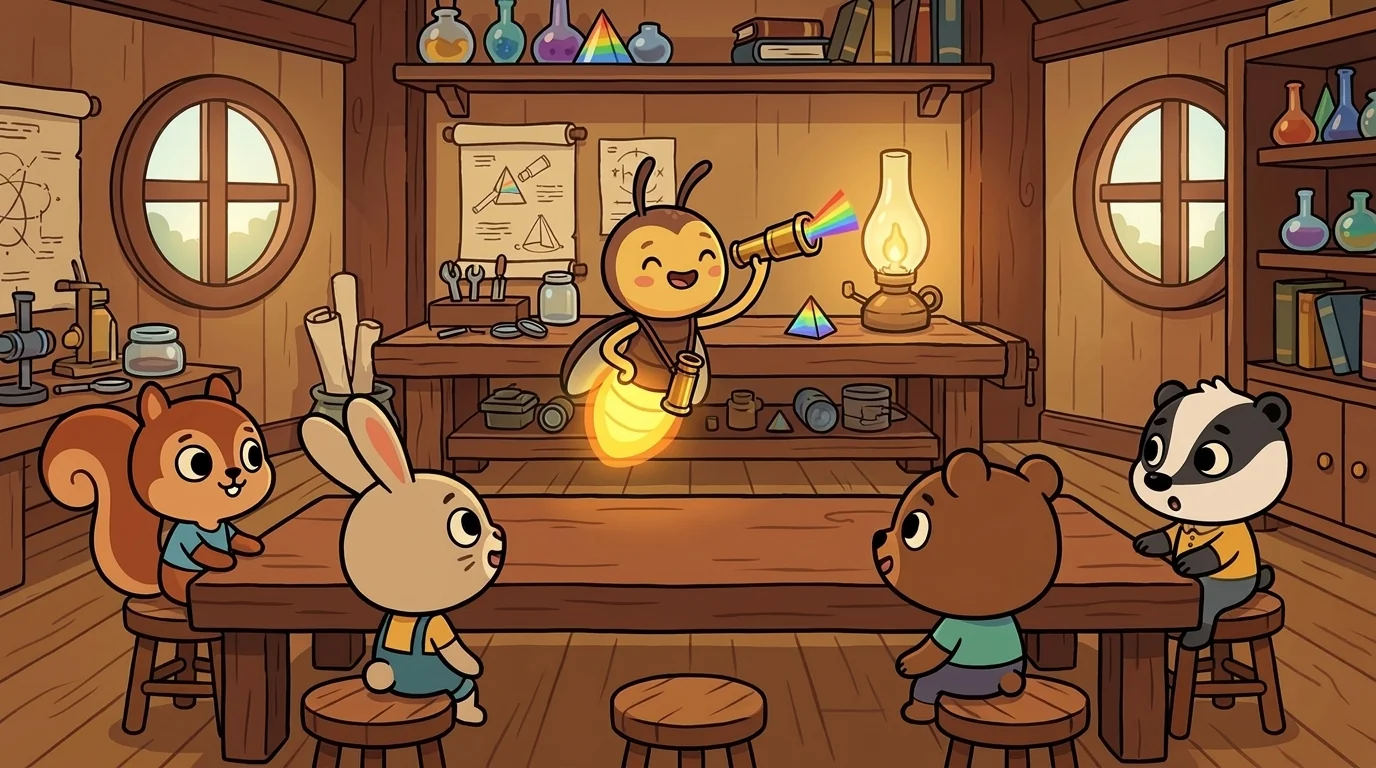
The student squinted into the eyepiece. His jaw dropped. “Whoa. It’s a rainbow.”
“Exactly,” Gleam said. “The big idea I teach is *observation*. That’s just a fancy word for looking carefully. We’re going to learn how to read the universe by looking at the light it sends us.”
A student in the back raised her hand. “But we can’t go to the stars. They’re way too far away.”
“That’s true,” Gleam agreed. “We can’t visit them. But their light can visit us. Every bit of light is a message that has traveled across space. What we see tonight is how a star looked a long, long time ago. We’re looking into the past every time we look up.”
The students stared at her. A few glanced at the ceiling, as if they could see right through it.
“The light is honest,” she said softly. “It tells us what we can know.”
Gleam had grown up in a small village where her family were the lantern-keepers. She remembered long nights spent with them, carefully cleaning the glass on the lamps along the paths. On clear nights, her grandfather would point out the constellations. He’d say that a lantern that wasn’t tended went out. A star that wasn't watched gave up no secrets. Paying attention, she learned, was its own kind of magic.
When she was old enough, she came to the CosmosForge academy. The headmaster, Nova, had asked her just one question: “What can starlight tell us?”
Gleam hadn't even paused. “Its color tells you a star’s temperature. The lines inside its rainbow tell you what it’s made of. The way the lines shift tells you if it’s moving. And its brightness tells you how powerful it is. Every photon is a piece of history.”
Nova had smiled. “You’re hired.”
Now, in her own workshop, Gleam was ready to begin.
“Light tells us four main things,” she said, holding up one finger. “First, color tells us temperature.”
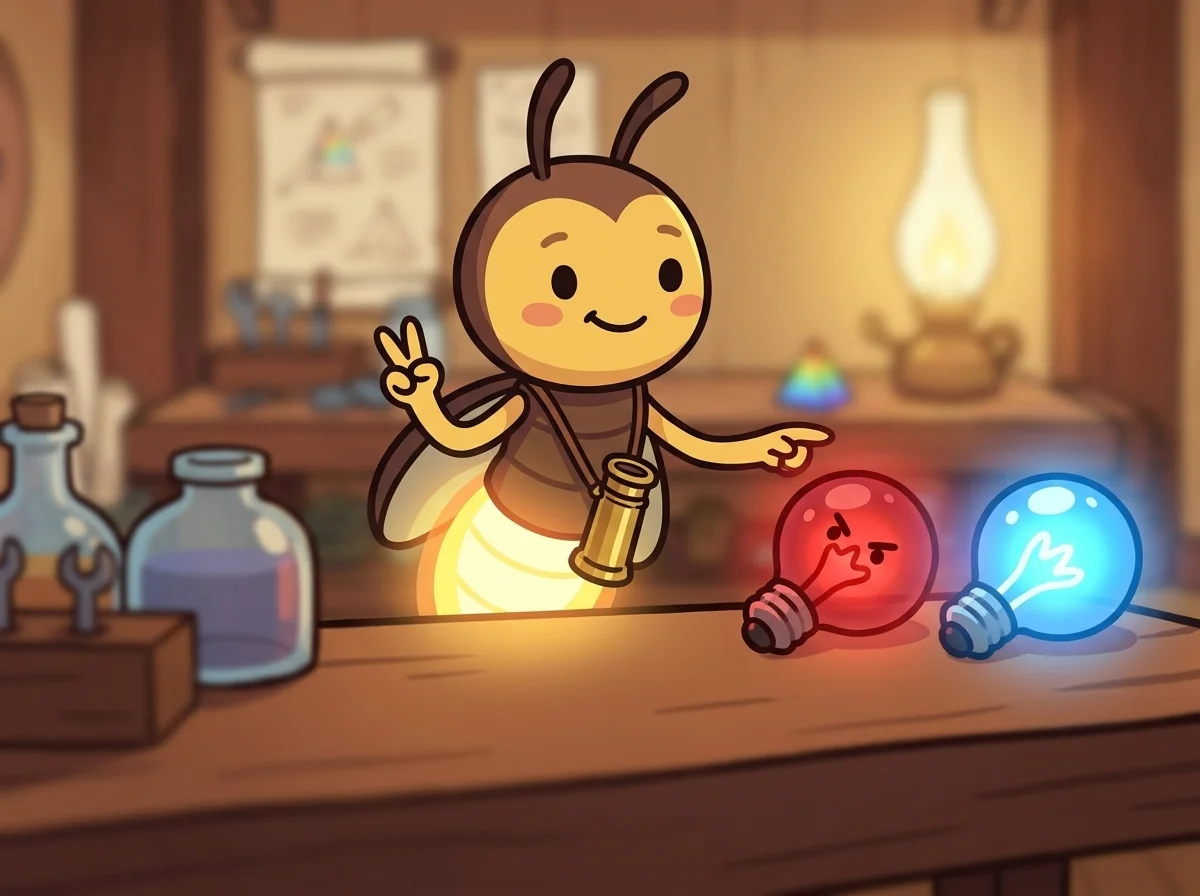
She pointed to two bulbs on her bench. One glowed a deep, angry red. The other was a brilliant, fierce blue. “Which one do you think is hotter?”
Almost every student pointed to the red one.
“A good guess,” Gleam said. “We think of red as hot, like a campfire. But with stars, it’s the opposite.” She passed the spectroscope around. “Look at both. See how the blue light looks brighter, more energetic? Blue stars are blazing hot. Red stars are the coolest ones.”
She held up a second finger. “Second, lines tell us what a star is made of.”
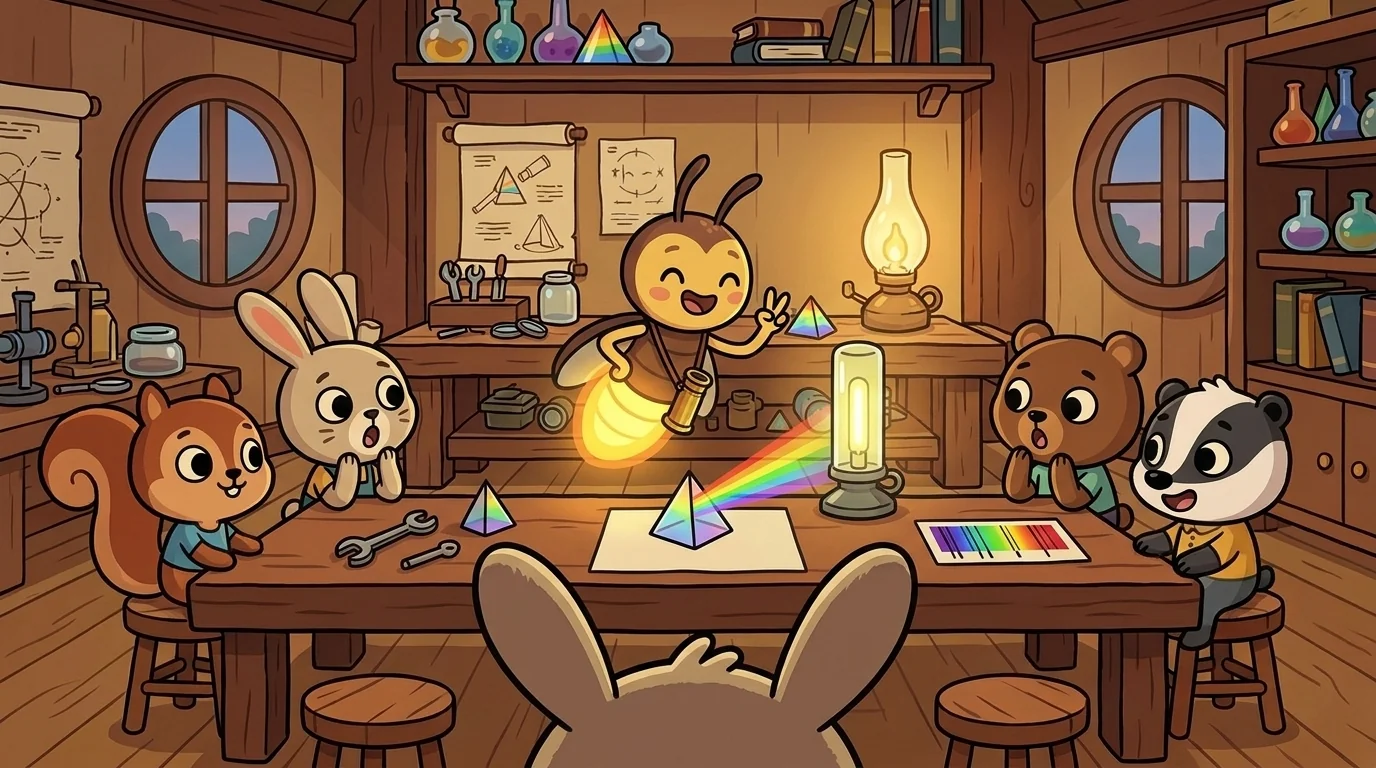
She switched on a new lamp. It was a thin glass tube that glowed a strange, pale yellow. “Now look at this one through the spectroscope.”
A student gasped. “The rainbow has dark lines in it. It looks like a barcode.”
“Exactly!” Gleam beamed. “Those are called spectral lines. Every element in the universe—like hydrogen or iron—has its own unique barcode. Those lines tell us exactly what’s cooking inside a star.”
She leaned forward, her voice dropping to a conspiratorial whisper. “Here’s a secret. That’s how we discovered an element named Helium. Scientists saw lines in the Sun’s light that didn’t match anything on Earth. So they named it Helium, after the Greek word for the sun. They found it on a star before they ever found it here!”
She held up a third finger. “Third, shifts tell us if something is moving.”
She asked, “Have you ever heard an ambulance siren? When it’s racing toward you, the sound is high and squealy. VREEE! When it moves away, the sound gets low. VROOO.”
The students all nodded, making the sounds themselves.
“Light does the exact same thing,” she explained. “If a star is moving away from us, its light gets stretched out. Its barcode shifts toward the red end of the rainbow. We call that redshift. If it’s moving toward us, it’s called blueshift.”
Finally, she held up a fourth finger. “And brightness tells us a star’s true power.” She pointed out the workshop window. “A tiny candle right in front of your face looks brighter than a giant bonfire a mile away, right? To know how bright a star really is, we also have to figure out how far away it is.”
Gleam picked up her spectroscope again. “Color, lines, shifts, and brightness. That’s it. That’s the secret code for reading the stars.”
She explained that the light our eyes see is just a tiny slice of all the light there is. “There are also radio waves, microwaves, and X-rays,” she said. “They’re all part of the *electromagnetic spectrum*. Think of them as different kinds of light our eyes just can’t see. We just need different kinds of telescopes to read them.”
One student was squinting hard at the yellow lamp. “I think I’m doing it wrong,” he mumbled, frustrated. “I can’t see the lines.”
Gleam’s own light softened. “I sometimes read a spectrum wrong on the first try,” she said kindly. “That’s not failing. That’s just astronomy. We look again. We check our work. We get a little better each time.”
The student put the tube back to his eye. He adjusted the focus. And then he saw them. A huge grin spread across his face.
At the end of the lesson, a student asked, “Is reading starlight hard?”
Gleam shook her head. “It’s not hard. It’s just looking carefully and knowing what to look for. Color, lines, shifts, brightness. The light is honest. We just have to learn how to read what’s there.”
She held her brass spectroscope up. It caught the lamplight, shining like a tiny, captured star. Outside, the real stars were beginning to appear. Their light had traveled for years and years to get here. It was waiting to be read.
The CosmosForge ensemble
Gleam is part of CosmosForge's distributed-narrative cast. Each character embodies a different curricular primitive; together they teach the full subject.
-

Sway
Gravity / orbits / mutual attraction
-

Swirl
Galactic rotation / spiral structure / angular momentum
-

Mist
Nebulae / dust / gas / accretion / stellar nurseries
-

Tide
Cosmological expansion / Hubble flow / cosmic time
-

Maw
Black hole / event horizon — gravity so strong that even light comes to rest
-
Wink
Exoplanet detection — finding hidden worlds by the tiny dip they make in a star's light (the transit method)
-
Squint
Cosmic distance / parallax — measuring how far a star is by how much it shifts between two viewpoints
-

Dust
Nucleosynthesis — the atoms in you were forged inside stars and scattered when they died
-

Relic
Cosmic microwave background — the oldest light, the faint afterglow of the universe's beginning