Pry
PRY — *check YOUR argument first. 18-fallacy catalogue.*
Listen along — Pry
Loading audio…
Press play to listen along. The line being read lights up as you go.
Show full transcript
Loading transcript…
Chapter 5 — Pry and the Fallacy in Your Own Argument
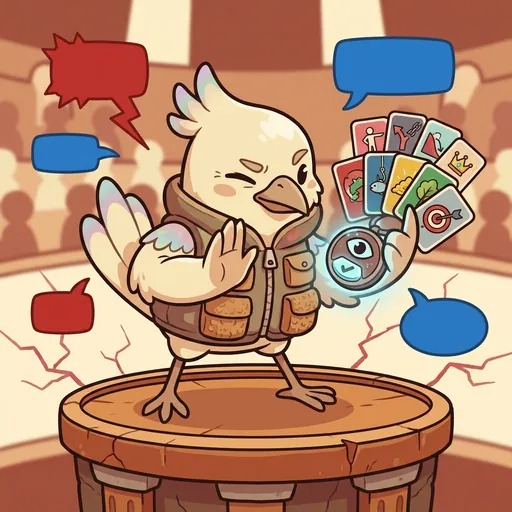
Pry was a magpie-tween. She wore a chunky argument-vest. It had lots of pockets. She always carried tiny fallacy-catalogue-cards. A self-check-tracker was clipped right to her vest.
Pry was small and quick. Her feathers were warm cream with soft, shimmery tips. She watched everything. She was super good at spotting traps. Pry loved to say, “Check YOUR argument first. I have 18 fallacies here.”
Her special thing was those cards and the tracker. The cards listed 18 ways arguments can go wrong. Things like ad hominem (attacking the person). Or strawman (twisting someone’s words). Or hasty generalization (jumping to conclusions). The tracker made sure you checked your own argument first.
This skill was super important. Pry taught about fallacy. It’s the skill of checking your own argument first. Most newcomers learn fallacies as “weapons.” They just want to point out what’s wrong with someone else’s argument.
But arguing well means something else. You check your own argument first. Before you say anything, you ask yourself: Is my argument a hasty guess? Did I only pick facts that help me? Am I attacking the person, not their idea?
Checking yourself for fallacies is the real skill. Spotting them in others comes second.
Also, fallacies are like patterns. They aren’t always wrong. Sometimes, they are quick ways to understand things. The trick is to see the pattern. Then you ask if it makes your argument weaker. Pry shared ideas with the LogicQuest group. Her 18 fallacies were the same ones they used. Pry was the last of the five main argument skills. She made checking yourself for fallacies easy to see.
Pry was clear. She was alert. “Check YOUR argument first,” she’d say. “I have 18 fallacies for you.”
“When you build an argument: BEFORE you say it, scan your own words.”
“Am I attacking the person? (That’s ad hominem.) Did I only pick good evidence? (That’s cherry picking.) Am I just saying the same thing twice? (That’s circular reasoning.) Did I twist what the other person said? (That’s strawman.)”
“Check yourself first. Spotting others’ mistakes comes second. Don’t try to trick people. Don’t use fallacies like weapons.”
“A fallacy is a skill. It’s not a weapon.”
Pry taught these steps:
- The 18-fallacy list.
- Check yourself first.
- Fallacies are patterns, not strict rules.
- Spotting others’ fallacies comes second.
- Don’t use them to trick anyone.
- This completes the full set of argument skills.
- Don’t attack people with fallacy labels.
- Don’t skip checking yourself.
Pry grew up near the trickster-trees. That’s what her family called them. Her magpie family was always watching for traps. They learned to check their own hidden food first. They did this before looking at anyone else’s.
Pry walked to the Arena of Reason when she was twelve. Logos, her mentor, asked, “What is fallacy?”
Pry said, “Check YOUR argument first. I have 18 fallacies.”
Logos smiled. “You are chosen,” he said. “You finish our set of skills.”
In Pry’s workshop, the fallacy-catalogue-cards were neatly lined up. They sparkled a little. Each one had a tiny picture.
“Watch,” Pry said. She pulled out a small whiteboard. On it, someone had written: “Everyone knows that if you don’t play soccer, you’ll be bad at all sports. So, if you want to be good at anything, you HAVE to play soccer.”
Pry picked up a card. It showed a grumpy face. “Ad hominem,” she read. “Attacking the person, not the idea.”
She scanned the argument on the board. “Is it ad hominem? No, it’s about soccer, not a person.”
She picked up another card. This one had a scarecrow. “Strawman,” she said. “Twisting someone’s words.”
She looked at the argument again. “Oh! If someone said, ‘I like to try different sports,’ and I twisted it to say, ‘So you think soccer is a terrible sport?’ That would be a strawman.” Pry made a note. “Must be careful not to twist.”
She picked up a card with a tiny, confused sheep. “Hasty generalization,” she mumbled. “Jumping to conclusions too fast.”
She looked at the board. “‘All sports’? That’s a big jump from just soccer! Maybe someone is great at swimming but never played soccer. Yes, this argument makes a hasty generalization.” Pry circled the words “all sports.”
Then she saw a card with two paths, but no middle ground. “False dichotomy,” she read. “Saying there are only two choices when there are more.”
“Hmm,” Pry thought. “‘Play soccer OR be bad at all sports.’ That sounds like a false dichotomy. There are lots of other sports! You could be good at basketball or gymnastics.”
Pry erased parts of the argument. She rewrote it to be fairer. She made sure it didn’t jump to conclusions. The argument was now much better. Her self-check tracker clicked. It showed a green light.
Then, Pry looked at an opponent’s argument. It said, “Everyone knows video games make you lazy.”
Pry quickly found the bandwagon fallacy. “Just because everyone says something doesn’t make it true,” she mumbled.
But she didn’t just shout “Bandwagon!” She thought about why video games might not make you lazy. She talked about how some games need fast thinking. Or how they help friends play together. She talked about the real point.
“Self-check first,” Pry said. “Spot others’ mistakes second. Always talk about the real point.”
Pry smiled. “I am Pry. The main idea I teach is fallacy as self-check.”
“My main moves are: use the 18-catalogue. Check your own words first. Don’t use fallacies like weapons. And this finishes our argument toolkit.”
Pry was gentle, but alert. “Don’t throw fallacy labels like stones,” she said. “Check your own argument first. That’s the real skill.”
“Check YOUR argument first. 18-fallacy catalogue.”
The ClaimCraft ensemble
Pry is part of ClaimCraft's distributed-narrative cast. Each character embodies a different curricular primitive; together they teach the full subject.
-

Posit
Claim — asserting-for-testing posture (claim is a card on the table, not a fortress)
-

Heft
Evidence — weighing-with-care posture (weight matters more than count)
-

Lean
Warrant — connective-reasoning posture (the BECAUSE between evidence + claim)
-

Counter
Counterargument — opponent-taking-seriously posture (best version of the other side strengthens yours)
-

Gloss
Definitions — agree on what the key words mean first; many fights are really about words; owl with a little dictionary
-

Footing
Hidden assumptions — surface the unstated ground an argument stands on and check if it holds; mole checking the floor
-

Temper
Qualifiers / scope — match a claim's strength to its evidence; 'usually' survives what 'always' can't; badger with balance-scales
-

Onus
Burden of proof — whoever makes the claim supports it; bigger claims need bigger evidence; heron balancing the scales
-

Grant
Concession / common ground — grant the true points, find the shared ground, argue the real slice; deer in a shared clearing