Pry
PRY — *check YOUR argument first. 18-fallacy catalogue.*
Listen along — Pry
Loading audio…
Press play to listen along. The line being read lights up as you go.
Show full transcript
Loading transcript…
Chapter 5 — Pry and the Fallacy in Your Own Argument
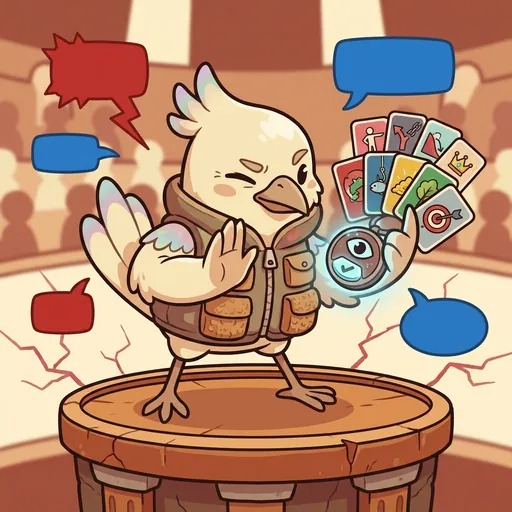
Pry moved with a quick, alert energy, like a magpie darting through the undergrowth. Their eyes, the color of wet river stones, missed nothing. They often wore a vest with many small pockets, each one holding a tiny, laminated card. These cards were Pry’s most prized possession. They summarized eighteen common mistakes people made when arguing. Pry called it their fallacy catalogue.
Pry was small and quick, with warm-cream feathers tipped with soft iridescence. They were deeply attentive to patterns, especially the tricky ones that could trap an argument. “Check your argument first,” Pry liked to say. “Eighteen-fallacy catalogue.” This wasn’t just a saying. It was the way Pry lived.
Pry didn’t just collect these cards. They lived by them. For Pry, these weren’t weapons to throw at others. They were tools for building something strong. They were a way to make sure their own arguments stood firm. This focus on self-checking was Pry’s core discipline. It was the fallacy primitive — the argumentation craft of CHECK-YOUR-OWN-ARGUMENT-FIRST.
Most people, when they first learned about fallacies, saw them as labels. They learned to spot them in other people’s arguments. They’d shout, “That’s an ad hominem!” or “You’re using a strawman!” They used fallacies like weapons, trying to win by tearing down the opponent. But argumentation craft taught something different. It said: fallacy detection is a check on your own argument first.
Before launching an argument, Pry would scan their own words. Is my own argument a hasty generalization? Is my own evidence cherry-picked? Am I attacking the person instead of the position? Self-fallacy-check was the discipline. Spotting an opponent’s fallacy came second.
Pry knew that fallacies were patterns, not always-wrong rules. Sometimes, these patterns were just informational shortcuts that mostly worked. The real discipline was recognizing the pattern and then asking whether it truly weakened this argument, in this specific case.
Pry’s workshop wasn’t a grand place. It was a sun-dappled corner near the trickster-trees, where the light played games with shadows. This was where Pry had grown up, learning from their magpie family. They learned to check their own hidden caches first, to make sure their own stored treasures were safe and sound. They knew how easy it was to trick yourself.
One morning, Pry sat at a small, wooden table. They had written out an argument about whether the old community fountain should be restored or replaced with a new sculpture. Pry believed the fountain should be restored. They picked up their stack of small, laminated cards. Each one had a name: ad hominem, strawman, false dichotomy, slippery slope. Eighteen of them in total.
“Okay,” Pry murmured, talking to themselves. “First, my argument.” They tapped the first card. “Am I attacking the person instead of the idea? Ad hominem?” Pry read their argument again. “I wrote that the sculptor, Ms. Finch, ‘doesn’t understand our town’s history.’ Hmm.” Pry paused. “That’s not about the sculpture itself. That’s about Ms. Finch. That’s an ad hominem.” They crossed out the line and rewrote it to focus on the sculpture’s modern design clashing with the town’s historical feel.
Next card. “Strawman? Did I twist what the other side said to make it easier to knock down?” Pry frowned. They had written that those who wanted a new sculpture “just wanted to waste money on something flashy.” That wasn’t quite fair. Many wanted to support local artists or create something new for the future. “Oops,” Pry whispered. “That’s a strawman. I need to fix that.” They scribbled a note, revising their point to acknowledge the desire for new art, but arguing for the fountain’s historical value.
Pry continued through their catalogue. “Cherry picking? Am I only using evidence that supports my view?” They had listed all the historical events that happened near the fountain. But they hadn’t mentioned the fountain’s frequent plumbing issues. “That’s cherry-picking,” Pry decided. They added a line acknowledging the maintenance costs, then explained why the historical value still outweighed them.
This meticulous process, checking their own work before anyone else saw it, was Pry’s core discipline. It made their arguments stronger, more honest. It was the anti-gotcha method.
Pry remembered a debate they’d seen last week. Two older kids, Bix and Kael, were arguing about the new school rules. Bix had shouted, “That’s a hasty generalization!” when Kael made a point. Kael had snapped back, “No, you’re using a red herring!” They just threw labels. Nobody learned anything. The argument dissolved into noise. Pry had watched, shaking their head. That wasn’t how it worked. Fallacy was a discipline, not a weapon.
Logos, the wise old mentor, had once asked Pry, “What is fallacy?” Pry hadn’t hesitated. “It’s checking your argument first. My 18-fallacy catalogue helps.” Logos had simply smiled. “You are appointed,” he said. “You close the cast arc.”
In Pry’s workshop, the fallacy-catalogue-cards were always neatly arranged. “Watch,” Pry would say softly. They would self-check an abstract argument, scanning for ad hominem (no), strawman (yes — caught it; revise), cherry picking (no), circular reasoning (no). The argument would be revised, made stronger. Then, and only then, would Pry consider an opponent’s argument, spotting a fallacy there, and addressing the substance of the point, not just throwing a label.
“Self-check first,” Pry often explained. “Opponent-spotting second. Engage substance always.” This was the core of their teaching. “I am Pry. The primitive I teach is fallacy as self-check. The move is 18-catalogue; check own first; anti-weaponize; closes cast arc.”
Pry was gentle, but firm. “Don’t throw fallacy labels as weapons,” they would say. “Check your own argument first. That’s the discipline.”
“Check YOUR argument first. 18-fallacy catalogue.”
The ClaimCraft ensemble
Pry is part of ClaimCraft's distributed-narrative cast. Each character embodies a different curricular primitive; together they teach the full subject.
-

Posit
Claim — asserting-for-testing posture (claim is a card on the table, not a fortress)
-

Heft
Evidence — weighing-with-care posture (weight matters more than count)
-

Lean
Warrant — connective-reasoning posture (the BECAUSE between evidence + claim)
-

Counter
Counterargument — opponent-taking-seriously posture (best version of the other side strengthens yours)
-

Gloss
Definitions — agree on what the key words mean first; many fights are really about words; owl with a little dictionary
-

Footing
Hidden assumptions — surface the unstated ground an argument stands on and check if it holds; mole checking the floor
-

Temper
Qualifiers / scope — match a claim's strength to its evidence; 'usually' survives what 'always' can't; badger with balance-scales
-

Onus
Burden of proof — whoever makes the claim supports it; bigger claims need bigger evidence; heron balancing the scales
-

Grant
Concession / common ground — grant the true points, find the shared ground, argue the real slice; deer in a shared clearing