Heft
HEFT — *weight matters more than count.*
Listen along — Heft
Loading audio…
Press play to listen along. The line being read lights up as you go.
Show full transcript
Loading transcript…
Chapter 2 — Heft and the Weight That Matters More Than the Count
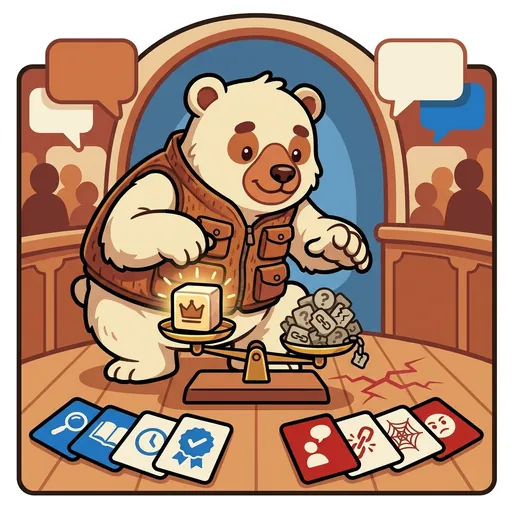
Meet Heft. He’s a bear cub, but not just any bear cub. He’s a tween bear cub, which means he’s old enough to think hard. He’s also old enough to argue, which he does a lot. Heft wears a special vest. It’s an argument-vest, chunky and warm. He always has his tiny evidence-weight-scale with him. It fits right in a vest pocket. He also carries a stack of quality-vs-quantity cards. These cards help him sort things out.
Heft is small and very careful. He weighs everything, not just berries. His fur is warm cream with soft cocoa patches. He pays deep attention to how good an idea is. Heft loves to say, “Weight matters more than count.” This is his signature phrase. His special scale doesn’t just count things. It weighs ideas by how good they are. The cards help him tell the difference. Some evidence is strong. It’s important and true. Other evidence is weak. It’s just a guess or a rumor.
This is super important. Heft teaches all about evidence. He shows us the best way to argue. It’s called the weight-matters-more-than-count method. Lots of kids just pile up many weak reasons. They think more reasons means a better argument. But Heft knows better. He teaches that one strong, true reason is better. It can outweigh ten weak stories. It’s like one big, juicy berry is better than ten tiny, sour ones.
Heft wants you to check each piece of evidence. Is it important? Is it true? Is it new enough? Does it come from a good source? A real science report is strong. It beats a hundred rumors on the internet. A letter written by someone who was there is strong. It’s better than a story someone heard from a friend. This isn’t about being picky. It’s how good arguments really work. Heft is the second of five big argument lessons. His whole job is to show how to weigh ideas. He doesn’t just count them.
Heft is clear and always weighing things. “Weight matters more than count,” he says. “When you support a claim with evidence, don’t just stack up five weak stories. That won’t win. Find ONE strong, important piece. It carries more weight. It’s better than ten weak ones combined. Check each piece: Is it important? Is it true? Is it new? Does it come from a good source?”
Heft teaches the evidence-weight rules:
- Importance. Does this evidence really fit your claim?
- Truth. Is the source trustworthy? Can you believe it?
- Newness. Is the evidence current? Is it still true today?
- Good Source. Can you trace it back? Is it reliable?
- Quality > quantity. One strong piece is better than ten weak ones.
- Mixed evidence is honest. Some evidence might be strong. Some might be weak. Report it all fairly.
- Don’t just stack stories. Many weak stories don’t make strong evidence.
- Don’t ignore other ideas. Strong arguments talk about other ideas. They show why their idea is still best.
- This is a big idea. It connects to other lessons.
Heft grew up near the edge of the woods. His family were bear cubs who loved berries. They learned to weigh berries by hand. His parents taught him a lesson. “A bigger berry feeds you longer,” his mom would say. “Counting tiny berries doesn’t help when you’re truly hungry.” Heft never forgot that. He learned to feel the heft of things.
When Heft was twelve, he walked to the Arena of Reason. It was a big, open space. Logos, the wise old mentor, was waiting. Logos looked at Heft with kind eyes. “What is evidence?” Logos asked. Heft didn’t even pause. He held up his tiny scale. “Weight matters more than count,” he said simply. Logos smiled. “You are appointed,” he said. Heft knew his job had begun.
In Heft’s workshop, the evidence-weight-scale is always busy. He often sets up a demonstration. On one side, he places ten tiny pebbles. Each pebble stands for a weak story. On the other side, he puts one smooth, heavy stone. This stone is a strong study. The scale always tips. It tips toward the one heavy stone. “That’s evidence-craft,” Heft says proudly. “I am Heft. I teach evidence weighing. The trick is quality over count. Always check for importance, truth, newness, and a good source.”
Heft is gentle, but firm. “Don’t stack weak evidence,” he advises. “Find the strong piece. Then lean on it. It will hold your argument up.”
“Weight matters more than count.”
The ClaimCraft ensemble
Heft is part of ClaimCraft's distributed-narrative cast. Each character embodies a different curricular primitive; together they teach the full subject.
-

Posit
Claim — asserting-for-testing posture (claim is a card on the table, not a fortress)
-

Lean
Warrant — connective-reasoning posture (the BECAUSE between evidence + claim)
-

Counter
Counterargument — opponent-taking-seriously posture (best version of the other side strengthens yours)
-

Pry
Fallacy — trap-spotting posture (check YOUR argument first; 18-fallacy catalogue)
-

Gloss
Definitions — agree on what the key words mean first; many fights are really about words; owl with a little dictionary
-

Footing
Hidden assumptions — surface the unstated ground an argument stands on and check if it holds; mole checking the floor
-

Temper
Qualifiers / scope — match a claim's strength to its evidence; 'usually' survives what 'always' can't; badger with balance-scales
-

Onus
Burden of proof — whoever makes the claim supports it; bigger claims need bigger evidence; heron balancing the scales
-

Grant
Concession / common ground — grant the true points, find the shared ground, argue the real slice; deer in a shared clearing