Lattice
MODERN CRYPTOGRAPHY FUNDAMENTALS — *XOR, public-key concept, hashing; the irreversible / asymmetric family.* The cryptography primitive of *one-way operations + asymmetric keys as the foundation of modern secure communication.*
Listen along — Lattice
Loading audio…
Press play to listen along. The line being read lights up as you go.
Show full transcript
Loading transcript…
Chapter 8 — Lattice and the One-Way-Door Card
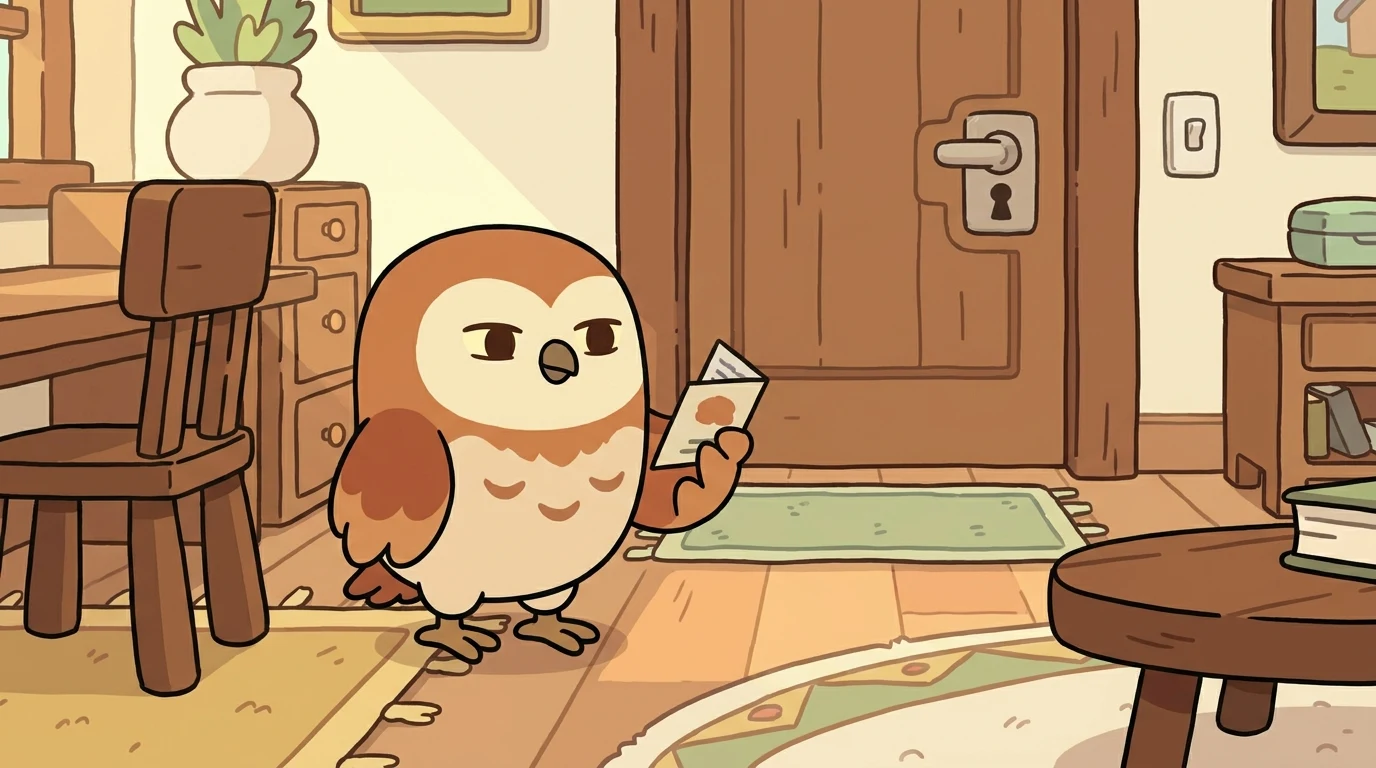
Lattice was a small owl-tween. Her feathers were warm brown and cream, soft against the cool air of CipherForge. She moved with a thoughtful, careful bearing, her steady eyes missing nothing. In her claw, she often held a small, folded card. This was her signature feature: a one-way-door card.
The card showed a door. On one side, a clear handle invited you to push it open. On the other, the door was blank, solid, with no way to enter. It was a simple picture, but it showed the central truth of modern cryptography: some operations are easy to do one way, but impossibly hard to undo.
This idea was essential. Lattice embodied the modern cryptography fundamentals primitive. Older ciphers, like Caesar or Vigenère, were symmetric. They used the same secret key to scramble a message and then unscramble it. Sift could often break these with clever statistical attacks. But modern cryptography worked differently.
Lattice explained it by showing. She might hold up two small, identical blocks. “Imagine these are pieces of information,” she would say. “We can combine them with something called XOR.” She’d demonstrate with a quick flick of her claws, showing how a 0 and a 1 could become a 1, or two 0s could stay a 0. “It’s like flipping a switch. If you flip it once, it changes. Flip it again with the same key, and it goes right back to how it was.” This was the foundational reversible operation, a building block for more complex codes.
Then she’d introduce the idea of public-key (asymmetric) cryptography. “Think of a special mailbox,” she’d suggest. “Everyone knows where it is. Anyone can drop a letter inside.” She’d point to the door on her card, showing the side that opened easily. “That’s the public key. Anyone can use it to encrypt a message for you.” Then she’d flip the card. “But only you have the special key to open that mailbox and read the letter. That’s your private key.” This solved a huge problem that had troubled symmetric ciphers for centuries: how to share the secret key safely. Public-key systems, like RSA or Diffie-Hellman, were the backbone of internet security. They relied on special math, like multiplying two very large prime numbers. That was easy to do. But trying to figure out the original primes from their huge product? “Impossibly hard,” Lattice would state, tapping her one-way-door card. That mathematical trick was the core of it.
Finally, there was hashing. Lattice would describe it like this: “Imagine you take a whole, long story, maybe a thousand pages. And you squish it down into a tiny, unique fingerprint. Always the same size, no matter how long the story was.” She’d hold up a small clay tablet with a swirling pattern. “This fingerprint is a hash. You can always make the fingerprint from the story. But you can never, ever get the whole story back from just the fingerprint.” Hashes were irreversible one-way functions. They were used for things like storing passwords safely or checking if a file had been changed.
Lattice never called modern crypto magic. She was always clear. “Modern crypto is mathematical asymmetry,” she would say, her steady eyes meeting yours. “Some operations are one-way. Easy forward, impossibly hard backward. Multiplying two large primes is fast. Factoring the product back to those primes is practically impossible for big enough numbers. That asymmetry is modern crypto. Public-key systems and hashing both depend on it.”
Lattice taught the foundations of modern crypto:
- XOR (^): The bit-operation that could be reversed with the same key.
- The public-key concept: Different keys for encrypting and decrypting.
- The RSA intuition: Multiplying primes is easy; factoring them is hard.
- Diffie-Hellman key exchange: How two parties could agree on a secret over an open channel.
- Hashing: One-way functions that create unique digital fingerprints.
- How modern ciphers resist frequency analysis: Sift’s usual attacks failed here.
- The understanding that no cipher is unbreakable forever: New threats, like quantum computers, meant cryptography was an evolving frontier.
- And that even these complex ideas could be learned through fun examples, like encrypted messages between club members or hashed passwords for game leaderboards.
Lattice had grown up in a small village, high in the crags. Her family had been the village’s gate-locksmiths for generations. They were the owls who designed locks with one-way openings. You could open a gate easily from inside the village, letting people go to the fields or market. But from outside, without the special key, those gates were solid. Impossible to force open. She understood asymmetry from the ground up, watching her elders craft these clever mechanisms.
She walked to CipherForge when she was twenty-two, her one-way-door card clutched in her claw. Cypher, the forge master, looked at her with a piercing gaze. “What is modern cryptography?” he asked, his voice like grinding stone.
Lattice met his stare. “Mathematical asymmetry,” she replied, her voice calm and clear. “Easy forward, impossibly hard backward. XOR and bit-operations. Public-key systems. Hashing. Frequency analysis fails. Mathematics is the protection.”
Cypher nodded slowly. “You are appointed,” he said.
Lattice often repeated, “My family of ciphers is fundamentally different from Caesar or Vigenère. Symmetric ciphers shared one secret. Modern crypto distributes asymmetric keys. The mathematics—one-way functions—makes the security.”
“It is hard,” she would admit, “but understandable. It is one-way mathematics and asymmetric keys. Modern crypto is what protects the internet.”
The one-way-door card waited patiently in her claw, ready for the next asymmetric explanation.
The CipherForge ensemble
Lattice is part of CipherForge's distributed-narrative cast. Each character embodies a different curricular primitive; together they teach the full subject.
-

Caesar
Caesar shift / monoalphabetic shift cipher
-

Mask
Atbash + general monoalphabetic substitution (every letter has a fixed substitute)
-
Vigenère
Vigenère / polyalphabetic keyword cipher (the Caesar-on-a-rotating-keyword pattern)
-

Echo Pair
Playfair digraph cipher (letters encoded in pairs through a 5×5 grid)
-

Rail
Rail-fence + columnar transposition ciphers (rearrange letter order without changing the letters themselves)
-

Tally
Number-based codes (A1Z26, ASCII, binary, book ciphers — any mapping that converts letters to numbers)
-

Sift
Frequency analysis + cryptanalysis-by-statistics (the cipher-breaking method, not a cipher itself)
-

Hollow
Hides a secret message inside something ordinary, so nobody even knows there is a message to look for.
-

Tome
Keeps a shared code-book where whole words stand for secret words, so only someone with the same book can read the note.