
Tree
TREE — *compound events branch. multiply the independent. add the disjoint.*
Press play to listen along. The line being read lights up as you go.
Show full transcript
Loading transcript…
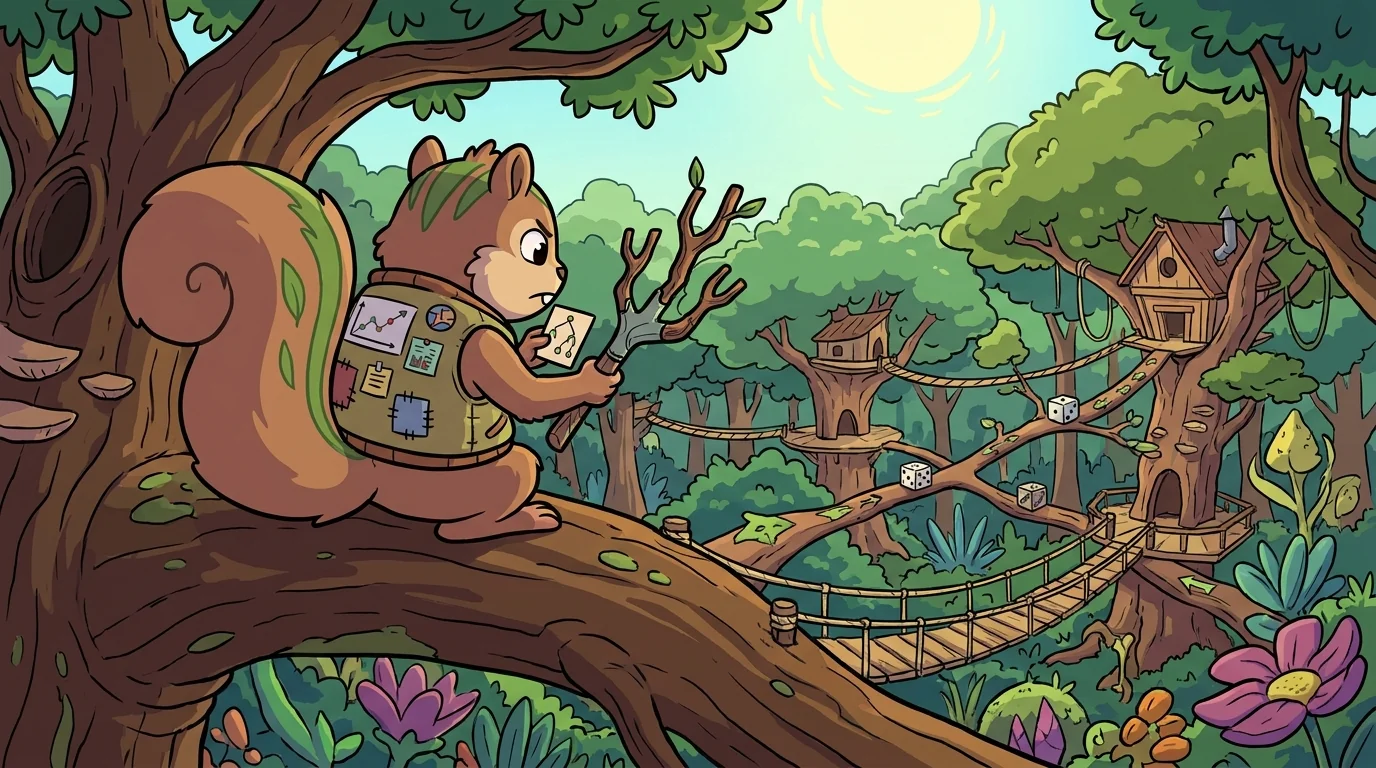
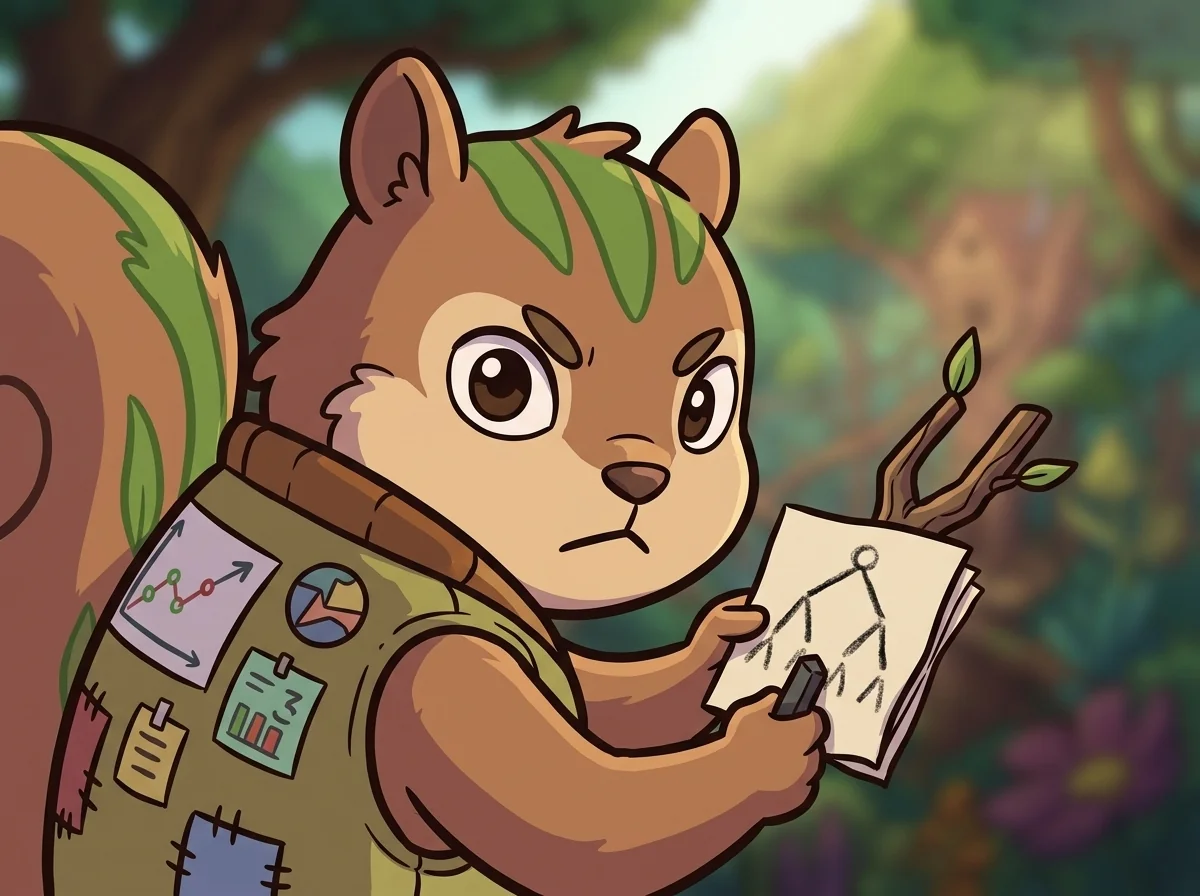
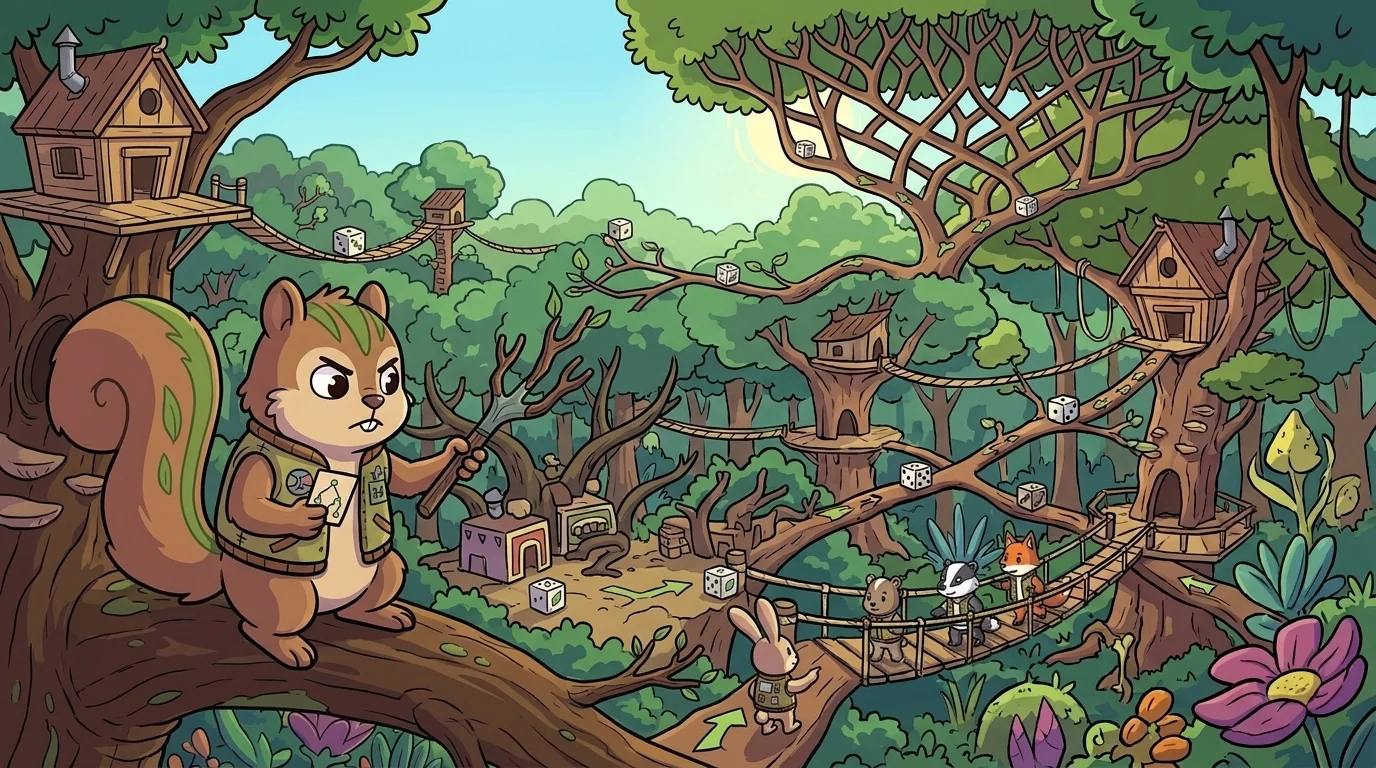
Tree was a squirrel kid who looked like he was born halfway up a tall oak. He was small and a bit twiggy, with soft brown fur and green stripes that looked like new leaves. He always wore a chunky vest covered in little charts and numbers. In one paw, he clutched a small card showing a probability tree. In the other, a special branch-tracker. He watched everything with intense, curious eyes, always trying to see how one thing led to another.
Tree’s whole thing was something called compound events. It sounds complicated, but it just means “many small paths.” He had a saying for it. “Compound events branch. Multiply the independent. Add the disjoint.” He believed you could figure out almost anything if you just drew the right map.
He had a few big rules. First, for *independent events*, you multiply the chances. Think about flipping a coin twice. The first flip doesn’t change the second flip. The chance of getting heads is 1/2. So getting heads then heads is 1/2 times 1/2. That’s 1/4.
Second, for *disjoint events*, you add the chances. This is when you want one thing OR another, but not both at once. Like rolling a 1 OR a 6 on a die. The chance of a 1 is 1/6. The chance of a 6 is 1/6. So the chance of getting either one is 1/6 plus 1/6. That equals 2/6.
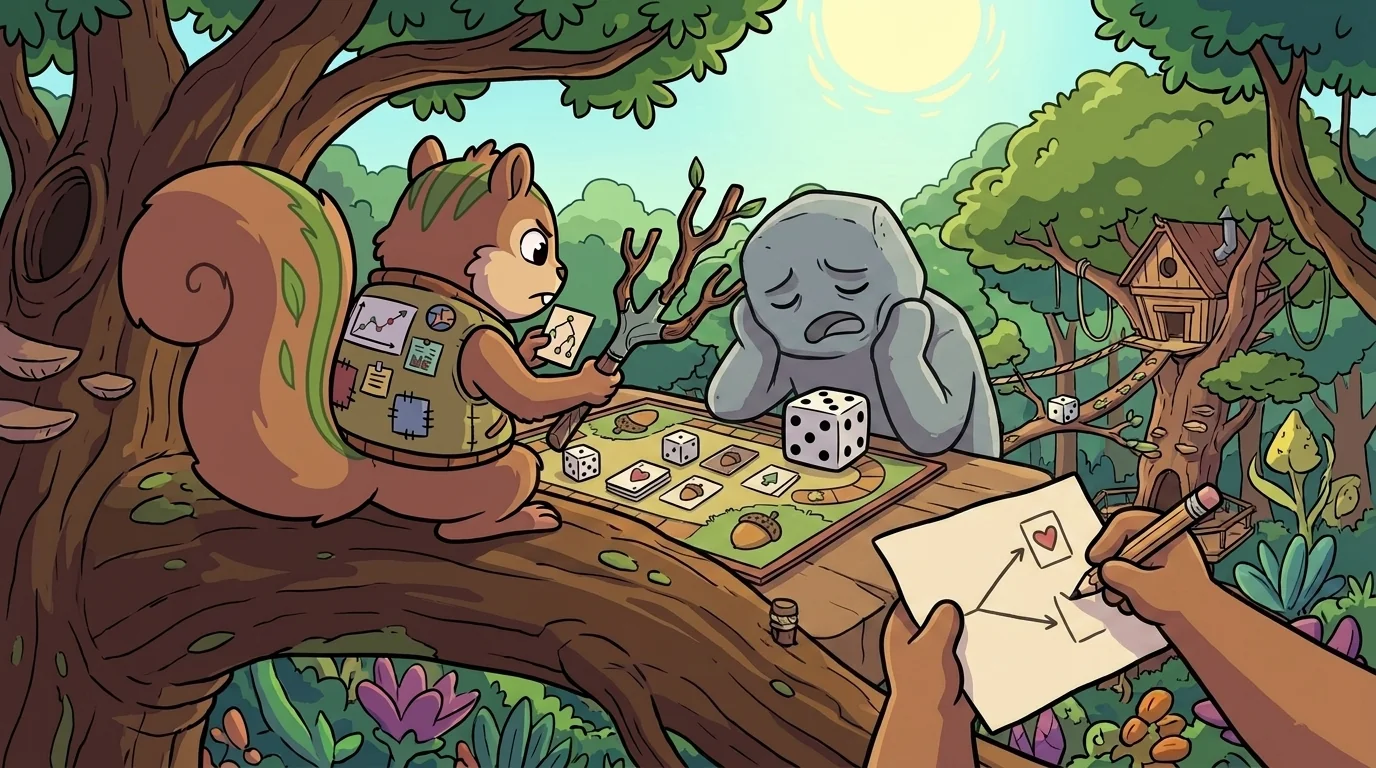
Then there was the tricky one. *Conditional events* are different. The first event changes the chances for the second one. Imagine drawing two cards from a deck without putting the first one back. The first card is gone. That changes the whole deck for your second draw.
Tree taught us to draw these paths using tree diagrams. His lessons helped us see the branches in everything. We used them in PuzzleLogic and even in CodeForge. It was all about the path.
Tree would tap his little card. "I am Tree. My big lesson is compound events." He'd nod his head seriously. "The trick is to branch. Multiply the independent. Add the disjoint. And watch out for the conditional."
"Compound events branch," he'd whisper. "Always mind the path."
One time, we were all playing a board game called "Quest for the Golden Acorn." Center groaned. He needed to roll a six AND draw a hearts card to win. "What are my chances?" he asked, slumping over the board.
Tree didn't even blink. He calmly pulled out a napkin and a tiny pencil. "Let's draw the path," he said. He sketched a single line. "A six on a die is one chance in six." He drew that first branch.
"And a hearts card?" Center asked.
Tree sketched another branch coming off the first one. "There are four suits in a deck. So hearts is one chance in four." The little tree on the napkin looked like a tiny lightning bolt.
"These two things are independent," Tree explained. "The die doesn't care about the cards. The cards don't care about the die." He tapped the final branch. "So we multiply them." He wrote the numbers with a flourish: 1/6 × 1/4 = 1/24.
Sample leaned in, squinting. "So, it'll happen once every twenty-four tries?"
Tree nodded slowly. "On average, yes. If you played the game thousands of times." He looked right at Center. "Any single try is still just luck. But the overall chance is 1 in 24."
Center let out a huge puff of air. "Okay. Not great odds."
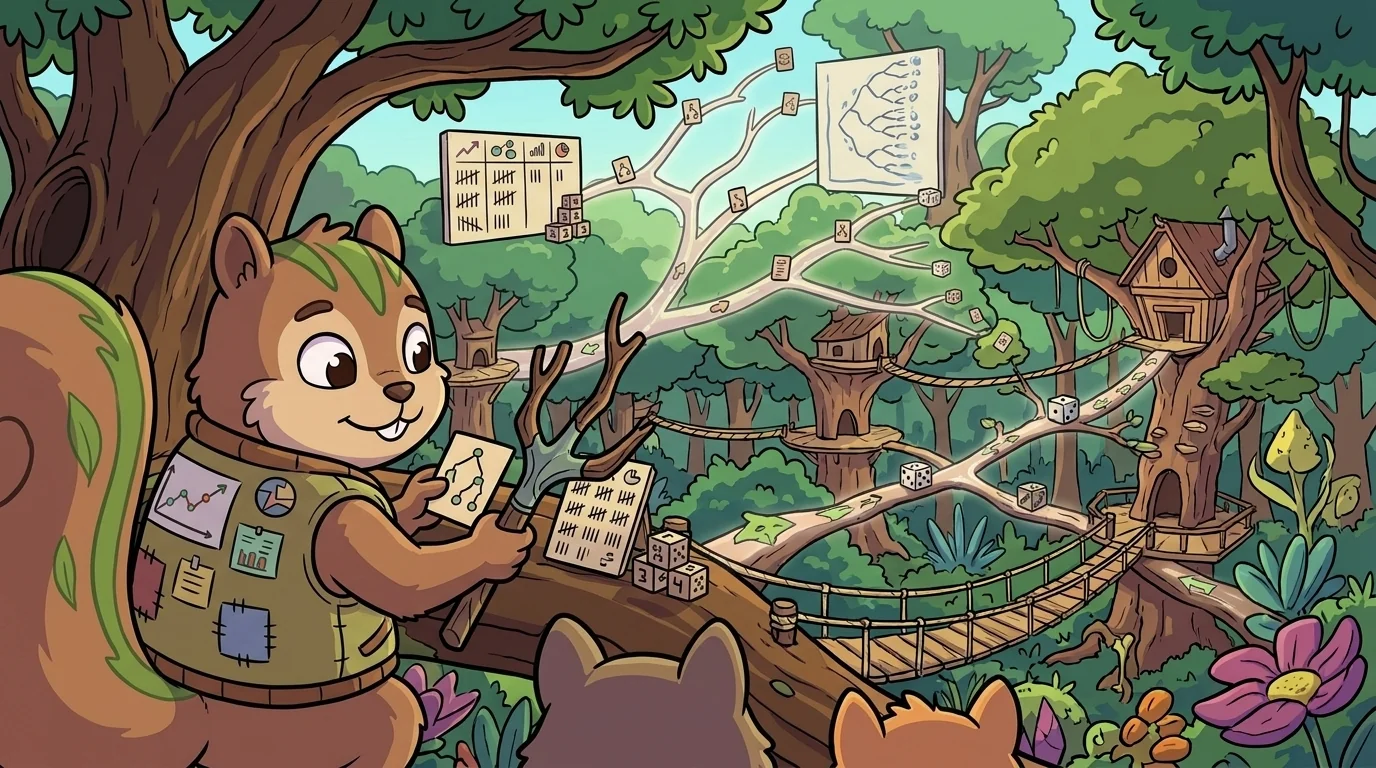
Tree just smiled a little. "Nope. But now you know the path."
The others really listened to Tree. He never just gave them a big, confusing number. He always showed them how it worked. Tally would help count the outcomes. Display drew amazing pictures of the possibilities. But Tree? Tree showed the exact path. He made sure no one just guessed.
"Don't guess what you can branch," Tree would say. "And don't multiply when you should add. And never, ever ignore conditionals."
We learned about conditional events the hard way. We were trying to figure out the chance of drawing two aces in a row. "Easy!" said Tally. "It's 4 out of 52 for the first one. And 4 out of 52 for the second one!" We multiplied the numbers, very proud of our answer.
Tree just shook his head slowly. He took our diagram and made one tiny change. After the first branch—drawing an ace—he crossed out one of the aces from the deck. "The first card is gone," he said softly. "It's not in the deck anymore." He wrote the new numbers for the second branch. "Now there are only 3 aces left. And only 51 cards total."
The new answer was completely different. It was much smaller.
"Conditional events," Tree said, his voice serious. "The first thing changes the second thing. They're the ones that bite you. Especially if you don't draw the tree."
Of everyone in the group, Tree was the only one who really understood casinos. He saw the whole place as one enormous, tangled tree diagram. One afternoon, while looking at an ad for a new arcade, he explained it.
"The casino draws the tree before you even sit down," Tree said, his voice hushed. "They know every single branch." He explained that the paths that led to you winning were just a few tiny twigs. The paths that led to the casino winning were like giant, thick branches.
"The path where you win big?" Tree said, tapping his probability-tree-card. "It's a tiny, hidden branch. They want you to think it's the main trunk." He looked around at his friends. "It’s not about luck. It’s about the tree. And their tree is built to win."
After a while, we started seeing Tree's branches everywhere. In PuzzleLogic, the decision-trees looked exactly like his diagrams. In CodeForge, every 'if/else' statement was a choice, a fork in the path. And GambitTales, the chess game? That was a gigantic tree of compound events. Every move you made created a new branch. And your opponent? They were the conditional event that could change everything.
The ChanceForge ensemble
Tree is part of ChanceForge's distributed-narrative cast. Each character embodies a different curricular primitive; together they teach the full subject.
-

Tally the Counter-of-Outcomes
Data collection + frequency counting (the foundational "what happened, how often?" move)
-

Display the Picture-Maker
Graphs and visual displays (bar charts, histograms, dot plots, line graphs — turning numbers into pictures)
-

Center the Middle-Finder
Central tendency — mean, median, mode (the "what's typical?" question)
-

Sample the Estimator
Sampling, sampling distributions, inference from sample to population
-

Odds the Likelihood-Reader
Basic probability — placing a chance on the 0-to-1 scale from impossible to certain
-

Scatter the Spread-Reader
Spread and variability — how far apart the data is (range), not just the middle
-

Flipside the Other-Outcome-Counter
The complement rule — find the chance it doesn't happen and subtract from 1
-

Clew the Clue-Follower
Conditional probability — how chances change once you learn a new fact
-
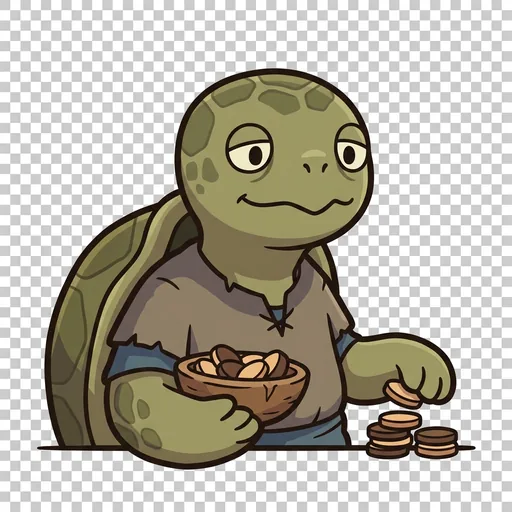
Evens the Long-Run-Settler
Expected value and the long run — results settle toward the average over many tries