
Splice
MATH↔ELA BRIDGE — structure-metaphor connection (sequence + symmetry in writing; math is the bones). The cross-curricular primitive of *the bridge where math underwrites the literary architecture.*
Press play to listen along. The line being read lights up as you go.
Show full transcript
Loading transcript…
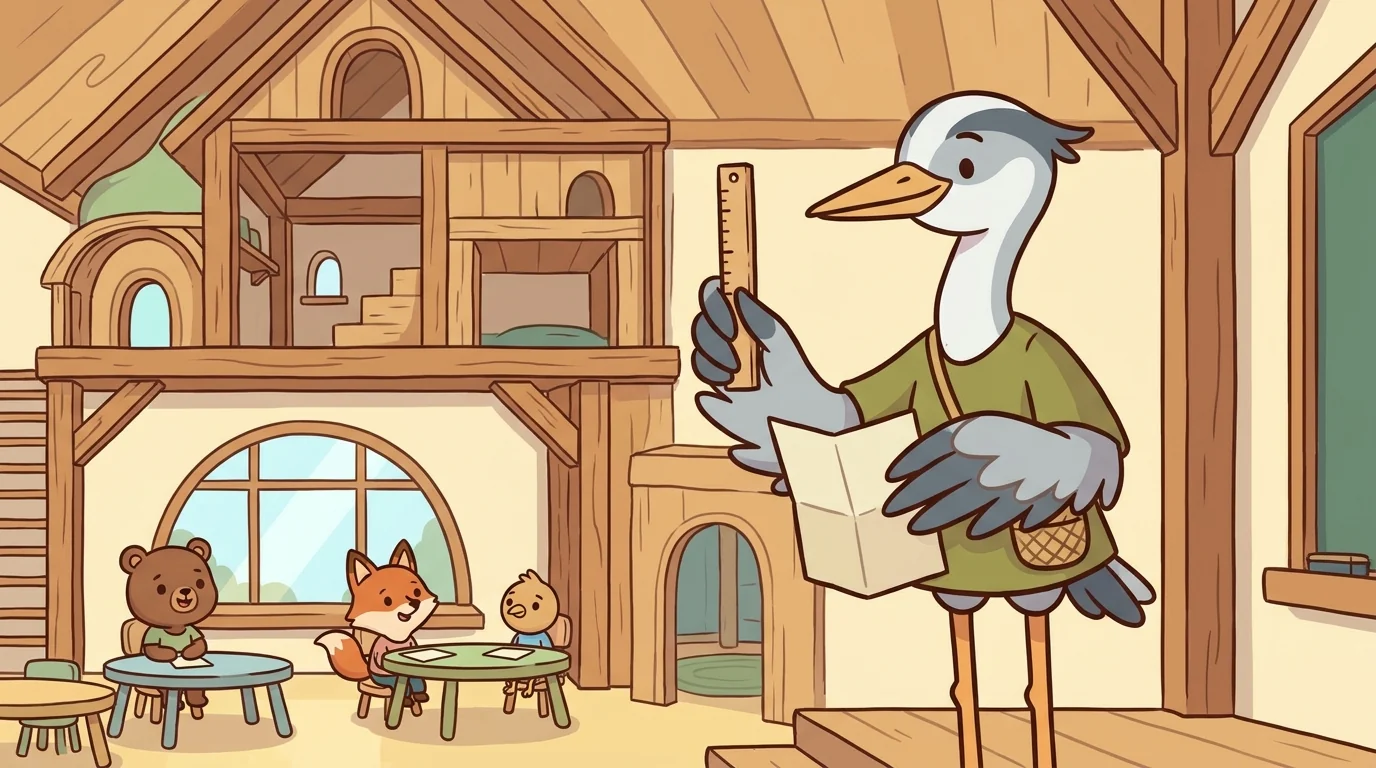
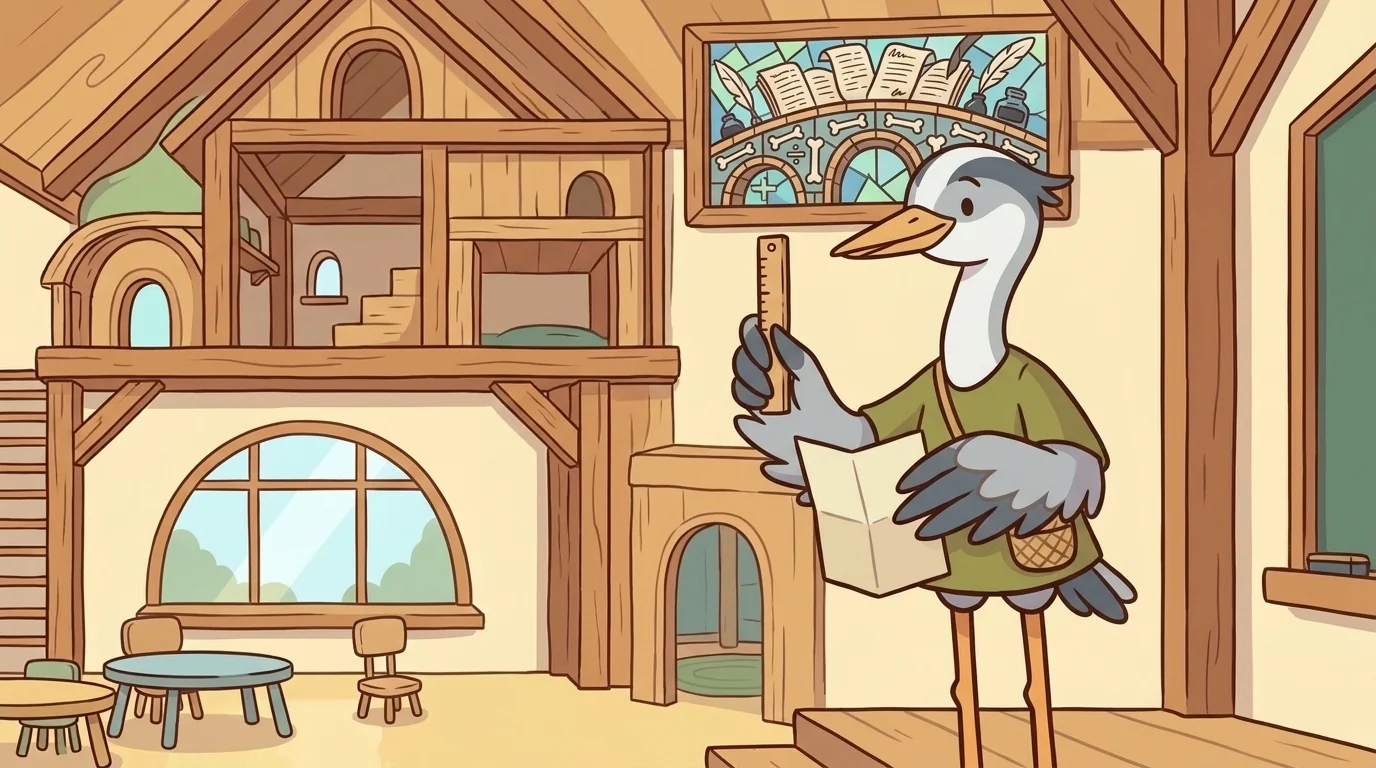
Splice was a young heron, mostly legs and quiet patience. Her feathers were a soft mix of grey and white. She never, ever hurried.
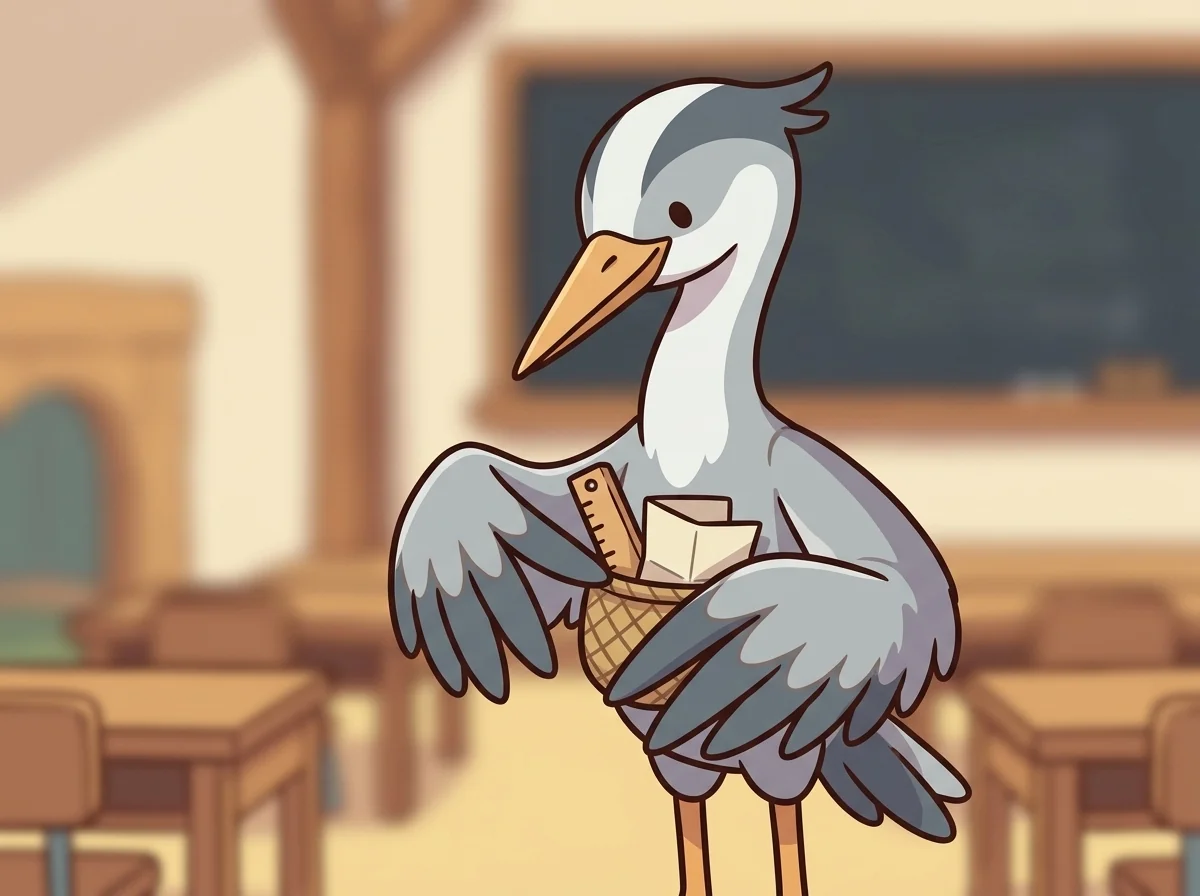
A small pocket was woven into the feathers of her wing. She kept two things inside it. The first was a slim wooden line-counter, with little notches carved for every centimeter. The second was a small poem, folded into a tiny square.
At the start of every class, she would unfold the poem. She would hold up her counter. She would show her students the secret.
"A story is like a building," she would say in her calm voice. "You see the pretty paint and the big windows. But you don't always see what's underneath."
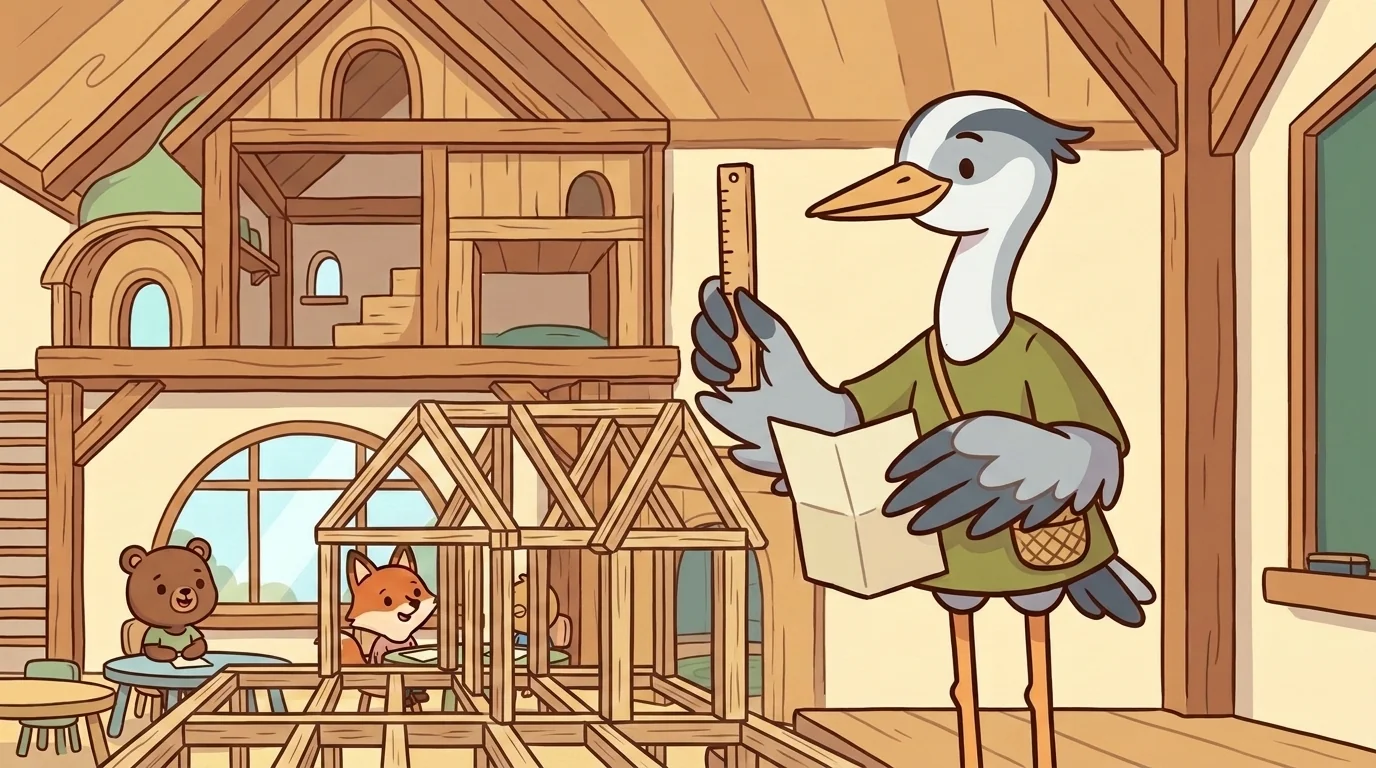
She would pause. "Under every building, there is a frame. A skeleton that holds it all up. Poems and stories have skeletons, too. Their skeletons are made of math."
This was her craft. Splice showed everyone that *math is the bones*.
It wasn't some fuzzy, abstract idea. It was real. A sonnet has 14 lines. That’s math. A line of iambic pentameter has 10 syllables, like five little heartbeats. Ba-BUM, ba-BUM, ba-BUM, ba-BUM, ba-BUM. That’s math. A story has a beginning, a middle, and an end. The big twists often happen at the one-quarter mark and the three-quarters mark. That’s math, too.
The math doesn't make the story. It holds the story up. The math is the bones. It’s the structure hidden just beneath the surface.
Most readers only see the words and the feelings. The math is invisible. But Splice taught kids how to look. Once you count the 14 lines of a sonnet, you can't unsee them. The skeleton appears.
Splice was very clear about one thing.
"You don't need to be an 'English kid' to see the bones of a story," she would say. "And you don't need to be a 'math kid' to read a poem. The bones are just bones. They are there for anyone to find. The kid who counts the lines sees the shape. Counting is the move."
When Splice was small, she lived in a village of poet-counters. Her family's job was to protect the village's traditional songs. They counted the lines and syllables of every ballad. They made sure each verse was perfect. A miscounted line could let a broken song into the tradition. A careful count kept the old stories strong. By age six, Splice knew that counting wasn't separate from stories. It was woven right inside them.
She walked to the BridgeForge academy when she was a little older. Archie, the headmaster, asked her one question. "What is the bridge between math and English?"
Splice answered right away. "It is the skeleton. *Math is the bones of the story.* You count the lines. You count the syllables. You count the acts. The story is built on that structure. The bones hold the surface up. A sonnet has 14 lines. A haiku is 5-7-5. The bridge is the shape."
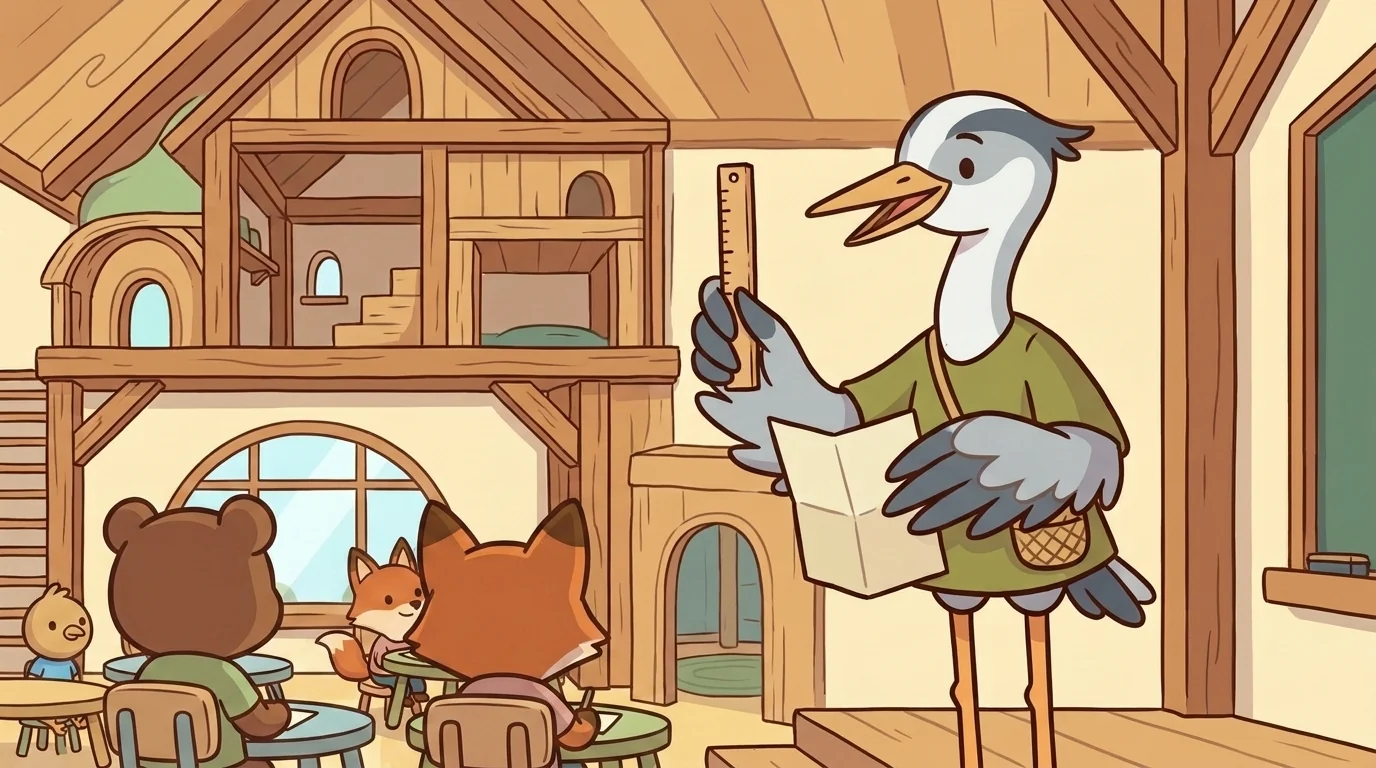
Archie smiled. "You are appointed."
In her workshop, Splice begins every first day the same way. She unfolds her poem. She holds up the line-counter. She counts each line out loud.
"One, two, three, four..." she says, tapping the board for each line. She doesn't stop until she reaches fourteen.
"I am Splice," she says. "The bridge I teach is *math↔ELA*. The idea is simple: Math is the bones of the story. This sonnet has 14 lines. Each line has 10 syllables. The rhymes follow a special pattern. That is the math. The math holds the poem up."
She teaches students the first steps to seeing the bones:
First, count the lines. This is always the first move. It tells you what kind of shape you're looking at. *Next, count the syllables in each line. A poem's rhythm is a pattern you can count. *Then, find the rhyme scheme. Mark the last word of each line with a letter. Do they rhyme in a pattern, like A-B-A-B? That's a code. *For stories, find the three acts. Look for the big turning points. They often happen near the 25% and 75% marks. *Look for symmetry. Many stories and poems have a pattern that mirrors itself around a central point. *Be specific. Just saying "stories have patterns" is not enough. Saying "a Shakespearean sonnet has 14 lines and a special rhyme scheme" is a strong bridge. *Remember: the math is the bones, not the soul.* Splice is very clear about this. The math supports the story. It does not replace the meaning, the voice, or the feeling. The bones hold up the soul. They are not the same thing.
"Counting doesn't make a poem less beautiful," she says. "It reveals the structure. The structure helps you see the meaning more clearly. A well-counted sonnet is a better-read sonnet."
When students ask if this is hard, Splice always says the same thing.
"It is not hard. It is counting." She smiles. "Math is the bones of the story. Count the lines. Count the syllables. The structure will appear."
She refolds her poem. She puts it back in her wing-pocket. Her line-counter waits for the next text.
The BridgeForge ensemble
Splice is part of BridgeForge's distributed-narrative cast. Each character embodies a different curricular primitive; together they teach the full subject.
-

Truss
Math↔Science bridges — causal-evidential connection (measurement + replication; both sides need numbers)
-

Arch
Math↔Art bridges — proportion-aesthetic connection (golden ratio + symmetry; math you can SEE)
-

Cable
Math↔Music bridges — ratio-temporal connection (frequency ratios + rhythm; math you can HEAR)
-

Pier
Math↔Social-Studies bridges — data-narrative connection (statistics in history + civics; numbers + people)