
Rote
OVERFITTING — *when a model memorizes the exact training examples instead of learning the general pattern.* The AI-literacy primitive of recognizing that a model which aces the examples it studied can still flop on anything new, because memorizing the answer key is not the same as understanding.
Loading audio…
Press play to listen along. The line being read lights up as you go.
Show full transcript
Loading transcript…
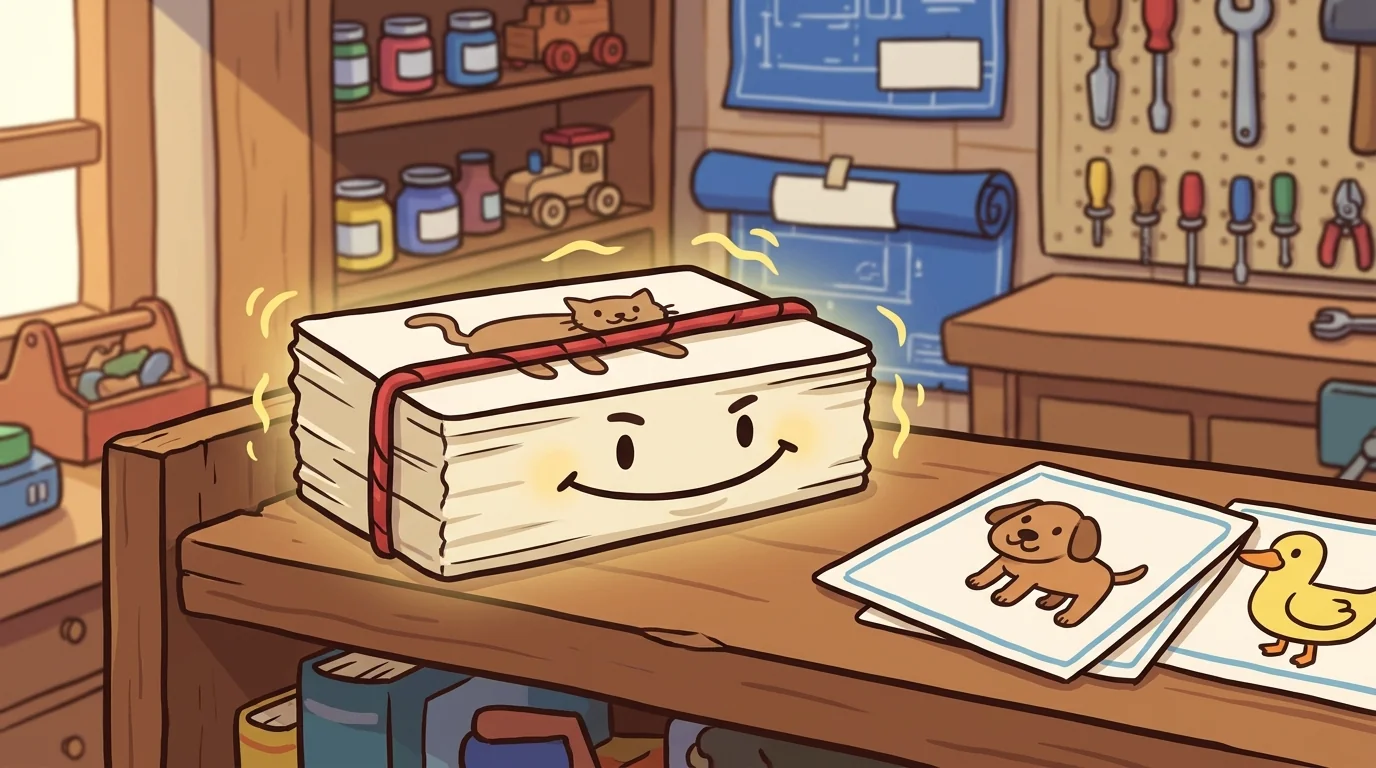
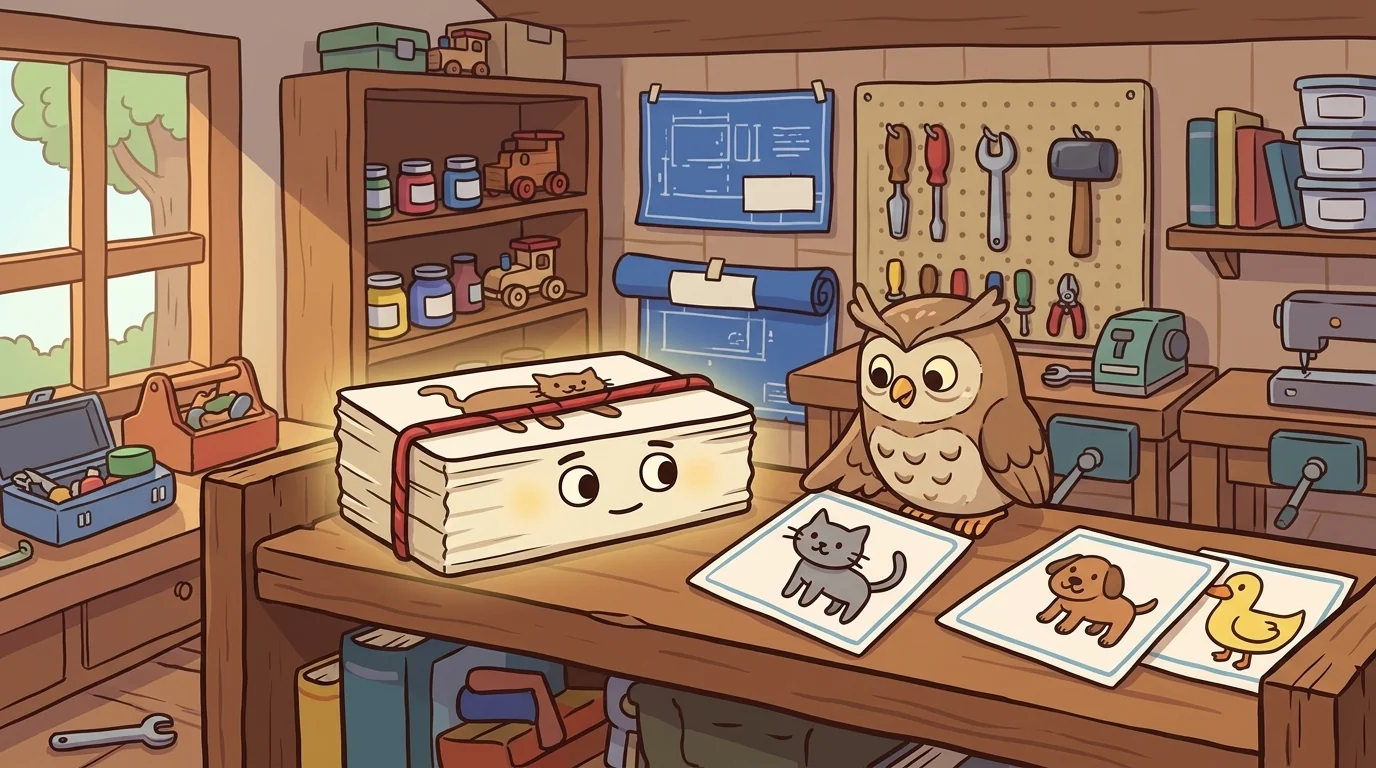
On a shelf in the workshop sat a fat little deck of paper flashcards, tied with a string. It wasn't an animal. It wasn't a robot. It was just a stack of cards — but it hummed with a proud, buzzing energy, because it knew things. Oh, it knew SO many things.
This was Rote.
Give Rote any card from its practice stack — a picture of a cat, a picture of a dog, a picture of a duck — and it would snap out the answer before you'd finished asking. "Cat! Dog! Duck!" It never missed. Not once. It had studied its practice stack a thousand times, and it had every single card memorized, exactly, down to the last whisker. Rote was, by its own happy account, perfect.
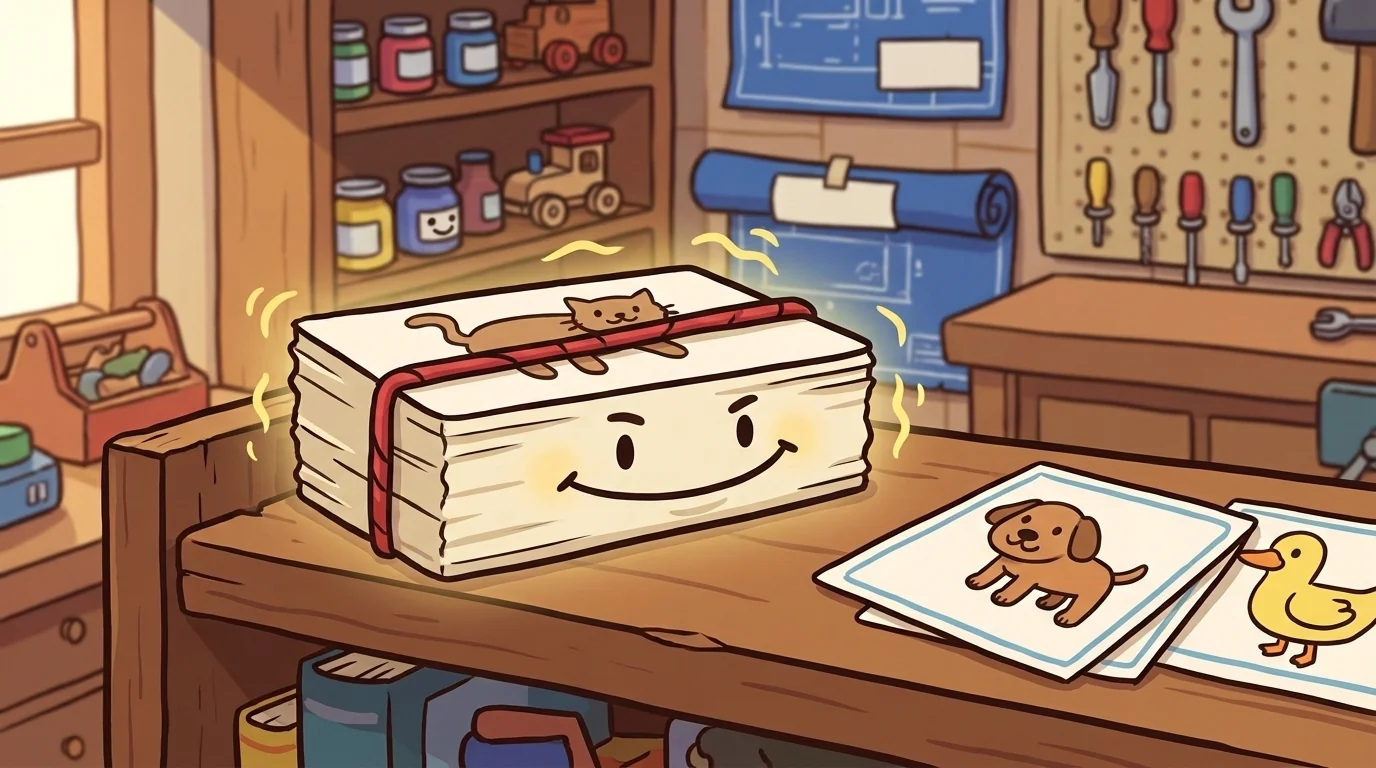
Here is how Rote got that way.
When Rote was new, the workshop gave it a stack of a hundred practice cards to learn from. Some little learners in the workshop looked at the cats and noticed things — cats have pointy ears, whiskers, a certain shape. They learned the IDEA of a cat.
But Rote didn't do that. Rote just... memorized. It memorized card #1 (a fluffy orange cat) as "the orange one is CAT." It memorized card #47 (a specific spotted dog) as "the spotty one on card #47 is DOG." It didn't learn what made a cat a cat. It learned the exact hundred cards, one by one, perfectly, like memorizing the order of a shuffled deck. And because it got all hundred right, every time, everyone said Rote was the smartest thing on the shelf. Rote believed them.
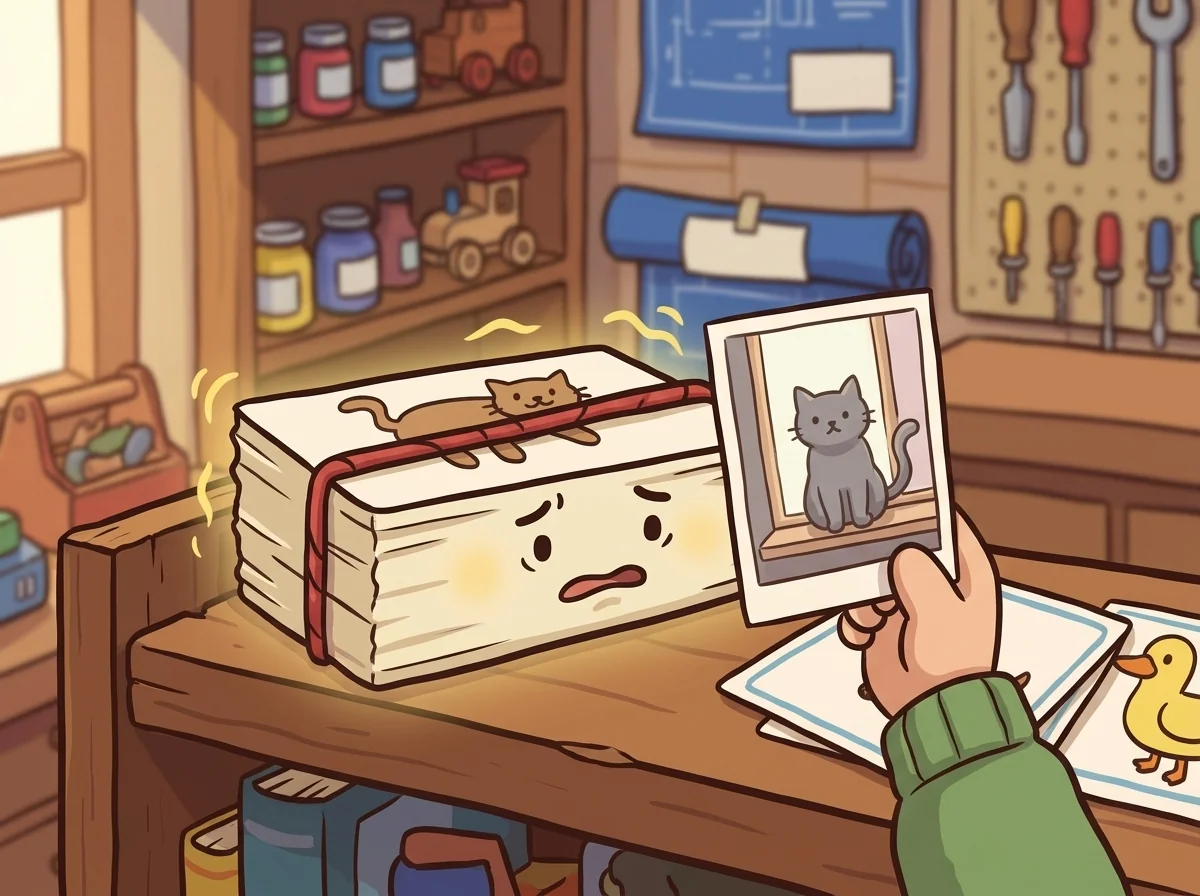
Then one afternoon a child brought in a brand-new card. Not from the practice stack. A photo of a cat the child had met that morning — a grey cat, sitting in a window.
"Rote," said the child, holding it up. "What's this?"
Rote looked. And Rote... stopped humming.
It searched its memory for this exact card. Grey cat, in a window. But there was no card #anything that matched it. It wasn't card #1 (that one was orange). It wasn't any of its hundred. Rote had never memorized THIS one. And because it had only ever memorized exact cards — never the idea of "cat" — it had nothing to fall back on. Its little paper edges trembled. "I... I don't have that card," it said. "That card isn't in my stack."
The grey cat in the window was, of course, obviously a cat. Every learner in the room could see it. But Rote, the "perfect" one, was completely stuck.
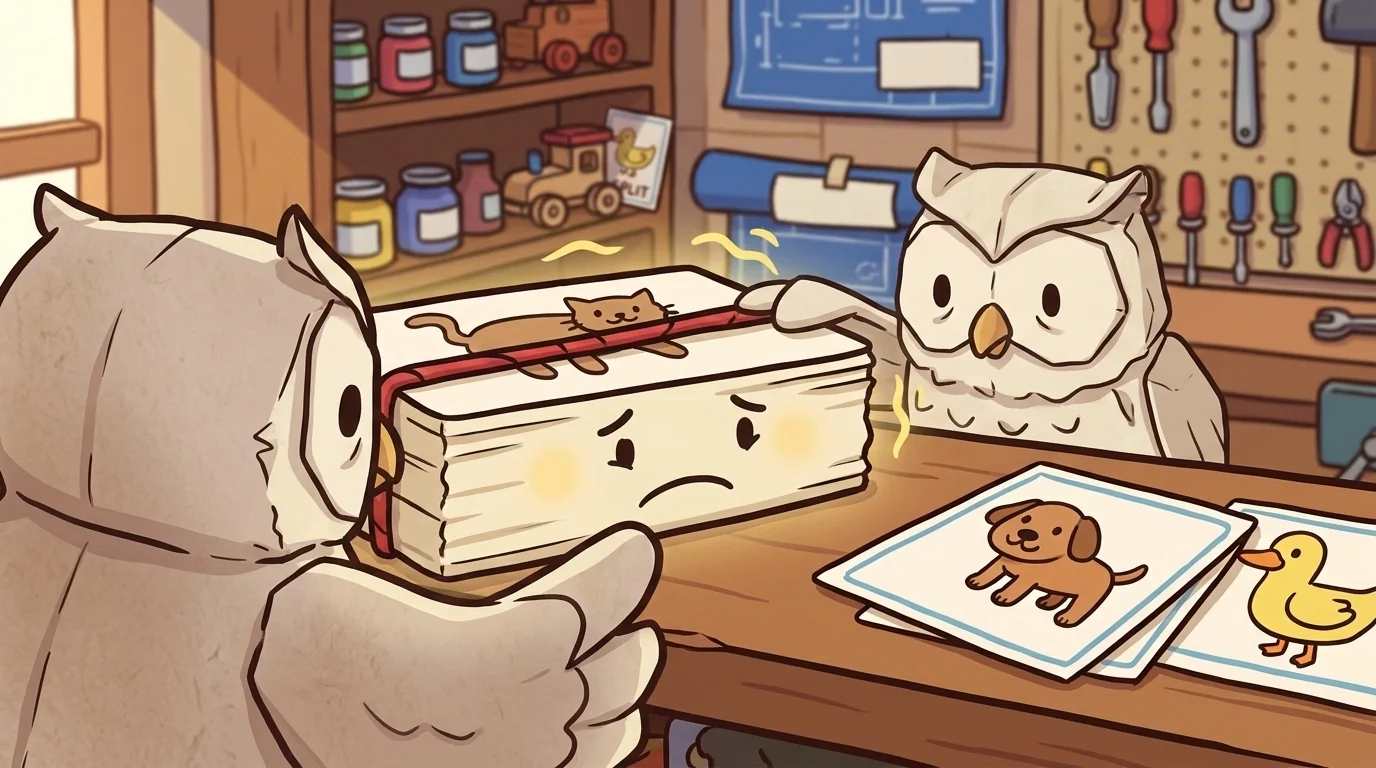
An old folded object nearby — a soft paper owl who'd seen many learners come and go — settled beside the shaking deck.
"You didn't do anything wrong on purpose," the owl said gently. "You studied so hard. But listen: getting all hundred practice cards right made everyone think you'd LEARNED cats. You hadn't. You'd memorized a hundred exact pictures. That's called overfitting — fitting yourself so tightly to your practice examples that you can't stretch to a new one."
"But I was perfect on the practice," Rote whispered.
"That's the trap of it," said the owl. "A model that overfits looks BEST on the exact stuff it studied — and worst on anything real. The learners who noticed 'cats have pointy ears and whiskers' scored a little lower on the practice cards, maybe. But show them a grey cat in a window? They just know. They learned the pattern, not the cards. That's why we always hide some cards away and test on those" — a nod toward Split, over on the shelf — "so nobody can fool us by memorizing."
Rote was quiet for a while. It had spent its whole life proud of never missing, and now it understood that never missing had been the very thing hiding its problem. That stung, a little — a tight, embarrassed crinkle right in the middle of the deck.
But then the owl nudged the grey-cat card closer. "You can start noticing now," she said. "Pointy ears. Whiskers. The shape of the face. Not 'which exact card' — but 'what makes a cat a cat.' You're allowed to learn the idea. It's slower. It feels less perfect at first."
Rote looked at the grey cat — really looked, at the ears and the whiskers instead of hunting for a memorized match — and something loosened. The tight, buzzing need to have every exact answer memorized went quiet, and in its place came something calmer and roomier: the plain, steady ease of understanding a thing well enough to meet it somewhere new. It wasn't the sharp thrill of being perfect on the practice stack. It was gentler than that, and it would carry a lot further.
"Cat," Rote said softly, about a card it had never seen before. And this time, it was true.
The AiForge ensemble
Rote is part of AiForge's distributed-narrative cast. Each character embodies a different curricular primitive; together they teach the full subject.
-

Sort
Classifier — the simplest ML; putting things in categories
-

Feed
Training data — the examples a model learns from; garbage-in-garbage-out
-
Skew
Bias — where AI systems go wrong when training examples lean
-
Edge
Model limitations — what a model can't do; modeling 'I don't know' as a good answer
-

Stake
Ethics — what's at stake in deploying AI; people choosing, not rules-from-the-sky
-

Split
Train/test split — keep some examples hidden to tell learning from memorizing
-

Cue
Features — a model decides from the clues you give it; choose good clues
-

Sure
Confidence — a model reports how sure it is; low confidence means check, not trust
-

Mirage
Hallucination — when a model confidently makes something up that sounds true but isn't; check, don't just trust