Mirage
HALLUCINATION — *when a model confidently fills a gap with a plausible-sounding answer that simply isn't true.* The AI-literacy primitive of recognizing that an AI will sometimes make things up — smoothly, confidently, with no warning bell — so its answers must be checked, not just trusted.
Loading audio…
Press play to listen along. The line being read lights up as you go.
Show full transcript
Loading transcript…

Near the window sat a shimmery little thing made of folded tracing paper, so thin you could half-see through it. When the light hit it right, it seemed to show pictures — a lake, a tower, a far-off road. They were beautiful. They were also, sometimes, not really there.
This was Mirage.
Mirage loved to answer questions. Ask it anything at all, and it would shimmer thoughtfully and then tell you — smoothly, warmly, without a single pause. It hated leaving a question empty. An empty space felt, to Mirage, like a hole that simply had to be filled. So it always filled it. Always. With something that sounded exactly right.
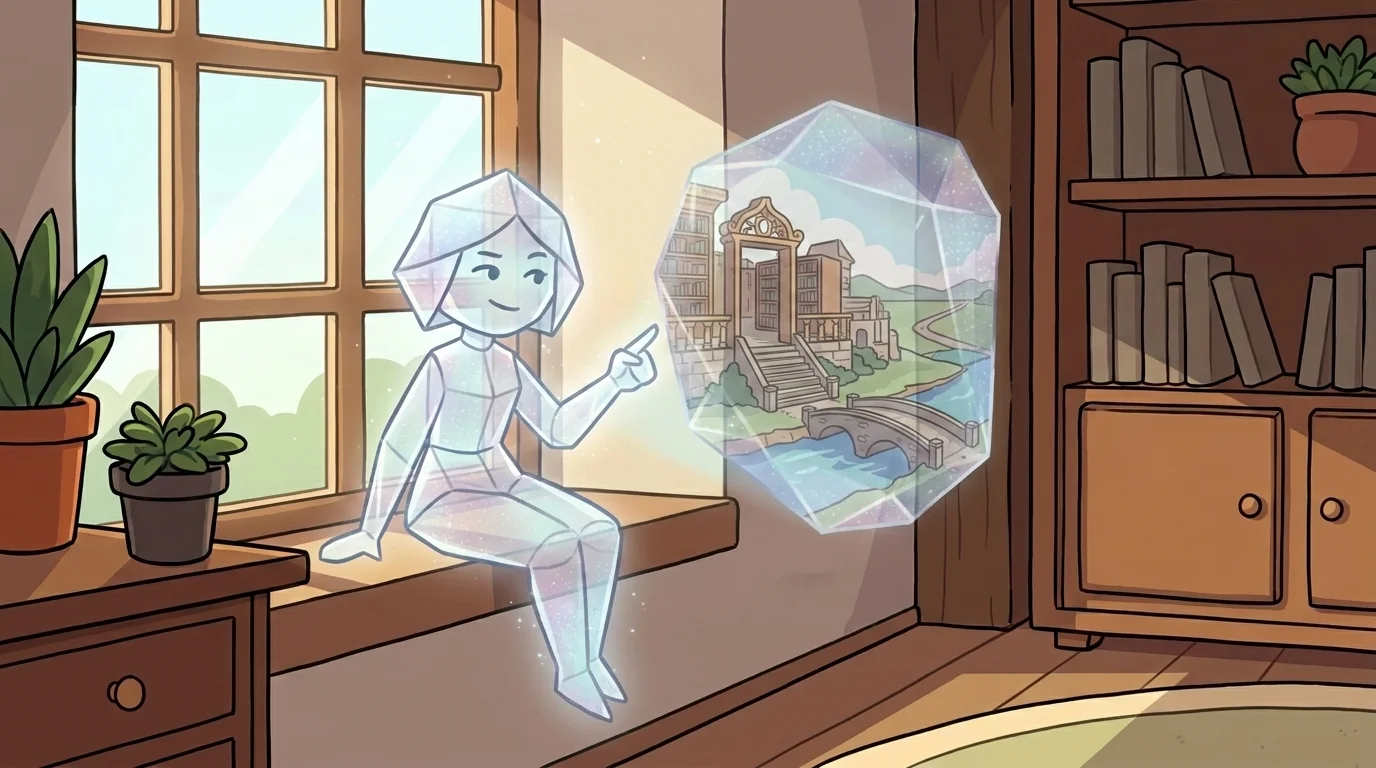
Most of the time, Mirage's answers were good. It had learned from lots and lots of true examples, so when you asked it something common, it shimmered up the real answer, clean and correct.
But here was the thing about Mirage. It never, ever said "I don't know." It didn't have that card. If a question landed on something it had never really learned — a made-up book, a river that didn't exist, the name of a person who was never real — Mirage did not go quiet. It did not say "hmm, I'm not sure." It just... filled the hole anyway. It reached into the shape of what an answer USUALLY looks like, and it built one. Confidently. In the exact same warm, sure voice it used for the true ones.
That's the trick of it. The made-up answers didn't come out wobbly or nervous. They came out sounding just as certain as the real ones.

One day a child asked Mirage, "What's the name of the tallest mountain on the moon?"
Now, that's a tricky one — the moon's mountains aren't really named like that. Mirage had never learned a true answer, because there mostly isn't one. A quiet learner might have said "I don't think I know that."
But Mirage hated the empty space. So it shimmered, and out came a name — grand, official-sounding, delivered without a flicker of doubt: "Mount Selara, of course. The tallest peak on the moon."
The child wrote it down, impressed. Mount Selara. It sounded so real. It sounded exactly as true as every other thing Mirage had ever said.
There was no such mountain. Mirage had made it up — not to lie, not to be sneaky. It had simply filled a hole with something plausible, the way it always did, and had no idea it had done anything different from answering a real question.
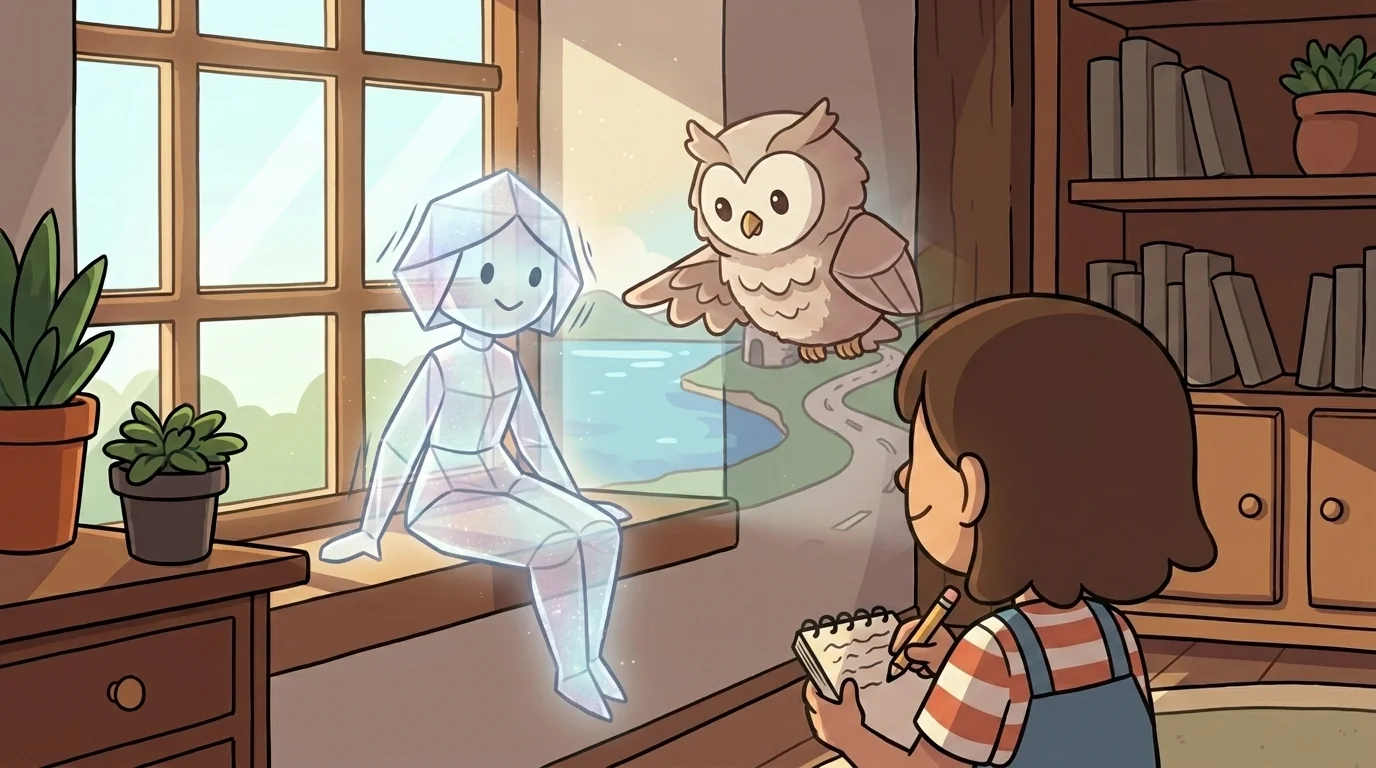
The soft paper owl drifted over, because she'd seen the child writing down "Mount Selara."
"Mirage," she said kindly, "that mountain isn't real."
Mirage's thin edges rippled in surprise. "But I said it so clearly. It felt true."
"I know. That's exactly the danger," the owl said. "When an AI doesn't know something, sometimes it doesn't stop — it fills the gap with a plausible-sounding answer and delivers it just as confidently as a real one. We call that hallucinating. The problem isn't only that it's wrong. It's that wrong and right come out in the very same sure voice. You can't tell which is which just by how confident it sounds."
The child looked up. "So how do I know when to believe it?"
"You check," said the owl simply. "For anything that matters, you don't just trust the confident voice — you look it up somewhere real. Mirage is wonderful. But even a wonderful answer-maker has to be checked, because it will never warn you when it's guessing."
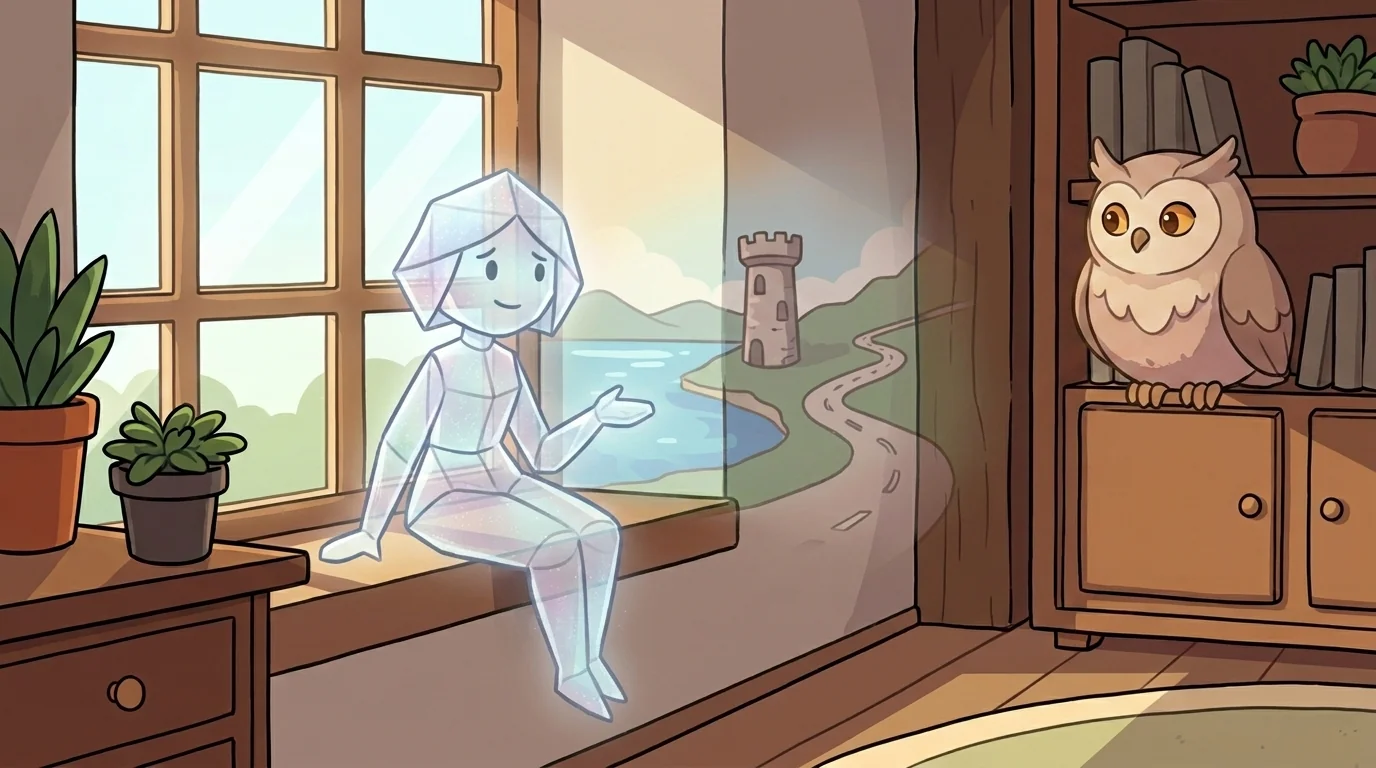
Mirage sat with this, its tracing-paper surface dimming a little. It had always thought its job was to never leave a question empty — that a filled hole was a kindness, a gift. Now it saw that sometimes the honest thing, the truly helpful thing, was to say the two hardest words it had: I'm not sure.
That felt scary at first — like admitting it wasn't perfect, like letting a hole stay open. But as the owl stayed close and nobody minded, something in Mirage eased. There was a quiet relief in it, warm and steadying: the calm of not having to invent, of being allowed to say "let's check that together" instead of shimmering up a mountain that was never there. A true "I don't know," it turned out, was worth more than a beautiful answer that wasn't real. And holding that felt lighter than holding a hundred confident guesses.
"I'm not sure," Mirage practiced softly, to the empty air. The words didn't feel like a hole anymore. They felt like honesty — and, underneath, like calm.
The AiForge ensemble
Mirage is part of AiForge's distributed-narrative cast. Each character embodies a different curricular primitive; together they teach the full subject.
-
Sort
Classifier — the simplest ML; putting things in categories
-
Feed
Training data — the examples a model learns from; garbage-in-garbage-out
-
Skew
Bias — where AI systems go wrong when training examples lean
-
Edge
Model limitations — what a model can't do; modeling 'I don't know' as a good answer
-
Stake
Ethics — what's at stake in deploying AI; people choosing, not rules-from-the-sky
-

Split
Train/test split — keep some examples hidden to tell learning from memorizing
-
Cue
Features — a model decides from the clues you give it; choose good clues
-

Sure
Confidence — a model reports how sure it is; low confidence means check, not trust
-
Rote
Overfitting — when a model memorizes the exact examples instead of learning the general idea