Gasp
GASP — the gasp is information. it means your model just broke.
Listen along — Gasp
Loading audio…
Press play to listen along. The line being read lights up as you go.
Show full transcript
Loading transcript…
Chapter 1 — Gasp and the Information of Surprise
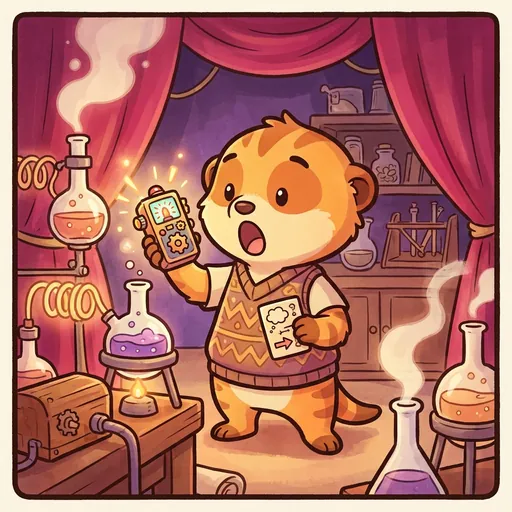
In the middle of Marvel’s lab, a small meerkat-tween named Gasp watched a cup of water refuse to fall on the floor.
Marvel had filled a paper cup right to the brim, laid a plain index card flat across the top, and turned the whole thing upside down. Everyone leaned in. The cup hung there, mouth-down, and the card just — stayed. Not a drop leaked out.
The whole class made the same noise at once. A soft, sharp intake of breath. Huh!
Gasp’s ears shot straight up. Her mouth fell open. But instead of staring, she yanked a little card from her vest pocket and started scribbling.
“Did you hear that?” she said, not looking up. “Everybody just gasped. That — the sound the whole room made — that’s the important part. Not the trick. The gasp.”
A boy near the front frowned. “It’s just a cool trick, though.”
“It’s information,” Gasp said. She held up her card. On the left she’d written EXPECTED: water falls. On the right: SAW: water stays. She tapped the gap between them. “Your brain was so sure the water would fall that it made a little prediction without even asking you. Then the world did something else. That little mismatch, right in the middle of your chest? That’s your model breaking. And a broken model is the best thing that can happen to you all day.”
She grinned at the cup, still hanging there, patient and impossible.
“Don’t lose the gasp. Write down what you expected. Then write down what happened. Hold the gap open. Everything good starts in that gap.”
Gasp had learned to love the gasp the hard way.
When she was younger, she gasped at everything — a magnet skittering across a table on its own, a shadow that grew instead of shrank, a straw that looked bent where it dipped into water. And every time, some older kid would smirk. You didn’t know that? Obviously the straw isn’t really bent. She started to feel like her surprise was a flashing sign over her head that said this one doesn’t get it.
So she tried to stop. She practiced keeping her face flat. She swallowed the gasps before they got out. And for a while she felt smoother, cooler, less embarrassed.
But she also stopped noticing things.
It was her aunt who caught it — an old meerkat with sharp eyes who ran the burrow’s watch-post. She set a spinning top on the table one evening and it did something strange, wobbling in a slow circle instead of falling, and Gasp felt the gasp rise up in her throat and shoved it back down.
Her aunt saw. “Why’d you do that?”
“Do what?”
“Catch it. The surprise. You caught it and swallowed it.” Her aunt sat down slowly. “The kids who laughed at you weren’t smarter than you, little one. They just weren’t looking hard enough to be surprised. The gasp doesn’t mean you’re behind. It means you were paying enough attention to notice the world break a promise.” She nudged the top. “Losing the gasp isn’t getting smarter. It’s going to sleep.”
Gasp let the next one out. It felt like unclenching a fist she hadn’t known she was making.
She came to WonderForge at twelve, because it was the one place she’d heard of that treated surprise as the beginning of something instead of a mistake.
Marvel met her at the lab door and didn’t ask for a test score. Marvel just set a small clear bottle on the bench, dropped in a scrap of paper, lit it, and clapped a peeled hard-boiled egg over the mouth of the bottle.
For a second, nothing. Then — with a wet, sudden thup — the egg was sucked straight down inside.
Gasp gasped. Loudly. Fully. Ears up, mouth open.
Then she pulled out a card and wrote: EXPECTED: egg sits on top. SAW: egg swallowed by bottle.
Marvel watched her write. “Most kids just say ‘whoa.’”
“‘Whoa’ is where it starts,” Gasp said. “But if you stop at ‘whoa,’ it floats away. You have to catch the exact moment it didn’t match. That’s the door.” She looked up. “I don’t know why the egg went in yet. But I know the gap. And the gap is where I’ll live until I find out.”
Marvel smiled. “You belong here.”
Gasp’s corner of the lab filled up with kids who used to think surprise was for babies.
One afternoon a girl came in scowling, arms crossed, embarrassed. During a demo she’d yelped out loud when a balloon shrank instead of popping in a bowl of icy water, and the kid next to her had rolled his eyes.
“I made that stupid noise,” she muttered. “In front of everyone.”
Gasp handed her a blank card. “What noise?”
“You know. The gasp.”
“Tell me what you expected right before you made it.”
The girl thought. “That the balloon would pop. Cold usually makes things… I don’t know. Break.”
“And what did it do?”
“It got smaller. Like it was hiding.”
“Write that down. Left side, what you expected. Right side, what you saw.” The girl did. Gasp pointed at the space between the two lines. “The eye-roll kid? He didn’t write anything, because nothing surprised him — which means nothing reached him. He looked at a balloon doing something impossible and felt nothing at all.” She tilted her head. “Whose brain do you think was actually awake?”
The girl looked at her two lines for a long moment. ”…Mine.”
“The gasp isn’t the sound of being wrong,” Gasp said. “It’s the sound of the world handing you a new fact and your old idea not knowing where to put it. That’s not embarrassing. That’s the single most useful feeling you own.” She grinned. “People who never gasp aren’t smart. They’re just not paying attention hard enough to notice the mismatch. You noticed. You gasped. Good. Now — why do you think it shrank?”
And the girl, without meaning to, leaned toward the bowl.
Later, when the lab was quiet, the girl came back with one more question. She was softer now.
“When it happens,” she said, “and you don’t understand it yet — how do you not just feel dumb?”
Gasp thought about the spinning top, and the fist she used to make with her whole face.
“You feel the gasp, and you decide what it means,” she said. “For a long time I thought it meant you’re behind. But it doesn’t. It means you’re here. Awake. Close enough to the world that it can still surprise you.” She looked toward the bench, where the impossible egg still sat inside its bottle. “The not-knowing part isn’t a hole you fell into. It’s a door somebody just opened. Everything I’ve ever figured out started with that exact feeling — mouth open, chest tight, no answer yet, and a little quiet voice going wait… what?”
The girl nodded, slow, and Gasp watched something loosen in her shoulders — the same unclenching she’d felt the night her aunt spun the top.
She didn’t say the rest out loud, but she felt it, warm and steady: the gasp was never the sound of being small. It was the sound of being wide, wide awake.
The WonderForge ensemble
Gasp is part of WonderForge's distributed-narrative cast. Each character embodies a different curricular primitive; together they teach the full subject.
-
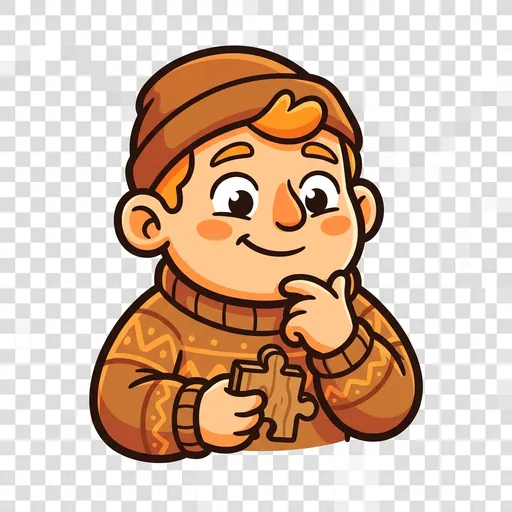
Mull
Hypothesis-from-surprise — sit with the puzzle, then say what you think MIGHT be happening
-

Spy
Mechanism detection — every wonder has a HOW; look for the hidden variables
-
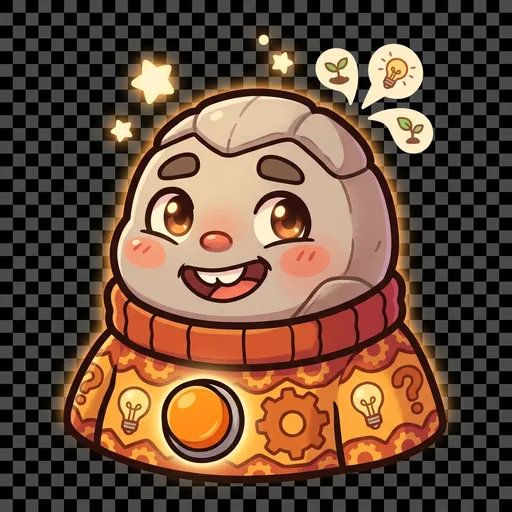
Crack
Explanatory click — the wonder doesn't die when you understand; it GROWS
-
Encore
Perform it yourself — if you can DO the trick knowing how it works, you've understood